Pulse24 Original
Junk Bond Spreads Just Fell to 271 Basis Points, the Tightest Level Since 2007. Nearly 80% of This Year's AI Data-Center Bonds Are Still Trading Below Where They Were Sold.
August 17, 2026
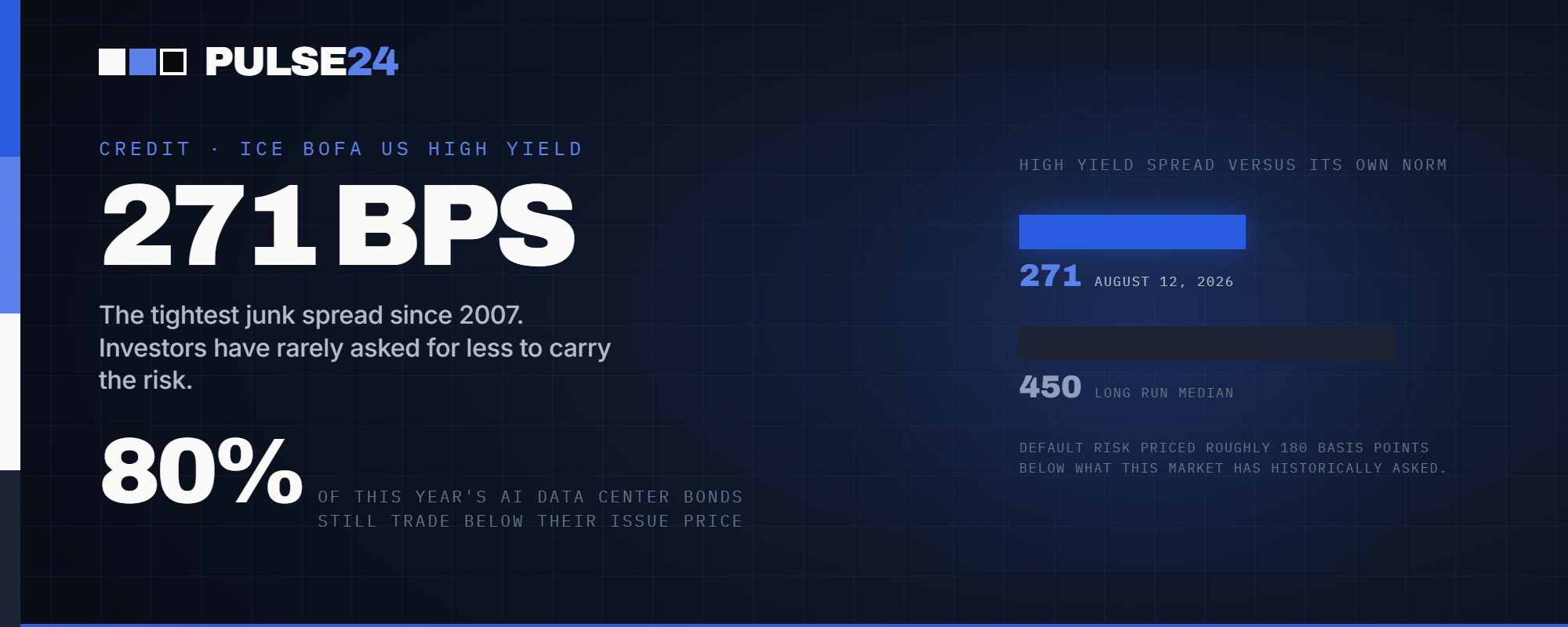
High-yield credit spreads just closed at 271 basis points, the tightest reading since 2007, while nearly 80% of this year's AI data-center bonds are still trading underwater. The broad junk market has rarely been more confident. One specific corner of it already isn't.
Junk bond spreads closed at 271 basis points on August 12. That is the tightest level since 2007, the year before Lehman Brothers collapsed and the same spread measure spent the following winter above 2,100 basis points. Investment-grade spreads tell a similar story, running around 74 basis points last quarter, a level in the first percentile of the past two decades. Put plainly: corporate America has rarely been able to borrow this cheaply relative to the government, and investors have rarely demanded so little extra compensation for the risk of getting stiffed.
Spreads move for a reason, and the reason usually says more about risk appetite than about the companies actually borrowing the money. A 30-year Treasury still yields more than most junk-rated companies paid for debt two decades ago. That gap between what a shaky borrower pays and what the safest borrower on earth pays is precisely what a credit spread measures, and right now that gap is about as thin as it's been since before the financial crisis.
What Changed
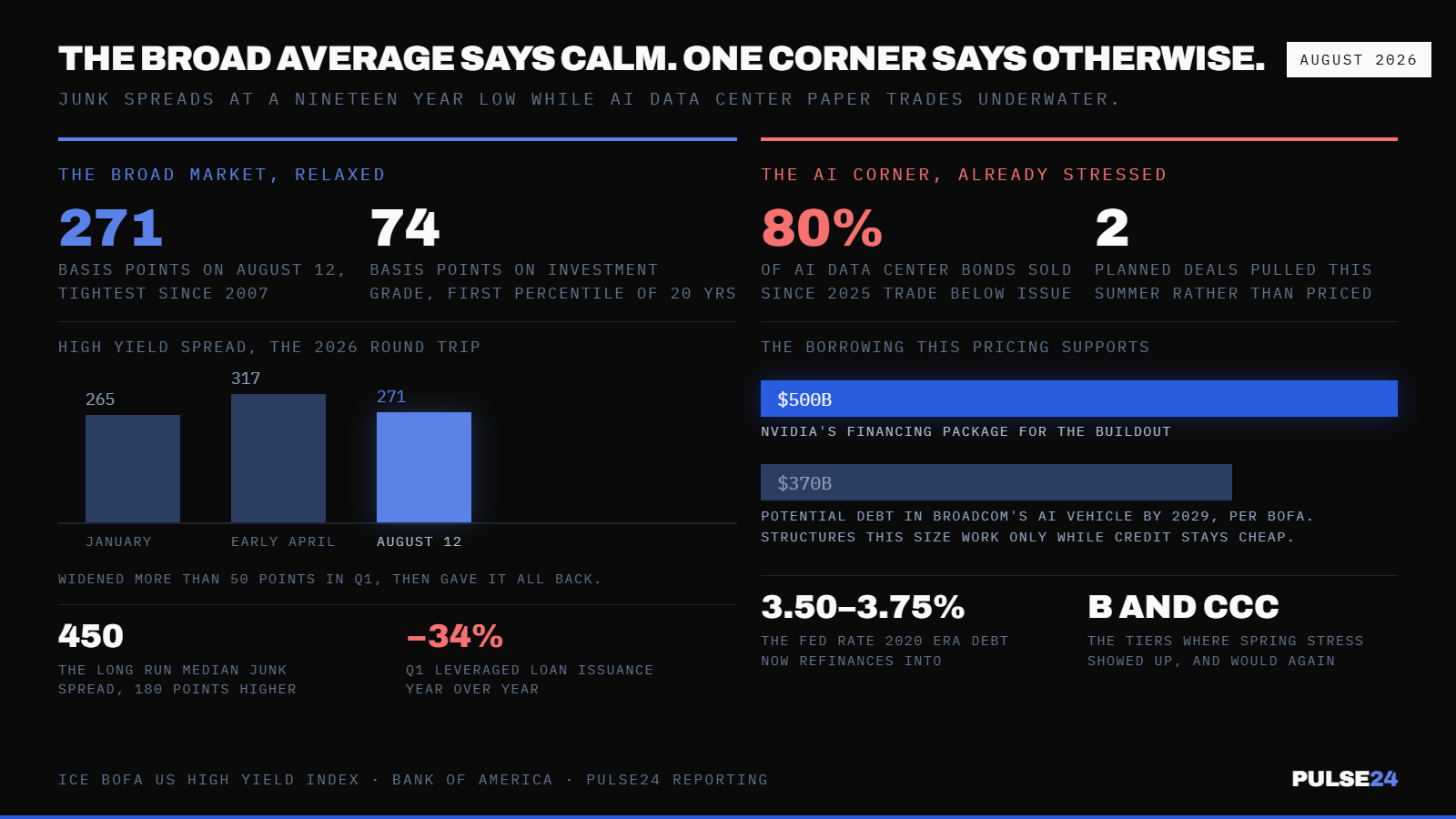
This wasn't a straight line. High-yield spreads started 2026 near 265 basis points, widened past 317 by early April as recession chatter and tariff anxiety spooked credit desks, then spent the following four months grinding back down to fresh cycle lows. That round trip matters more than the headline number alone. It shows a market that flinched, priced in real stress for about a quarter, and then decided the stress wasn't going to show up in actual defaults.
The rally hasn't been uniform underneath the surface. BB-rated credits, the highest tier of junk, have held their gains comfortably. The stress that briefly showed up in the spring stayed concentrated in single-B and CCC-rated issuers, the names with the thinnest cushion against a downturn. Leveraged loan issuance in the primary market fell roughly 34% year over year in the first quarter, even while secondary spreads kept compressing. Fewer new deals got done, but the ones that traded got bid up anyway.
Underneath both trends sits a refinancing wall building since the ultra-low-rate borrowing binge of 2020 through 2022. Debt priced when the Fed's benchmark rate sat near zero is coming due now, and it has to be refinanced at a federal funds rate that's held at 3.50% to 3.75% since July, the fifth straight meeting without a change. Strategists have started using the phrase "zombie companies" for borrowers whose interest expense already exceeds their operating income. Tight spreads make the refinancing cheaper than it otherwise would be. They don't make the underlying cash flow problem go away.
Why It Matters
Credit spreads this tight are a read on conviction, not just cost. When a market that historically demands 450 basis points of compensation for junk risk settles for 271, it's making a bet that defaults stay low and growth holds up. That bet doesn't happen in isolation. It's the same instinct that's pushed unprofitable small-cap stocks to outrun profitable ones in the Russell 2000's record run, and the same instinct funding hundreds of billions in AI infrastructure spending on the assumption the returns eventually show up.
Some of that AI-linked borrowing is enormous by any historical standard. Nvidia lined up $500 billion to help finance the buildout it's selling chips into, and Bank of America has flagged Broadcom's AI financing vehicle as a structure that could carry $370 billion in debt by 2029. Structures like that only work if credit stays cheap and investors stay willing. Right now they are, almost everywhere.
Almost is the operative word. Nearly 80% of the AI data-center bonds sold since early 2025 are trading below their issue price, and two planned deals got pulled from the market entirely this summer rather than price into weak demand. That's a real divergence sitting inside a market that otherwise looks more relaxed than it has in nineteen years. The broad average says complacency. One specific, fast-growing corner of the market is already telling a different story.
There's a liquidity backdrop to all of this too. The Fed's reverse repo facility, the buffer that absorbed excess cash during years of quantitative easing, has fallen to roughly $1.45 billion from a $2.55 trillion peak. That doesn't mean a cash crunch is imminent. It does mean one of the shock absorbers that used to sit between "normal market" and "funding stress" isn't there in the same size it used to be.
What to Watch Next
Watch the single-B and CCC tiers specifically, not the broad index. That's where spring's stress showed up first and where it would likely reappear if it's coming back. A widening gap between BB spreads and CCC spreads, even while the headline number stays low, would be an early tell that the market is starting to price companies individually again instead of treating junk credit as one undifferentiated pool of yield.
Watch primary issuance too. Leveraged loan volume already fell sharply in the first quarter even as pricing rallied. If that gap persists into year-end, it suggests borrowers with real balance sheet problems are staying out of the market rather than testing investor appetite, which would understate how much stress is actually sitting out there unpriced.
And watch what happens to AI-linked credit specifically. If the data-center bond weakness spreads into the broader tech and infrastructure complex rather than staying contained, that's a meaningfully different story than a handful of aggressively priced deals cooling off on their own.
The Pulse24 Take
Tight spreads by themselves aren't a warning sign. They're often just a market saying the economy looks fine, and after a soft patch of GDP scares and tariff headlines this spring, "fine" isn't a bad place to land. What makes 271 basis points worth watching isn't the level. It's the company it's keeping: record equity highs, unprofitable stocks leading rallies, half-trillion-dollar AI financing packages, and a liquidity buffer that's basically empty, all showing up at the same time.
None of that guarantees trouble. Spreads sat near similarly historic tights twice before, in the run-up to the 1998 Russia default and the collapse of Long-Term Capital Management, and again in the run-up to the 2007-2008 financial crisis. Both stretches held for months before something broke, and both ended with the same spread measure trading multiples wider than where it started. Neither prior episode means this one repeats. But the asymmetry only cuts one way from 271. Spreads have far more room to widen than to compress further, and the market is currently being paid almost nothing to worry about that possibility, which is exactly the condition under which worrying stops being optional and starts being cheap.
How we read the data
Curious how we get from raw data to a take like this? Our Trader's Toolkit walks through the tools we lean on.
Explore the Toolkit