Pulse24 Original
The Russell 2000 Just Set a Record for the Second Day in a Row. Stocks Losing Money Are Gaining Faster Than the Ones Turning a Profit.
August 14, 2026
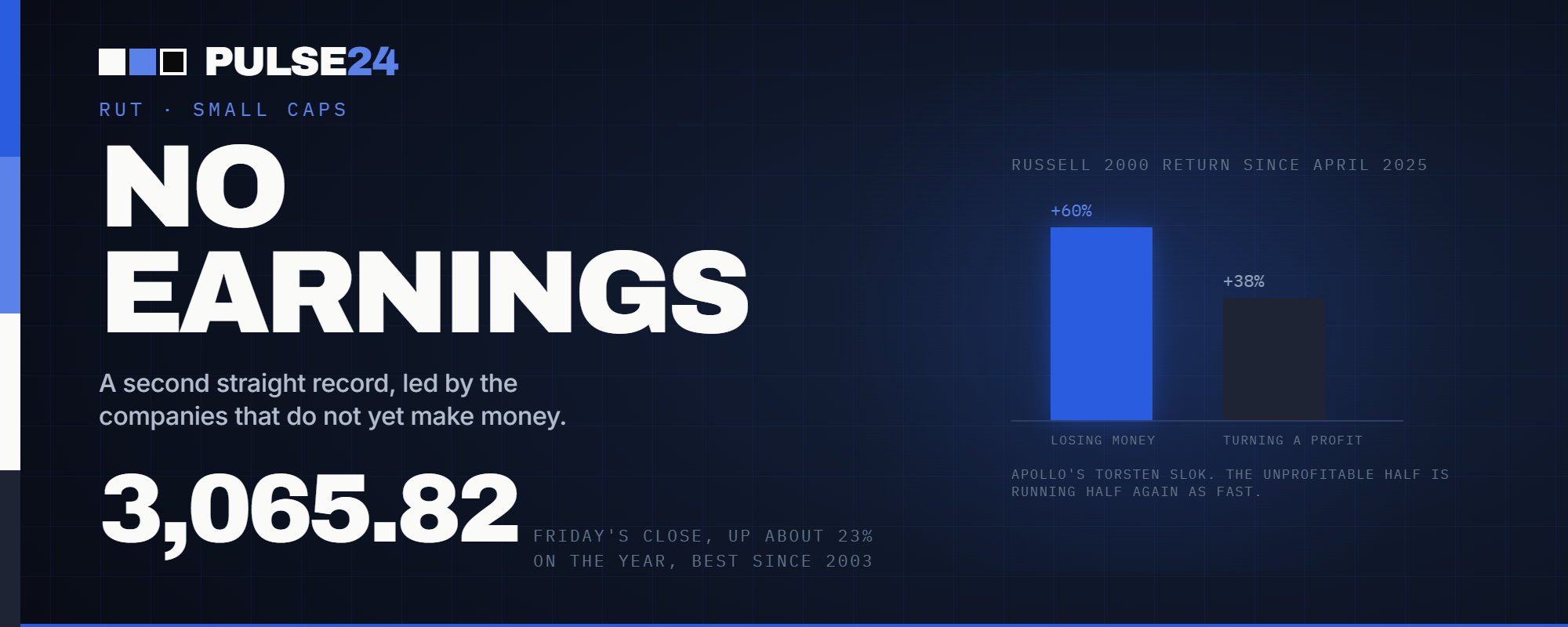
The Russell 2000 closed at a fresh record Friday, its second in as many days, and small caps are having their best year since 2003. The catch: unprofitable companies in the index have gained 60% since April, well ahead of the 38% gain for profitable ones, and the reason has almost nothing to do with small-cap fundamentals.
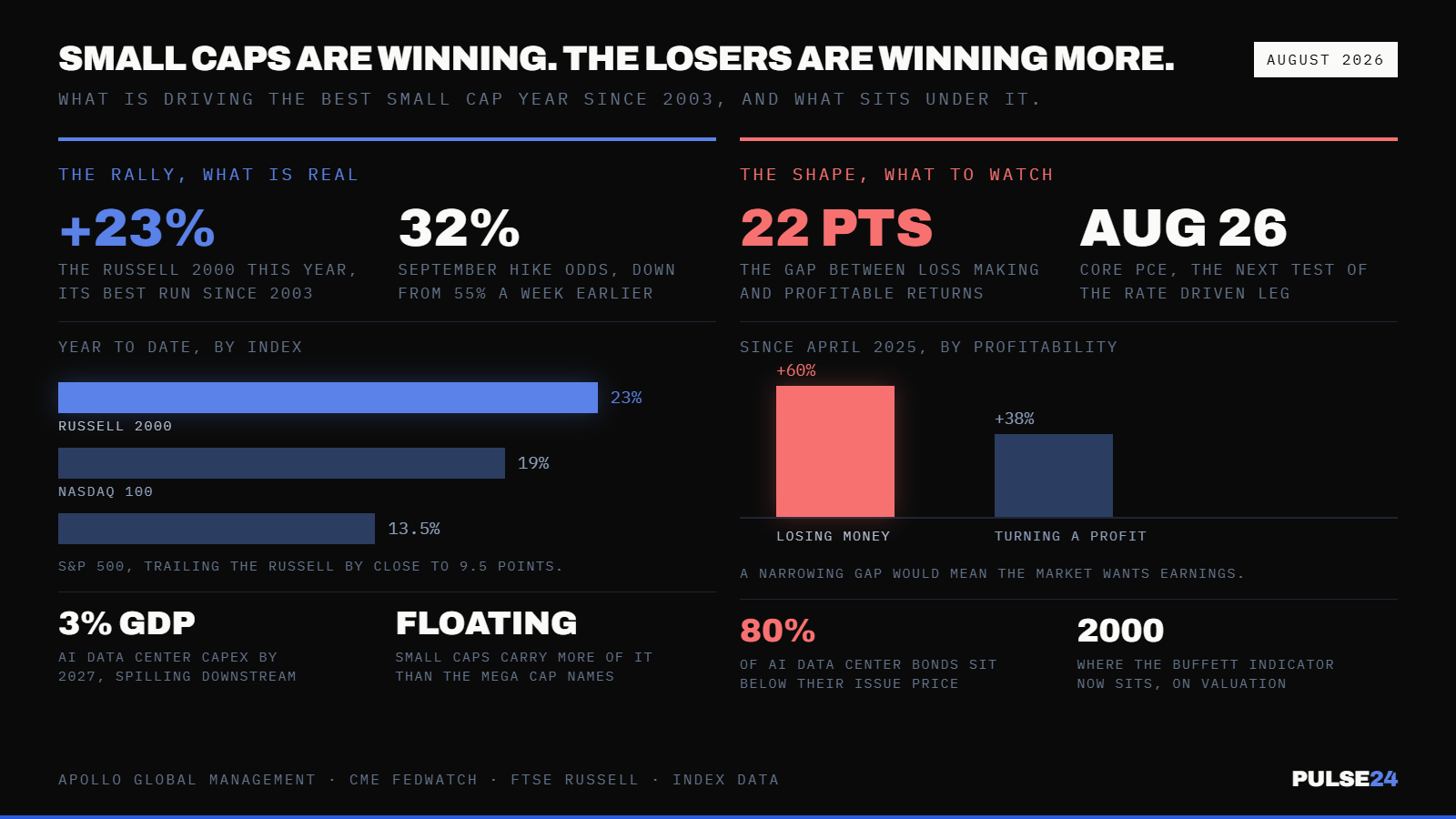
Three thousand and sixty-five. That's where the Russell 2000 closed Friday, a fresh record for the second consecutive session, capping a run that has the small-cap index up roughly 23% for the year, its best showing since 2003. The S&P 500 crossed 7,800 for the first time this week on the back of a surprisingly flat producer price report, and the Russell rode the same wave, but small caps have been outrunning the rest of the market by a wider margin than a single week of soft inflation data explains.
What's driving that gap is worth more attention than the record headline gets. Unprofitable companies inside the Russell 2000 have climbed about 60% since April 2025, according to Apollo Global Management chief economist Torsten Slok. Profitable small-cap firms are up 38% over the same period, a real gain, just a noticeably smaller one. The index isn't just rallying. It's rallying harder for the companies losing money than for the ones making it.
What Changed
Small caps have spent most of the last decade trailing mega-cap tech, and 2026 has flipped that pattern. The Russell 2000's roughly 23% year-to-date gain is running ahead of the Nasdaq 100's 19% and outpacing the S&P 500 by close to 9.5 percentage points, according to index data cited this week. That's a meaningful reversal for a corner of the market that spent years being told AI spending was a mega-cap story, Microsoft, Amazon, Alphabet and Meta writing the checks, Nvidia cashing them.
The mechanism turns out to be spillover. Those four companies are still committing hundreds of billions of dollars toward AI infrastructure, but building that infrastructure, the power capacity, the cooling systems, the networking gear, the physical construction, requires thousands of smaller suppliers who don't show up in anyone's mega-cap earnings call. Pulse24 covered the scale of that buildout directly: AI data-center capital spending is on pace to hit 3% of US GDP by 2027, building at roughly twice the speed of the mid-2000s housing boom. A lot of that spending lands on companies small enough to sit inside the Russell 2000 rather than the S&P 500.
Rates have helped too, and helped small caps specifically. CME futures-implied odds of a September rate hike fell to roughly 32% after Thursday's flat PPI print, down from 55% just a week earlier. Small-cap companies carry more floating-rate debt on average than the S&P 500's largest constituents, so a Fed that looks less likely to tighten further matters more to a Russell 2000 balance sheet than a mega-cap one sitting on a decade of cheap, already-locked-in financing.
Why It Matters
The unprofitable-outpacing-profitable split is the detail that deserves the most scrutiny, because it's a pattern this publication has already flagged in a different part of the market. Berkshire Hathaway's own favorite valuation gauge, the ratio of total US stock market value to GDP, was already sitting at dot-com-era levels before this week's rally pushed it higher still. A market willing to pay up for a small company's AI story ahead of its balance sheet is exactly the kind of behavior that shows up late in a cycle, not early in one. It doesn't mean the rally is wrong. Genuine spillover demand for smaller AI-infrastructure suppliers is real and measurable. It does mean a meaningful slice of the Russell 2000's 2026 gain is riding on revenue that hasn't shown up yet rather than revenue that already has.
There's a second tension worth sitting with. Equity investors are rewarding AI-adjacent small caps on the promise of future infrastructure spending, while credit investors have been getting more cautious about the exact same buildout, with nearly 80% of AI data-center bonds sold since early 2025 now trading below their issue price. Stocks and bonds tied to the same underlying trade are telling two different stories right now, and that kind of split usually resolves in favor of whichever market is pricing the risk more carefully, not whichever one is having more fun.
What to Watch Next
Watch whether the unprofitable-versus-profitable gap narrows or widens from here. A narrowing would suggest the market is starting to demand actual earnings evidence from AI-infrastructure suppliers rather than just a plausible story. A widening would suggest the opposite, and it's the more worrying of the two outcomes given how closely it echoes the earnings-agnostic enthusiasm that characterized 2000. Also worth tracking: the August 26 core PCE release, the inflation gauge the Fed weighs most heavily, since another soft print would likely extend the same hike-odds retreat that's been fueling small-cap borrowing costs lower all month. A hot one would test how much of this rally is really about rates rather than infrastructure spending.
The Pulse24 Take
A record for small caps sounds like broad-based good news, the kind of headline that implies the rally has finally spread beyond a handful of trillion-dollar companies into the rest of the economy. Some of that is true. Real AI infrastructure spending is landing on real smaller suppliers, and that's a legitimately different, healthier growth story than five stocks carrying an entire index. But the specific shape of this rally, unprofitable companies outgaining profitable ones by more than 20 percentage points since last spring, isn't the same as broad economic health. It's investors paying for a story rather than a balance sheet, in a smaller, less liquid corner of the market than the one that already has a Buffett Indicator flashing dot-com levels. Records are easy to cheer. What actually separates this year's small-cap rally from the last speculative one is whether the earnings eventually catch up to the enthusiasm, and that's a 2027 question, not a Friday-close one.
How we read the data
Curious how we get from raw data to a take like this? Our Trader's Toolkit walks through the tools we lean on.
Explore the Toolkit