Pulse24 Original
The Fed's Reverse Repo Facility Has Fallen to Just $1.45 Billion, Down From a $2.55 Trillion Peak. The One Buffer That Prevented a Repeat of 2019's Repo Chaos Is Now Basically Empty.
August 10, 2026
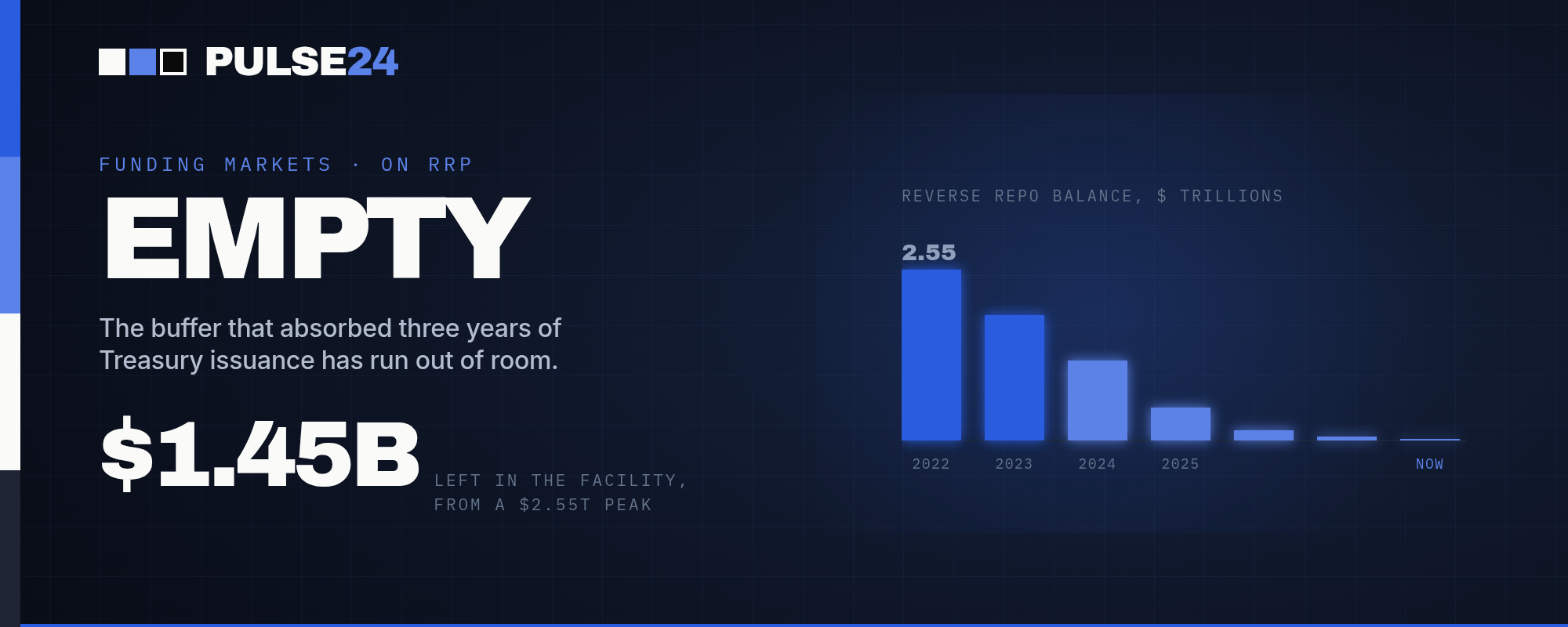
Cash sitting in the Fed's reverse repo facility has collapsed to $1.45 billion, next to nothing compared with its $2.55 trillion peak in 2022, right as the Treasury drains bank reserves to rebuild its own checking account. The shock absorber that helped prevent a repeat of 2019's repo crisis is now essentially empty.
The Federal Reserve's overnight reverse repo facility held just $1.45 billion this week, down from a peak of $2.55 trillion at the end of 2022. That's about as close to empty as the facility gets, and the number matters more than it looks, because that facility has spent the past three years acting as the banking system's shock absorber.
Money market funds and other cash-rich institutions used the facility to park spare dollars overnight with the Fed instead of chasing yield in a crowded Treasury bill market. When Treasury needed to issue more bills, that cash generally came out of the reverse repo pool first, leaving bank reserves largely untouched. There isn't much left in that pool anymore. Now, as the Treasury rebuilds its own checking account, the cash increasingly has to come from bank reserves directly, the same reserves that banks rely on to meet daily payment and lending obligations.
Why the Treasury Is Draining the System Right Now
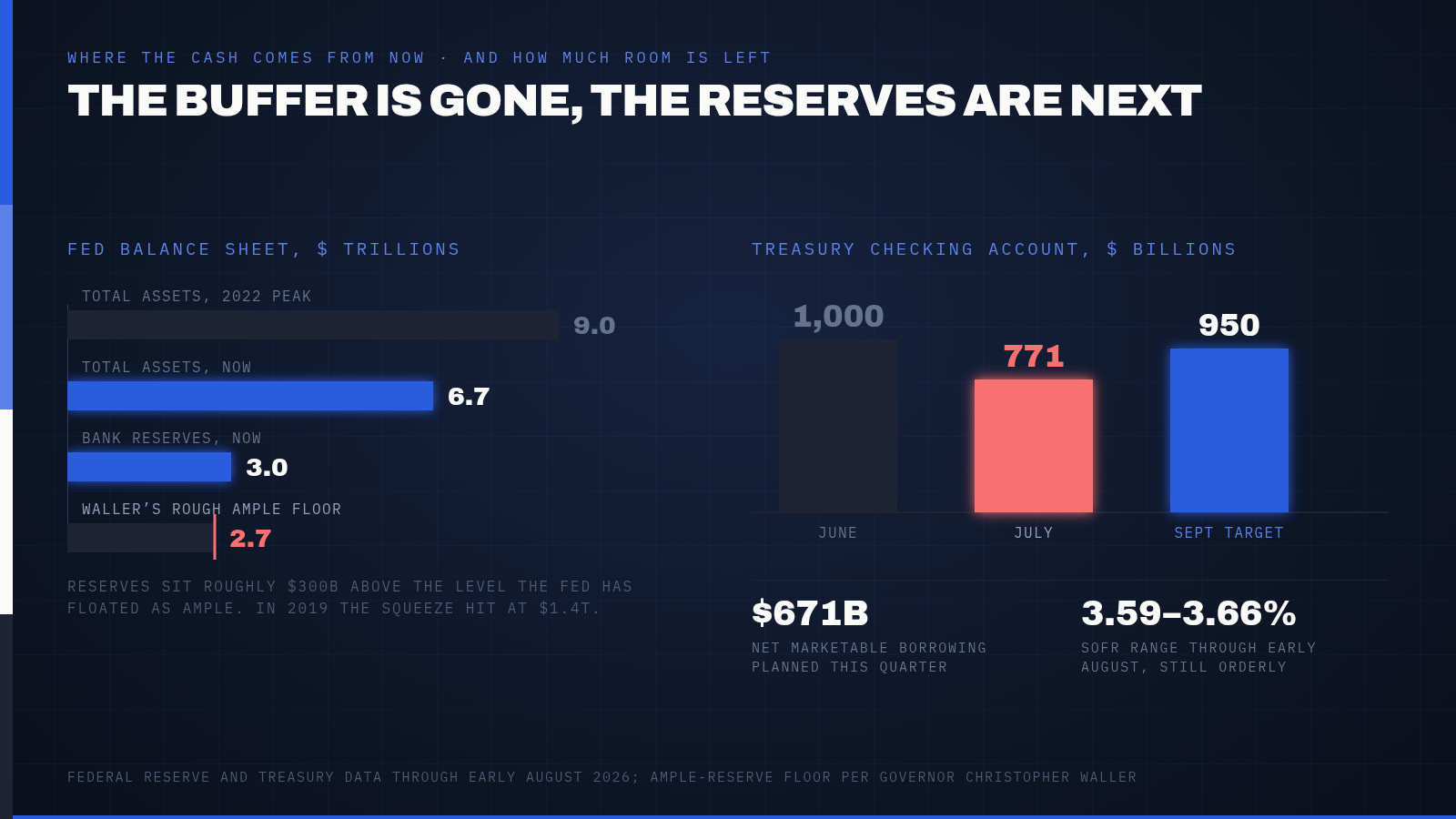
The Treasury General Account fell from roughly $1 trillion to $771 billion in July, and the department's own estimates call for about $671 billion in total net marketable borrowing this quarter, aiming to land the account near $950 billion by the end of September. None of this is unusual on its own. Treasury drains and rebuilds its checking account several times a year depending on tax receipts and spending patterns. What's different this time is that the reverse repo facility, the buffer that absorbed past rebuilds without touching bank reserves, isn't there to soften the blow.
The Floor Nobody Has Found Yet
Bank reserves currently sit around $3.0 trillion, well above the $1.4 trillion level that prevailed in September 2019, when a similar squeeze sent overnight repo rates spiking toward 10% and forced the Fed into emergency intervention. But reserves are already closing in on the roughly $2.7 trillion level Federal Reserve Governor Christopher Waller has floated as a rough floor for what the Fed considers ample, a threshold that sits well above 2019's because the banking system itself has grown substantially since then. The Fed restarted what it calls reserve management purchases in December 2025, buying assets specifically to keep reserves from dropping too fast even as its overall balance sheet has shrunk from a $9 trillion peak in 2022 to $6.7 trillion now. The problem is that nobody, including the Fed, knows the exact floor until markets actually test it. Reserves aren't at 2019-crisis levels today. What's changed is that the early-warning gauge, a reverse repo facility with room left to shrink, has already run out of room to give one.
Markets Are Already Feeling the Edges of It
The stress hasn't shown up in headline interest rates yet. SOFR, the benchmark overnight funding rate, has held in a tight 3.59% to 3.66% range through late July and early August, exactly where the Fed wants it. But an analysis of settlement dates since last October found a clear pattern underneath that calm surface: semiconductor stocks in the SMH ETF rose on only about 40% of Treasury settlement days, averaging a 52 basis point decline, compared with a roughly 65% win rate and a 55 basis point average gain on non-settlement days. High-beta, capital-intensive sectors like chipmakers tend to feel a reserve squeeze before broad indexes do, in part because they lean more heavily on the same funding markets Treasury issuance competes with. It's a similar dynamic to what's shown up in AI infrastructure credit markets recently, where lenders have started charging more and demanding tighter terms as the sheer scale of AI-related borrowing collides with a financial system that has less spare cash sitting around than it used to.
What to Watch Next
The reverse repo balance is worth watching for whether it stabilizes near zero or the Fed has to lean harder on reserve management purchases to keep reserves from falling further. SOFR and the Fed's standing repo facility usage matter too. Any sustained move above the top of the Fed's target range would be the clearest sign that reserves have gotten scarce enough to matter. There's also the AI financing angle: a fresh wave of data center capital spending is working through corporate bond and loan markets at the same time Treasury is issuing hundreds of billions in bills, and a banking system funding cushion that's thinner than it's been in years has less room to absorb both at once.
The Pulse24 Take
None of this means a repeat of September 2019 is imminent. Reserves are still comfortably above where they were then, the Fed is actively managing the drawdown instead of ignoring it, and funding rates remain orderly. But the margin for error has narrowed in a way that's worth understanding rather than dismissing. For most of the past three years, an enormous reverse repo balance meant Treasury could issue however much debt it needed without banks feeling it directly. That's no longer true. The next time a debt ceiling fight, a tax season surprise, or an unplanned bout of Treasury issuance forces a fast TGA rebuild, it's bank reserves that absorb it, not a parking lot of idle cash that nobody will miss. Markets that look past the AI capex headlines and the earnings beats to the funding plumbing underneath tend to see problems coming before everyone else does.
How we read the data
Curious how we get from raw data to a take like this? Our Trader's Toolkit walks through the tools we lean on.
Explore the Toolkit