Pulse24 Original
Bloom Energy Fell 10% and GE Vernova Dropped 6% in a Single Session, Even as Google and Amazon Raised Their AI Spending Plans This Week. A New Report Found Nine Tech Giants Are Carrying $3 Trillion in Commitments Their Balance Sheets Don't Show.
August 19, 2026
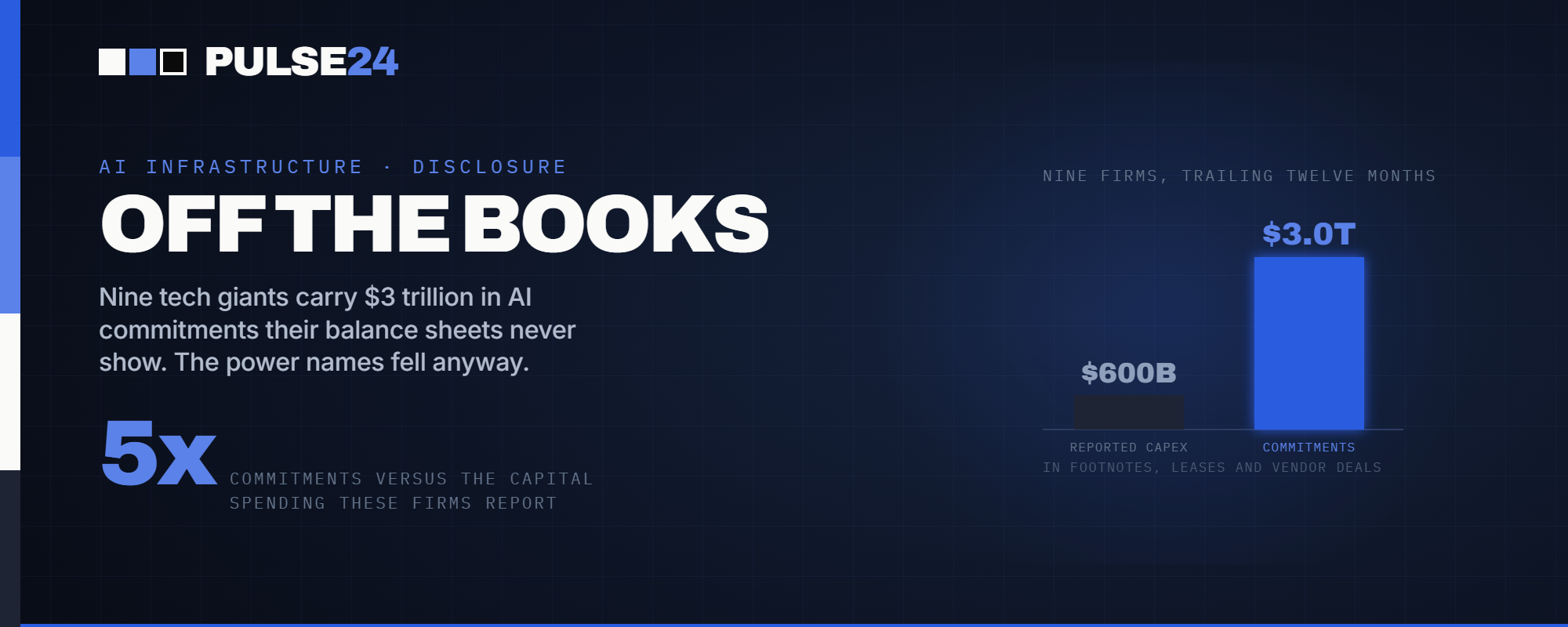
Bloom Energy, GE Vernova and Vertiv all sold off Tuesday even as Google and Amazon raised their AI spending guidance, after a Wall Street Journal analysis found nine tech giants are carrying $3 trillion in AI commitments that never hit their balance sheets. The gap between reported spending and total commitments is now roughly five to one.
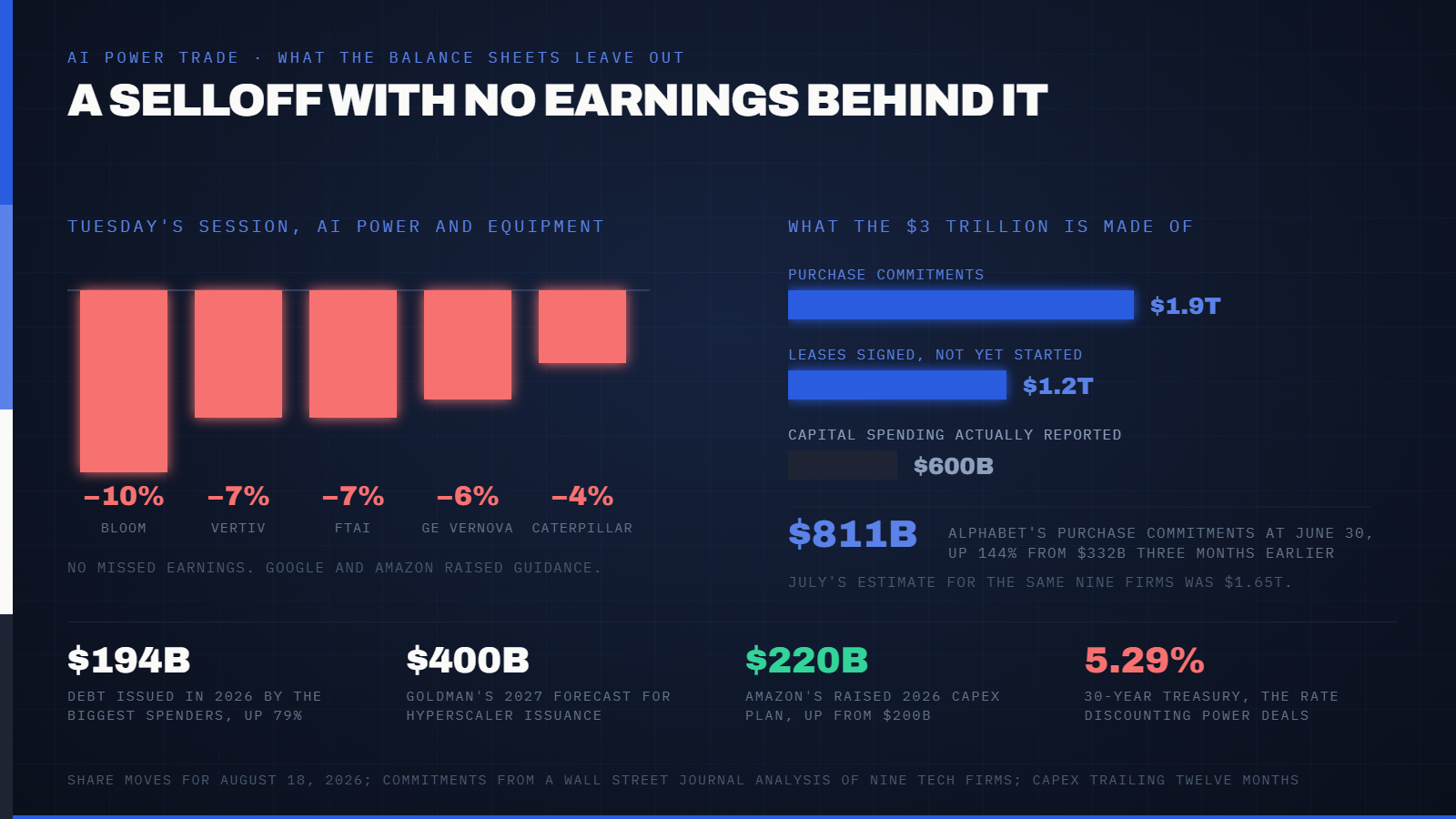
Bloom Energy dropped 10% on Tuesday. Vertiv and FTAI Aviation each gave up 7%. GE Vernova fell 6%, and Caterpillar slid 4%. None of these companies missed earnings or cut guidance that day. What hit them instead was a Wall Street Journal analysis showing that nine of the biggest names in AI, including Microsoft, Amazon, Alphabet and Meta, are sitting on $3 trillion in commitments that never show up on their balance sheets.
What Changed
The Journal's analysis put off-balance-sheet AI commitments at $3 trillion across the nine companies, nearly double the $1.65 trillion estimate that circulated in July and roughly five times the $600 billion these same firms report as trailing twelve-month capital spending. The total splits into $1.9 trillion in purchase commitments for chips, servers and hardware, plus $1.2 trillion in leases that have been signed but haven't started yet. Alphabet's own purchase commitments and obligations jumped to $811 billion as of June 30, up 144% from $332 billion just three months earlier. None of this is hidden in a strict sense. It sits in footnotes and joint-venture structures, vendor financing arrangements, and leases that current accounting rules don't count as liabilities until construction actually begins.
Spending guidance kept climbing anyway. Google raised its 2026 capital spending outlook to $195 billion to $205 billion, up from $180 billion to $190 billion. Amazon lifted its own number to $220 billion from $200 billion. Meta's 2026 capex guidance sits near $145 billion, roughly double what it spent in 2025, and a growing share of that is funded through vehicles that stay off Meta's own books too, including a roughly $27 billion data center project financed through Blue Owl Capital rather than Meta's balance sheet directly.
The bond market is where the strain is starting to show. The four biggest AI spenders have issued $194 billion in debt in 2026 through early July, up 79% from the prior year's pace, and Goldman Sachs projects that climbing to $250 billion this year and $400 billion in 2027 across five hyperscalers. A combined $75 billion offering from Nvidia, SpaceX and Amazon struggled to clear the market this summer, and Amazon's own $25 billion sale needed extra yield to get done. Layer on a 30-year Treasury yield that topped 5.29% this week, its highest level since 2007, and the discount rate applied to decades-long power contracts just got noticeably steeper.
Why It Matters
A five-to-one gap between reported capex and total commitments means investors have spent this year pricing AI infrastructure risk off an incomplete picture. Off-balance-sheet financing doesn't make the spending disappear, it just changes who's holding the risk if any part of the buildout disappoints. Broadcom's own AI financing vehicle was an earlier version of the same pattern, and last week's selloff in utilities tied to the AI power boom was a related but different worry, whether the promised electricity actually gets built at all. Tuesday's move is a newer question layered on top: who eats the loss if some of what does get built doesn't pay off the way its financing assumed.
Apollo's chief economist Torsten Slok has been asking who becomes the marginal buyer of investment-grade paper as hyperscaler issuance keeps climbing toward roughly 15% of total investment-grade supply, competing for buyers against a federal deficit running near $2 trillion a year with about $1 trillion in interest costs attached. Nearly 80% of the AI data-center bonds sold since early 2025 are already trading below the price they were issued at, which is the bond market's own early verdict on how much more compensation investors want for holding this paper. Power-adjacent equities are usually priced off the same long-duration cash flow assumptions as those bonds, so when the discount rate investors demand goes up, the stocks feel it before the underlying contracts change at all.
What to Watch Next
Microsoft and Oracle report next, and their filings are the next test of whether Alphabet's 144% jump in purchase commitments was a one-off or the new pace across the industry. Oracle's depreciation load is projected to rise from 7% to 28% of revenue by fiscal 2028, and Meta's from 9% to 19% over the same stretch, which is where accounting eventually catches up to financing structure regardless of how the commitments are labeled today.
Watch whether AI bond issuance keeps climbing toward Goldman's $250 billion estimate for this year without needing materially higher yields to clear. That's the real-time test of investor appetite for this leverage. If demand keeps cracking the way it did with Amazon's $25 billion sale, expect more sessions like Tuesday's, where the equities tied to building and powering AI data centers get discounted harder than the spending headlines alone would suggest.
The Pulse24 Take
Capex headlines stopped telling the whole story this week. Reported spending of roughly $600 billion sits alongside another $2.4 trillion in commitments parked in leases and purchase contracts that accounting rules don't yet require on the balance sheet. This doesn't mean the AI buildout is fake, or that anyone did anything improper. Unstarted leases and vendor financing are ordinary, legal tools that predate this boom by decades. What it does mean is that two questions markets have been treating as one are worth separating: is AI spending still growing, and who actually carries the risk if part of it disappoints. Google and Amazon answered the first question this week with bigger guidance numbers. Tuesday's selloff in Bloom Energy, GE Vernova, Vertiv and the rest of the AI power basket looks like investors starting to answer the second question on their own, and pricing it separately from the first.
How we read the data
Curious how we get from raw data to a take like this? Our Trader's Toolkit walks through the tools we lean on.
Explore the Toolkit