Pulse24 Original
Utilities Betting on the AI Power Boom Are Down More Than 30% From Their Highs. New Research Says 72% of the Electricity They've Been Asked to Supply Will Never Get Built.
August 17, 2026
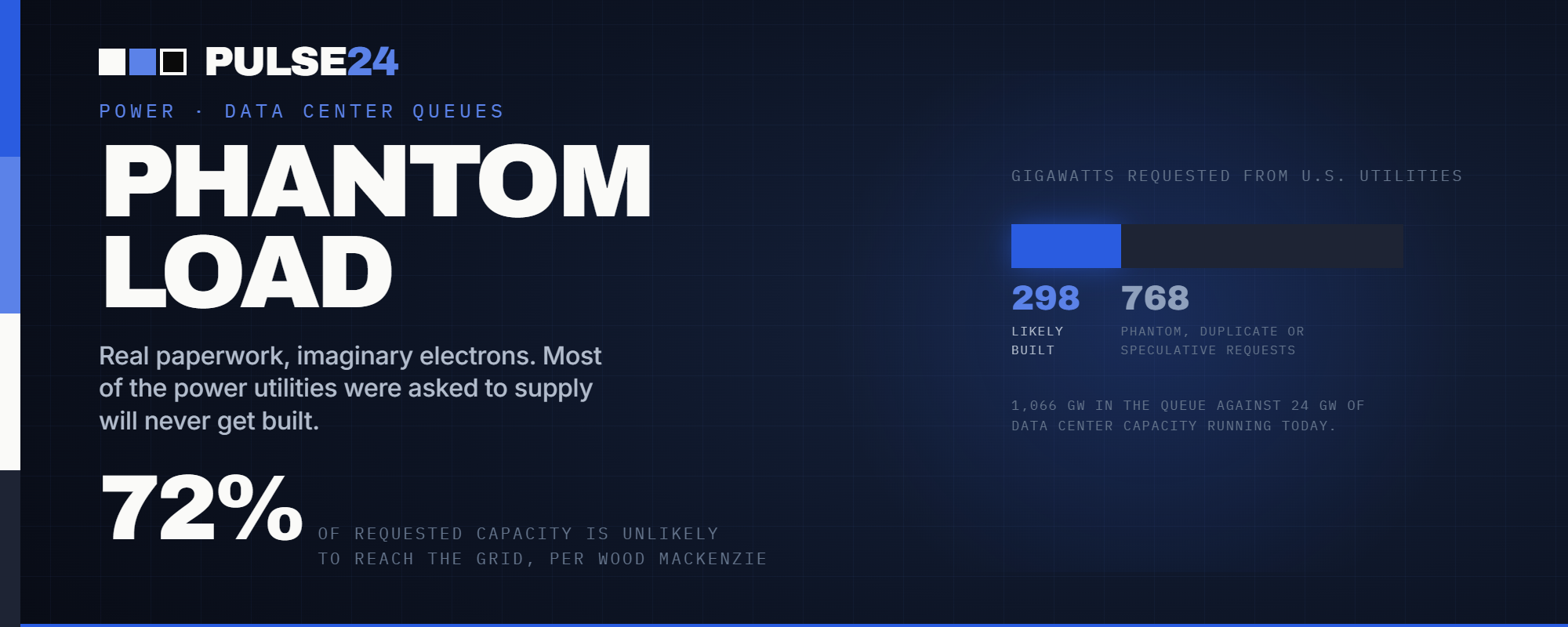
Wood Mackenzie says only 28% of the 1,066 gigawatts utilities have been asked to line up for U.S. data centers will actually get built. The two utility stocks most tied to that story are already down double digits from their highs, real hyperscaler contracts included.
Wood Mackenzie put a number on something traders have been muttering about for months. The energy research firm's grid edge team dug through interconnection queues across the country and found 1,066 gigawatts of requested capacity tied to data center projects. Only about 298 gigawatts of that, 28% of the total, is likely to actually get built. The other 768 gigawatts is sitting in utility filing cabinets as what the firm's analysts call phantom load: real paperwork, imaginary electrons.
To put that number in context, total current U.S. data center capacity is roughly 24 gigawatts. Wood Mackenzie projects that figure climbing to around 110 gigawatts by 2030. The 1,066 gigawatts in the queue isn't a forecast of where demand is going. It's closer to 83% of the country's entire existing utility-scale generation fleet, requested by developers who mostly haven't broken ground on anything.
Why the Queue Numbers Got So Distorted
Ben Hertz-Shargel, Wood Mackenzie's global head of grid edge, described the pattern as a small number of massive, speculative projects concentrated disproportionately in the South and Southwest. The mechanism is simple enough. A developer with a hyperscaler term sheet, or sometimes just an ambition to get one, submits nearly identical interconnection applications to three or four utilities at once, shopping for the best power price and the fastest timeline. Whichever utility wins gets to build. The other two or three are left holding a phantom request that inflates their planning numbers until someone finally cancels it.
This isn't a new problem in power markets. Renewable developers have run the same playbook for years, filing duplicate wind and solar applications to preserve optionality. What's different with data centers is scale. A single gigawatt-class AI campus can rival the power draw of a mid-sized city, so even a handful of speculative filings can distort a regional grid operator's entire long-term plan.
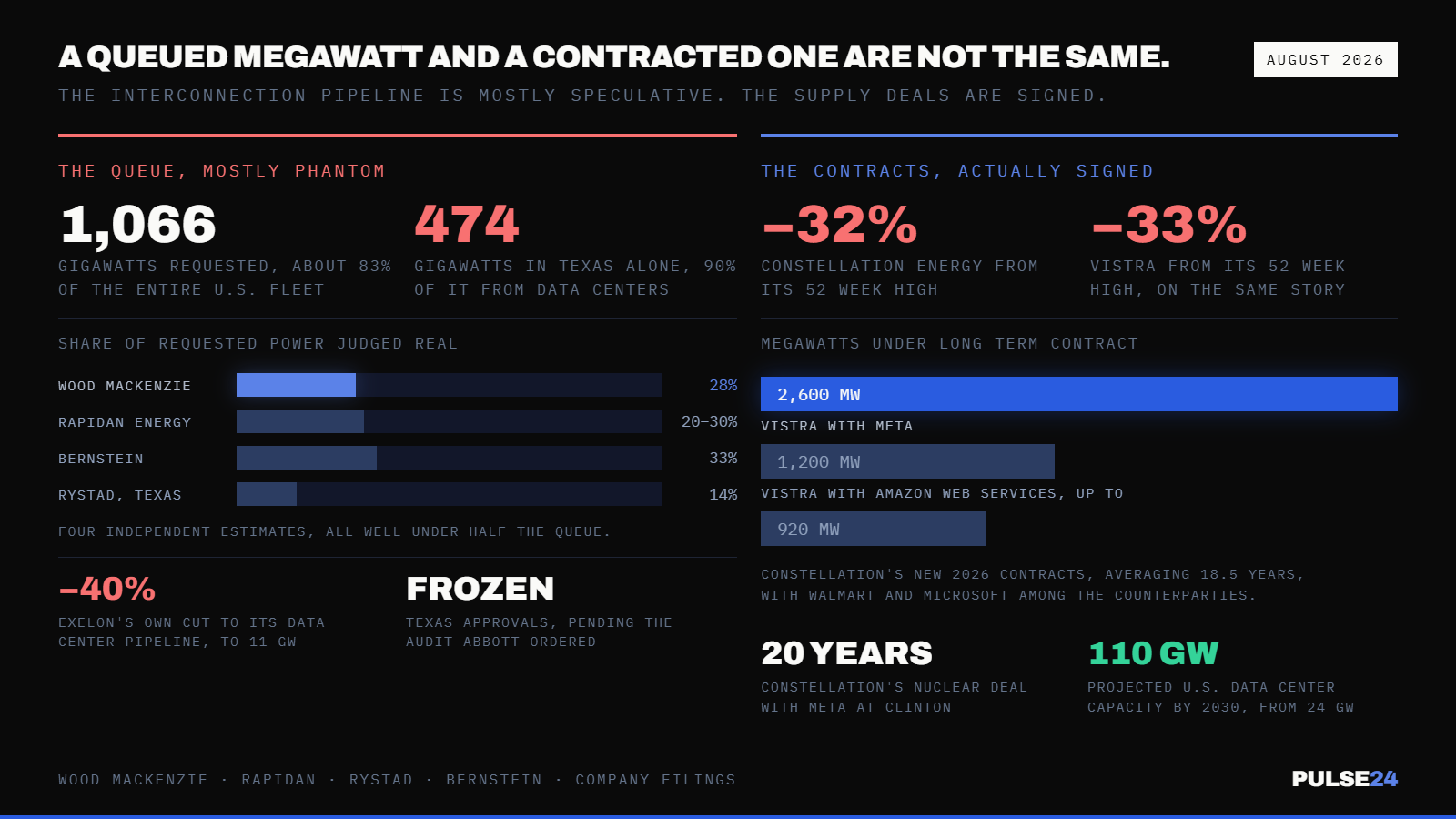
The regional breakdown makes the distortion concrete. Texas's ERCOT grid is tracking around 474 gigawatts of requests, roughly 90% of it from data centers, against a system that has never carried more than a fraction of that load even at its all-time peak. PJM, the mid-Atlantic grid operator, has effectively committed to serve about twice the new large-load demand that its currently planned generation can support. Other analysts land in a similar range: Rapidan Energy Group puts the credible share of requested power at 20% to 30%, Rystad Energy sees roughly half of PJM's applications as legitimate but only 14% of Texas's, and Bernstein's own dataset of 492 gigawatts pegs about a third as real.
Utilities are starting to respond. Exelon has trimmed its data center pipeline by close to 40%, to around 11 gigawatts, a sign that even companies benefiting from the AI buildout are done taking developer projections at face value. The industry is moving toward first-ready, first-served allocation, with utilities now demanding site control, financing commitments and steep upfront collateral before a request even gets modeled into a grid plan. Regulators are pushing in the same direction. Governor Abbott's audit order in Texas has paused new connection approvals across the state while officials sort out which requests are real.
The Stock Market Paradox
Constellation Energy and Vistra are the two names Wall Street has treated as the clearest proxies for data center power demand, and both are down more than 30% from their 52-week highs, Constellation by about 32% and Vistra by about 33%. That's a striking move for a sector that was supposed to be the picks-and-shovels play on AI infrastructure that couldn't lose.
But the phantom-load numbers don't map cleanly onto either company. Constellation has locked in roughly 920 megawatts of new long-term power contracts this year, averaging 18.5 years, with counterparties including Walmart and Microsoft. That is on top of a separate 20-year nuclear supply deal with Meta signed last year for the Clinton plant in Illinois. Vistra has a 2,600 megawatt agreement with Meta and up to 1,200 megawatts from Amazon Web Services. Those are signed, priced commitments running decades into the future, not speculative interconnection filings. The pullback in both stocks looks less like investors discovering the AI power story was fake and more like a market repricing the difference between a contracted megawatt and a queued one, after months of treating them as roughly interchangeable.
That gap between contracted and speculative megawatts is genuinely useful for separating winners from losers inside the AI power trade, and it's why the 30%-plus selloff in Constellation and Vistra deserves a second look rather than a shrug. It also lines up with what's been happening in the credit market for AI infrastructure more broadly. Nearly 80% of AI data center bonds sold since early 2025 are trading below their issue price, a sign that fixed-income investors have already started discounting the gap between announced AI capacity and financeable AI capacity. Wood Mackenzie's queue data gives that skepticism a harder number to point to.
Texas offers a preview of what happens when a grid operator stops taking demand projections on faith. The state has already moved to make data centers responsible for their own power costs after the industry racked up $25 billion in unpaid electricity bills, and the new audit requirement adds another layer of scrutiny before a project can even get in line.
What to Watch Next
The next real test comes with third-quarter earnings from Constellation, Vistra and other power names later this month, when analysts will be pressing management for a cleaner breakdown of contracted versus speculative demand in their own backlogs. Watch for more utilities to follow Exelon's lead and formally cut their pipelines, since a shrinking headline number from a utility that's actually gaining share would be a healthy sign, not a bearish one. The Texas audit is also worth tracking closely. If it results in a large chunk of the state's 474 gigawatts of requests getting formally withdrawn, that could reset expectations for how big the eventual buildout really is, separate from how big it currently looks on paper. Keep an eye on AI data center bond issuance too. If financeable capacity really is a fraction of announced capacity, credit spreads on new deals are one of the fastest places that adjustment shows up.
The broader AI infrastructure buildout is already enormous by any historical measure, running at a pace some economists compare to the housing boom relative to GDP. Wood Mackenzie's report doesn't say that buildout is an illusion. It says the queue numbers used to size it have been badly inflated, and that the real number, whatever it turns out to be, is going to look a lot smaller than 1,066 gigawatts.
The Pulse24 Take
The headline stat here is punchy: 72% phantom load sounds like proof the AI power story was overhyped all along. Read more closely, though, and the story is narrower than that. Interconnection queues were never a demand forecast in the first place. They were a list of open applications, and treating them as interchangeable with committed capacity was always going to produce a number too big to be true. What Wood Mackenzie has done is quantify the gap rather than reveal it.
Both Constellation and Vistra have real contracts sitting behind their numbers, the kind of demand that doesn't evaporate when a state auditor starts asking questions. If the market keeps pricing contracted and speculative megawatts the same way it has for the past year, the gap between perception and reality is where the next mispricing shows up, in either direction. Investors chasing the AI power theme going forward would do well to ask a utility not how many gigawatts sit in its queue, but how many of those gigawatts have a signature on them.
How we read the data
Curious how we get from raw data to a take like this? Our Trader's Toolkit walks through the tools we lean on.
Explore the Toolkit