Pulse24 Original
Nvidia Guaranteed $105 Billion for OpenAI's New Ohio Data Center, $145 Billion Below the Number First Reported in July. The Deal Landed Nine Days Before an Earnings Report That's Already Reopening the Circular-Financing Debate.
August 22, 2026
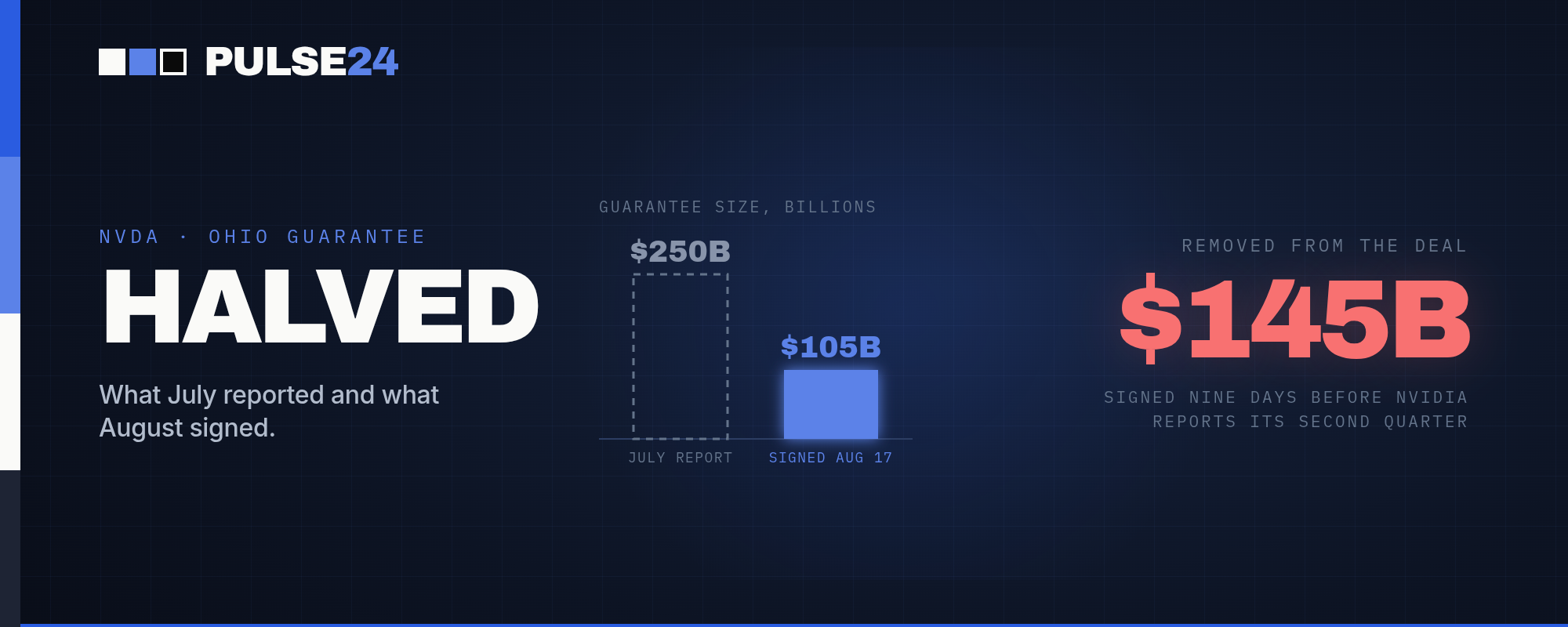
Nvidia's backing for OpenAI's new Ohio data center landed at $105 billion, well below the roughly $250 billion figure first reported in July. The cut comes just over a week before Nvidia's own earnings put its growing web of AI financing deals back under scrutiny.
Nvidia guaranteed up to $105 billion in lease and power payments for a new OpenAI data center in Ohio on August 17. Three weeks earlier, the number attached to the same deal was closer to $250 billion.
That $145 billion gap is the actual story here. Nvidia chief executive Jensen Huang has spent months arguing that financing arrangements like this one aren't the circular scheme critics describe, where a chipmaker effectively funds the customers buying its own hardware. A guarantee that shrank by more than half between its first mention and its signed version gives both sides of that argument new evidence to work with.
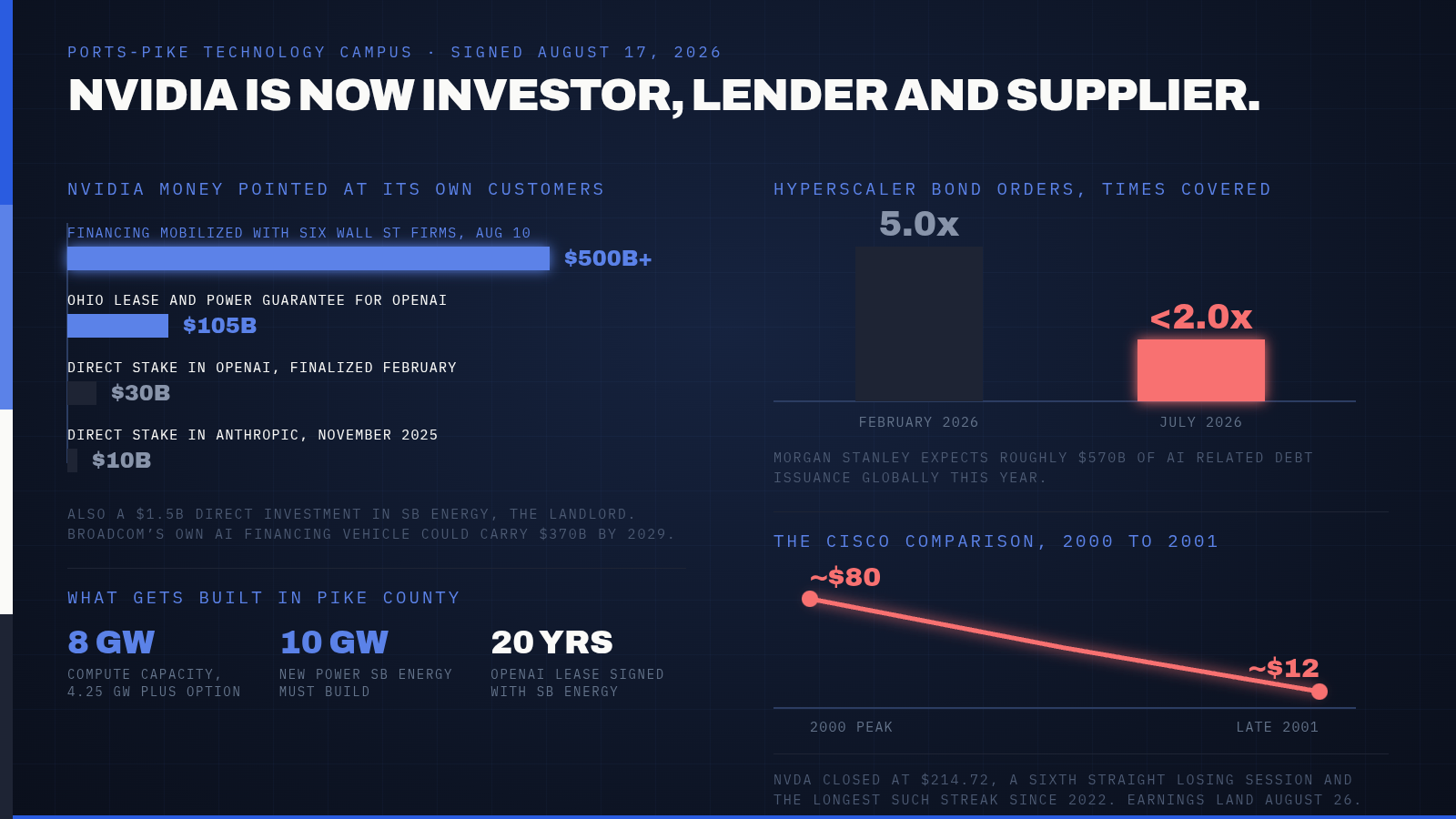
The site itself carries some history. PORTS-Pike Technology Campus sits on land in Pike County, Ohio, once home to the Portsmouth Gaseous Diffusion Plant, a Cold War era uranium enrichment facility the federal government shut down years ago. SoftBank's SB Energy will build and own the new campus under what the companies call a land, power and shell model: an initial 4.25 gigawatts of computing capacity, with an option for 3.75 gigawatts more, backed by at least 10 gigawatts of new power generation and a separate $4.2 billion investment in the regional grid with utility AEP Ohio. OpenAI signed a 20 year lease directly with SB Energy. Nvidia's role is to guarantee up to $105 billion of those lease and power obligations if OpenAI can't cover them, on top of a direct $1.5 billion investment in SB Energy itself.
Huang's defense rests on that structure. "AI is becoming infrastructure, the foundation for intelligence in every industry, and land, power and shell have become vital in the age of AI," he said announcing the guarantee. The chip supplier isn't wiring OpenAI cash to buy Nvidia hardware in this version of events. It's backstopping a landlord so the building gets built, closer to how an anchor tenant supports a large real estate project than how a lender fuels its own sales.
Why It Matters
Whether that distinction survives scrutiny matters more than the wording does. Nvidia put $10 billion into Anthropic in November 2025 and finalized a $30 billion stake in OpenAI in February, both companies it also counts on to buy its chips. On August 10, it went further still, signing memorandums of understanding with six of Wall Street's largest asset managers, Apollo, BlackRock, Blackstone, Brookfield, Goldman Sachs and KKR, aimed at mobilizing more than $500 billion in financing for its own customers. Anthropic's revenue has grown 14-fold to $11.5 billion this year, which is exactly the kind of growth that makes all of the above easy to justify, right up until it isn't.
Broadcom is running a version of the same playbook. Bank of America estimates Broadcom's own AI financing vehicle could carry $370 billion in debt by 2029, even though Broadcom's direct exposure is reportedly capped at $29 billion. Cisco tried something similar in the late 1990s, financing customer purchases to keep its own revenue climbing, and its stock fell from around $80 at the 2000 peak to around $12 by late 2001 once that spending slowed. Morgan Stanley now expects roughly $570 billion in AI related debt issuance globally this year, and demand for that debt has already started to soften. Hyperscaler bond orders covered nearly five times the amount on offer back in February. By July, that coverage had slipped below two times.
What to Watch Next
Nvidia reports fiscal second quarter earnings on August 26, nine days after the Ohio deal closed and with the stock still working through a rough August. Hedge funds are already split on how much conviction to hold in the name heading into that print, and analysts on the call are likely to press management directly on the Ohio structure and whether similar guarantees are coming for other customers.
Bond investors are worth watching too. If hyperscaler debt coverage keeps falling the way it did between February and July, the cost of financing the next data center becomes a shared problem, not just a Nvidia one. And SB Energy still has to deliver 10 gigawatts of new power generation on schedule, in a sector where utilities have missed AI buildout timelines before.
The Pulse24 Take
A guarantee shrinking by more than half between its first mention and its signed version isn't automatically a warning sign. Deals get renegotiated as due diligence runs its course, and $105 billion is still an extraordinary sum for one data center campus. What deserves attention is the pattern, not this single contract. Nvidia is now investor, lender, and supplier to several of the companies buying its chips, and Broadcom is assembling something similar. That arrangement worked fine for Cisco too, until the spending it was funding slowed down. Nvidia's answer is that its customers are footing their own bills. The August 26 earnings call, and whatever guidance comes with it, will be the first real test of whether the market still believes that.
How we read the data
Curious how we get from raw data to a take like this? Our Trader's Toolkit walks through the tools we lean on.
Explore the Toolkit