Pulse24 Original
Dan Loeb's Third Point Dumped Its Entire Nvidia Position in Q2. David Tepper's Appaloosa Bought More of the Same Stock at the Same Time.
August 22, 2026
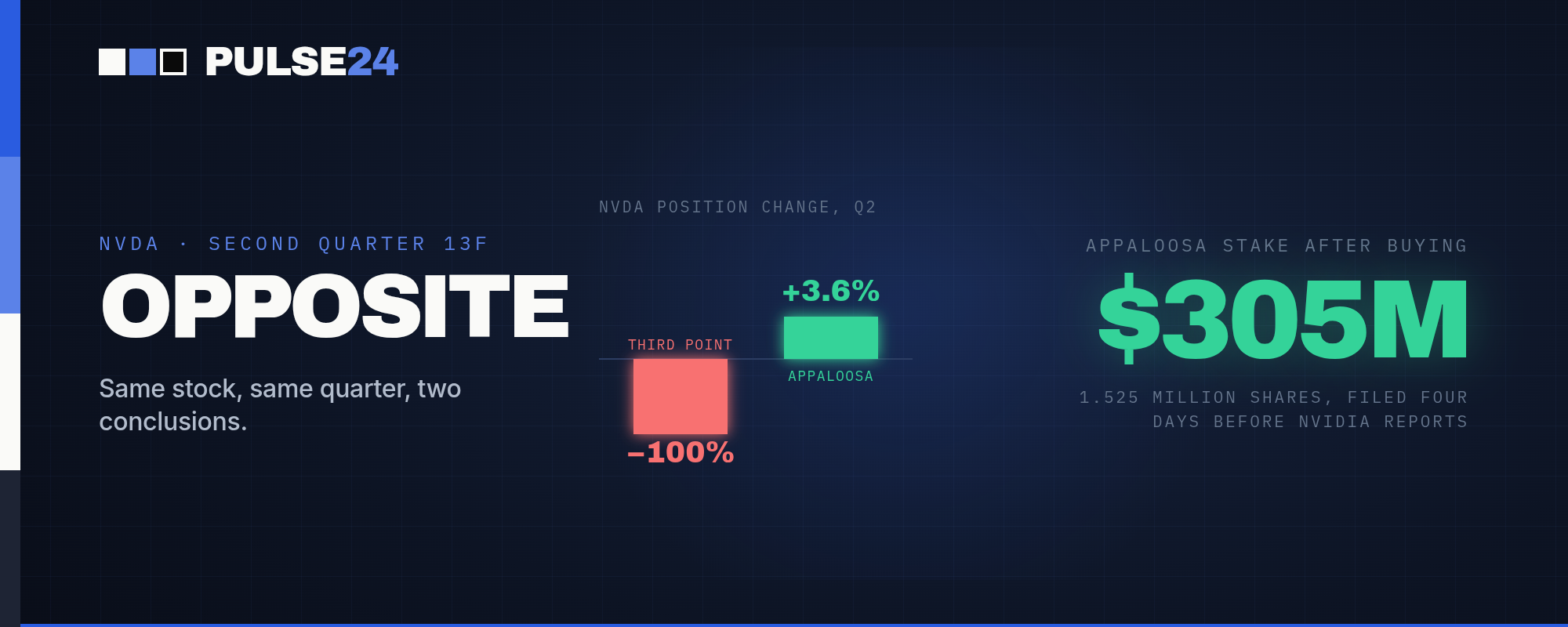
Dan Loeb's Third Point walked away from Nvidia entirely last quarter and put the money into Warner Bros Discovery instead. David Tepper's Appaloosa added to its Nvidia stake over the same three months, four days before Nvidia reports earnings and while AMD locks up billions in new AI chip commitments.
Dan Loeb held zero shares of Nvidia at the end of June. Three months earlier, Third Point Management's position was large enough to show up as a meaningful line in the fund's filings. The 13F Loeb's firm submitted to the SEC on August 17 tells a specific story: a complete exit from Nvidia, Meta Platforms, Broadcom, KLA Corporation, Lam Research, and the VanEck Semiconductor ETF, all in the same quarter. None of that money rotated into a smaller AI name. It went into 20 million shares of Warner Bros Discovery, a media company whose upside case rests on asset sales and restructuring, not GPUs.
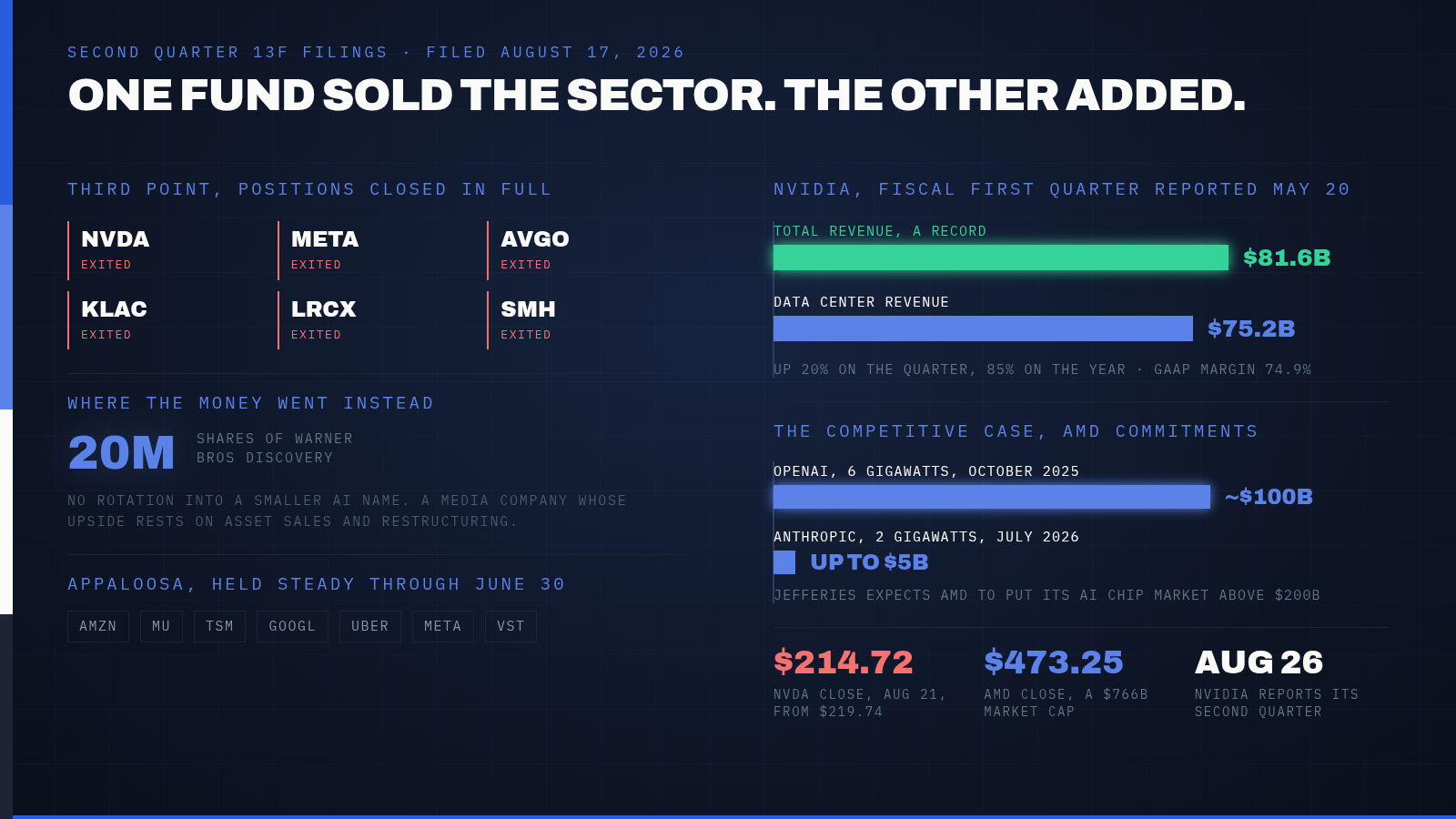
David Tepper made the opposite call with the same stock. Appaloosa Management's own 13F, covering the identical three-month window, shows the fund adding 53,500 Nvidia shares. That brings Appaloosa's position to 1.525 million shares, worth roughly $305 million as of the June 30 filing date. Tepper held the rest of his AI-adjacent portfolio steady too, keeping Amazon, Micron, Taiwan Semiconductor, Alphabet, Uber, Meta, and the power producer Vistra all on the books through June 30.
Why It Matters
Two well-known funds looking at the same stock over the same quarter and reaching opposite conclusions isn't unusual on its own. What makes the timing notable is that both filings became public four days before Nvidia reports its own fiscal second-quarter results on August 26, the biggest single catalyst left on the calendar for the AI trade this year. A 13F is backward-looking by design, showing positions as of June 30 and filed six weeks later, so neither Loeb nor Tepper was reacting to anything that's happened since. The split simply shows up right as the market has to decide how much confidence to put in Nvidia's next guide.
Nvidia's own numbers still support the bull case on paper. The company posted record revenue of $81.6 billion in its fiscal first quarter, reported May 20, up 20% from the prior quarter and 85% from a year earlier, with $75.2 billion of that coming from data centers alone and a GAAP gross margin near 74.9%. Nvidia stock closed at $214.72 on August 21, though, down from $219.74 three sessions earlier, a decline that lines up with growing chatter about how much of Nvidia's moat is actually intact.
That chatter has a name attached to it now: AMD. In July, AMD agreed to invest up to $5 billion in Anthropic and deploy up to 2 gigawatts of its Instinct MI450 series GPUs, with the first gigawatt going live in the first half of 2027. Anthropic's revenue has grown 14-fold to $11.5 billion this year, which is exactly the kind of customer AMD needs to prove its chips can run frontier AI workloads at scale, not just soak up overflow demand Nvidia can't fill. AMD chief executive Lisa Su called it a chance to combine "Anthropic's leadership in frontier AI with the full strength of AMD high-performance computing." Anthropic co-founder Tom Brown put the rationale more plainly, saying running workloads across a diversified range of hardware lets the company match the right chip to the right job.
The Anthropic deal builds on a bigger one. AMD and OpenAI announced a partnership in October 2025 to deploy 6 gigawatts of AMD GPUs, a deal worth roughly $100 billion that came with a warrant for OpenAI to acquire up to 10% of AMD's shares. Between the two labs, AMD now has real, dollar-denominated commitments from two of the companies most responsible for the current AI infrastructure buildout. Jefferies expects AMD to raise its own addressable market estimate for AI chips above $200 billion, a figure that would top the number Nvidia itself gave back in May, a sign Wall Street is taking AMD's growth ambitions seriously even without declaring a clear hardware edge over Nvidia.
AMD stock reflects some of that optimism already, though not smoothly. Shares fell more than 4% on August 18 and nearly 4% more the next day before recovering to close at $473.25 on August 21. That's a volatile stock reacting to a volatile trade rather than a clean handoff from Nvidia. Investors have grown more skeptical of AI infrastructure spending even when the underlying numbers look strong, and Broadcom, one of the five positions Third Point exited entirely, is dealing with its own scrutiny over an AI financing vehicle Bank of America estimates could carry $370 billion in debt by 2029.
What to Watch Next
Nvidia reports fiscal second-quarter earnings on August 26. Wall Street already expects another revenue record that day. The figure worth watching instead is the data center growth rate, along with whatever management says about competitive pressure when analysts inevitably ask about AMD on the call. A guide that shows decelerating growth, even from a high base, would give Loeb's exit more weight in hindsight. One that reaccelerates would do the same for Tepper's addition.
Also worth tracking: whether other large holders follow either fund's lead when third-quarter 13Fs come due in November, and whether AMD's MI450 deployment actually hits its first-gigawatt target on schedule in early 2027. AI infrastructure promises have missed timelines before.
The Pulse24 Take
Betting against Nvidia has been a losing trade for most of the past three years, and nothing in this quarter's filings proves that's about to change. What the Third Point and Appaloosa split actually shows is narrower than that: the AI trade's biggest believers no longer agree on how to express that belief through a single stock. Tepper is still willing to concentrate risk in Nvidia specifically. Loeb decided the better way to play the same theme was to leave chip stocks behind entirely and buy something whose value doesn't depend on the next earnings call at all. Both can be right for their own portfolios. What the next few weeks will test is whether Nvidia's results give the market a reason to lean toward one view over the other, or whether the split just becomes the new normal for how sophisticated money treats the most important stock in the market.
How we read the data
Curious how we get from raw data to a take like this? Our Trader's Toolkit walks through the tools we lean on.
Explore the Toolkit