Pulse24 Original
TSMC's July Revenue Jumped 44.7% to a Record $14.5 Billion. The Stock Barely Moved, Three Weeks After a Very Different Set of Record Numbers Sent It Down 7%.
August 14, 2026
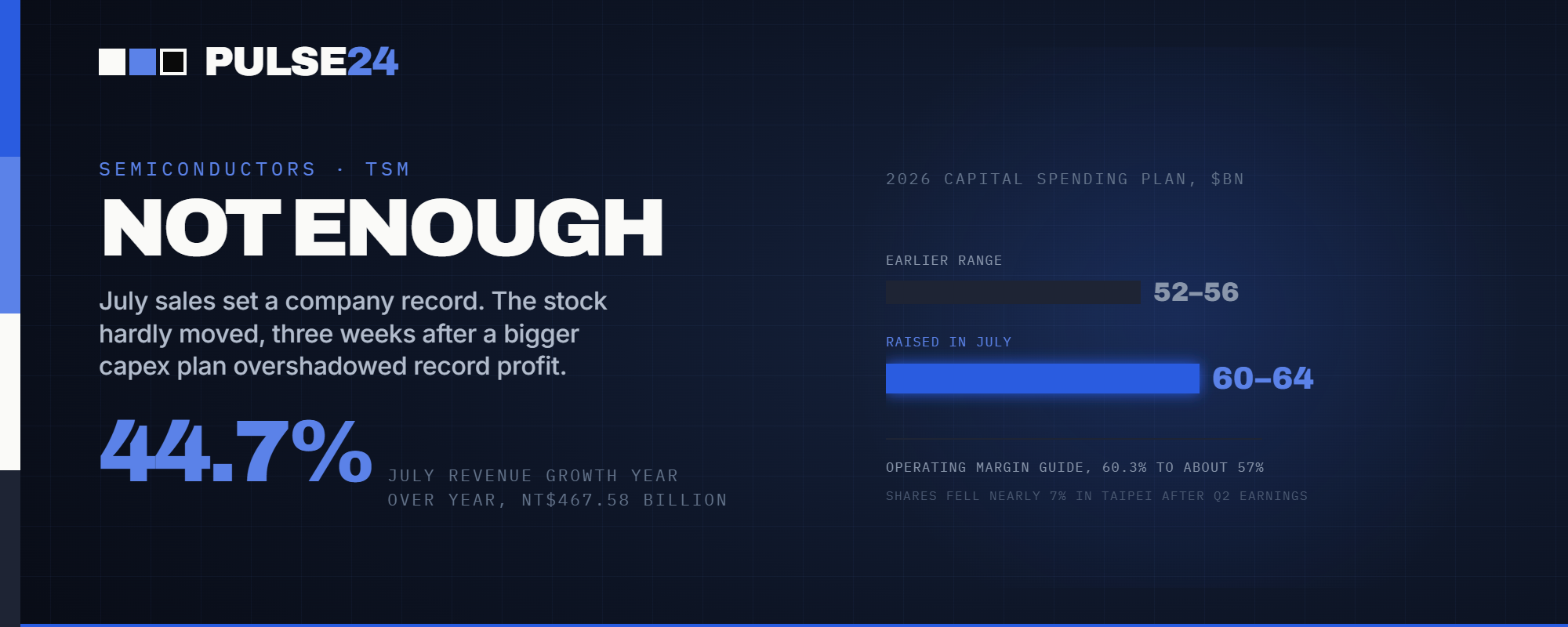
TSMC's July revenue rose 44.7% to a record NT$467.58 billion, extending a run of AI-driven chip demand that keeps beating expectations. The stock's muted response says more about what's already priced in than about the demand itself.
Taiwan Semiconductor Manufacturing Company booked NT$467.58 billion in revenue for July, a company record and a 44.7% increase from the same month in 2025. Revenue also climbed 5.6% from June, and the seven-month total for 2026 now stands at NT$2.87 trillion, up 37% from the same stretch last year. Chip demand tied to artificial intelligence keeps arriving faster than most forecasts assumed even a quarter ago.
What Changed
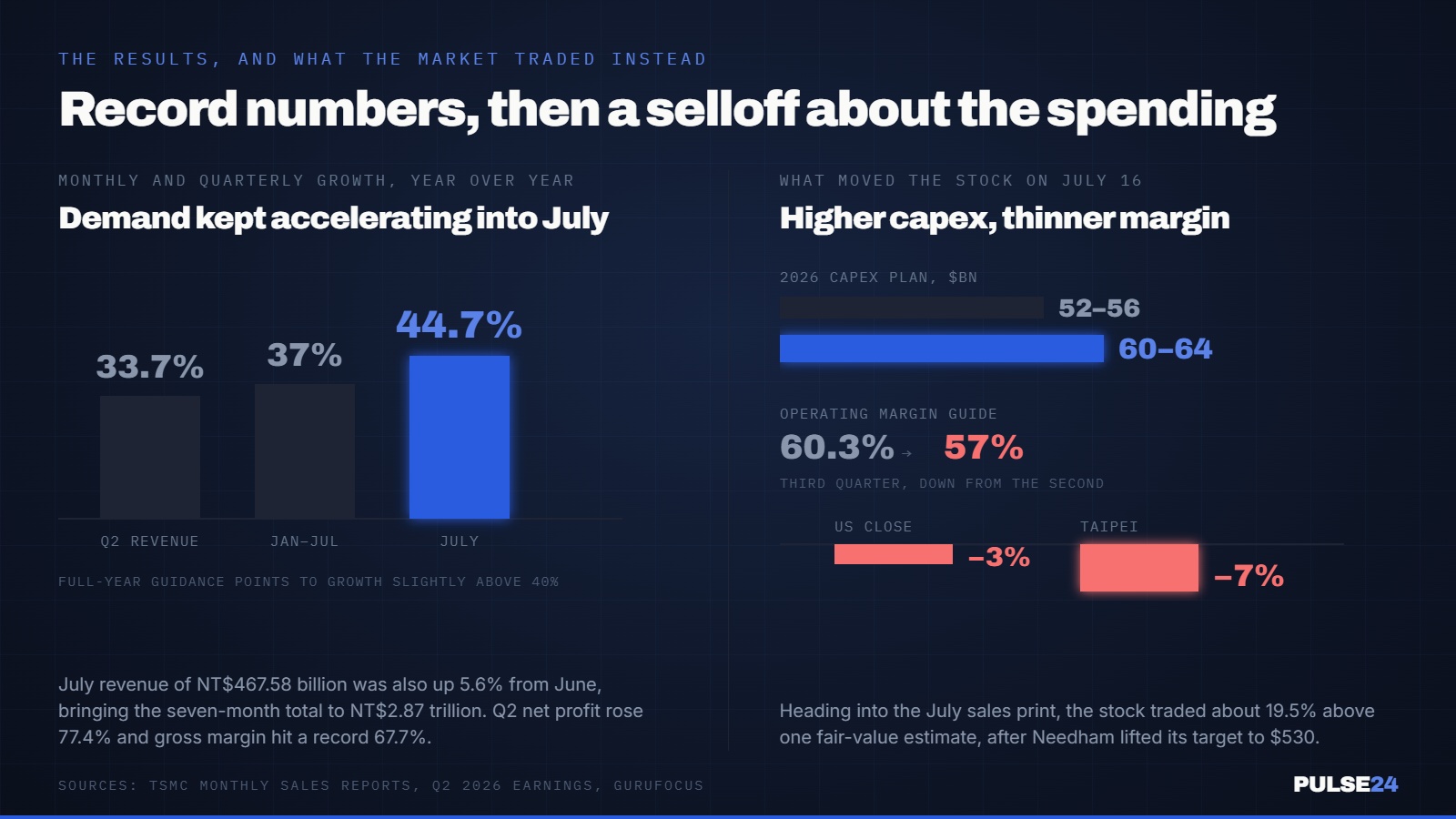
The July print matters less on its own than in contrast to what happened three weeks earlier. TSMC reported second-quarter results on July 16: revenue of $40.2 billion, up 33.7% year over year, and net profit of $22 billion, up 77.4%, with gross margin at a record 67.7%. US-listed shares fell as much as 5% intraday and closed down roughly 3% on the news. Shares in Taipei dropped nearly 7%, and the stock touched a two-month low within two days. Investors weren't reacting to weak demand. They were reacting to TSMC raising its 2026 capital spending plan to $60 billion to $64 billion, up from an earlier $52 billion to $56 billion, and to guidance showing operating margin sliding toward roughly 57% in the third quarter from 60.3%. Several sell-side analysts flagged the capex increase as a near-term drag on margins. Building advanced packaging capacity fast enough to keep up with an order book that already stretches into 2028 isn't cheap, and Wall Street priced that cost in before it fully credited the growth.
So when the July sales figure landed on August 10, confirming that demand hadn't slowed even a little, the stock barely moved. GuruFocus had TSMC trading around 19.5% above its estimated fair value heading into the report. A 44.7% jump in monthly revenue is an extraordinary number by almost any company's standard. For a stock already priced for extraordinary, it wasn't quite enough to move the needle.
Why It Matters
TSMC's monthly sales are one of the cleanest real-time reads available on whether AI infrastructure spending reflects actual chip orders or is simply getting ahead of itself. On that measure, the July numbers argue demand is real: production and revenue keep climbing at rates most consumer or industrial businesses never approach. But production strength and market confidence are no longer moving in the same direction, and that gap has shown up in more places than just TSMC's stock. Nvidia lined up $500 billion in financing for the AI buildout in July and lost $130 billion in market value the same day. Bonds tied to AI data centers are trading below the price they were sold at in roughly 80% of deals issued since early 2025. None of that points to a demand problem. It looks more like a financing and valuation problem, and it's becoming as much a part of the AI story as the chip volumes themselves.
TSMC isn't the only company watching strong results get an indifferent or negative reception. SK Hynix's operating profit jumped 557% last quarter and its stock fell anyway, with investors focused on a new spending plan rather than the earnings beat. The pattern keeps repeating across the AI supply chain: companies posting historic numbers, and markets responding by asking what happens after the spending that produced them.
What to Watch Next
TSMC's August sales figures are due in the first days of September, and any deceleration from July's pace would be the first real test of whether this growth rate is sustainable or borrowed from later quarters. The company's third-quarter earnings call, expected in mid-October, will update both the capex range and the margin guidance that spooked investors in July. Also worth tracking: whether credit spreads on AI-linked debt keep widening or start to stabilize, since that market has become a sharper gauge of investor conviction than the equity market currently is.
The Pulse24 Take
There's a version of this story where TSMC's July numbers settle the AI demand debate: production at this scale, growing this fast, doesn't happen without real orders behind it. A different reading treats the stock's flat response as the more honest signal, evidence that the market has stopped rewarding proof of demand and started demanding proof that the spending pays off. Both can be true at once. TSMC's order book reportedly runs into 2028, which speaks to conviction from the customers actually buying the chips. Its stock trading near 20% above fair-value estimates, even after a quarter of record profit met a selloff, speaks to a different kind of conviction, one coming from investors funding the buildout rather than the ones consuming it. The chips are shipping. What's still being negotiated is who absorbs the cost if the spending outruns the payoff.
How we read the data
Curious how we get from raw data to a take like this? Our Trader's Toolkit walks through the tools we lean on.
Explore the Toolkit