Pulse24 Original
Marvell Landed a $12.2 Billion Warrant From Google. Broadcom Fell 5% the Same Day, and Its Presumed Exclusivity Deal Is Now in Question.
August 24, 2026
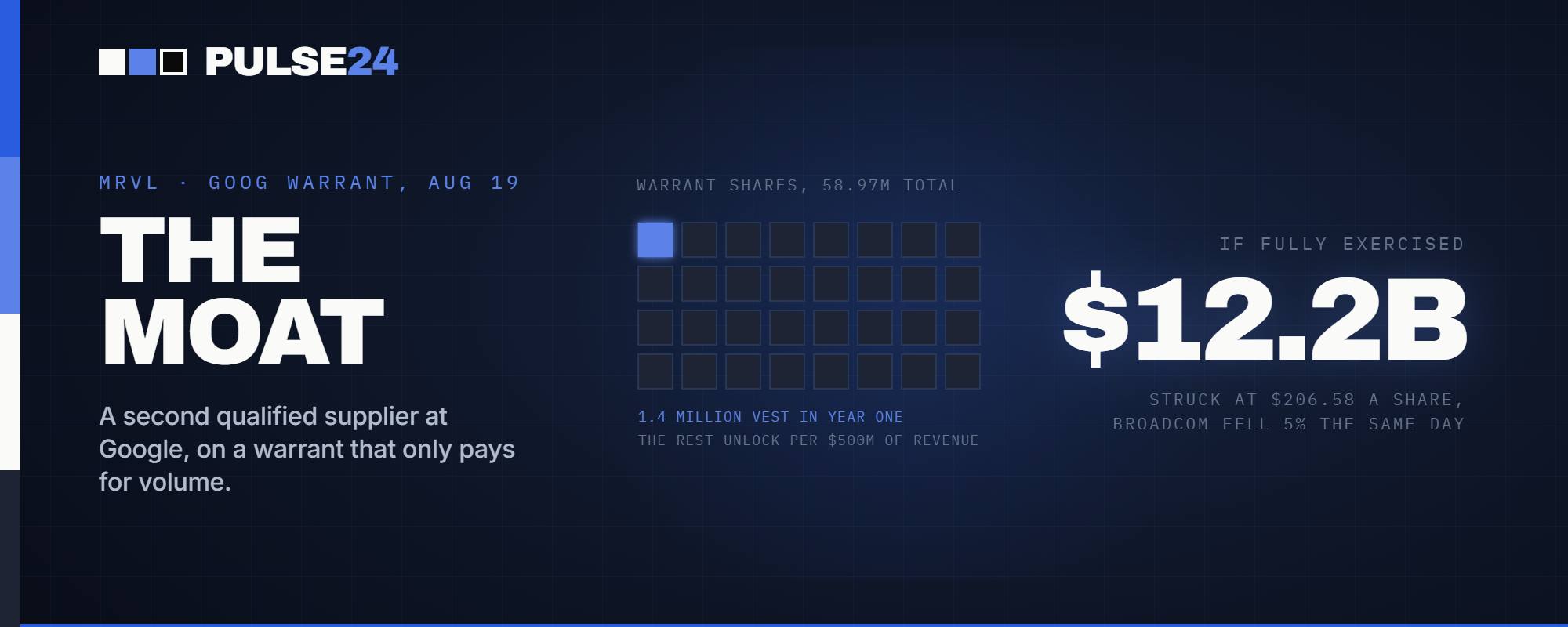
Google handed Marvell a $12.2 billion warrant to build custom AI chips, and Broadcom's stock dropped about 5% the same day on fears its presumed exclusive Google relationship just got a second supplier. The last time Broadcom lost a major customer this way, in 2023, the stock rose more than 500% anyway.
$12.2 billion is the size of the warrant Google picked up from Marvell Technology on August 19, the price of admission for what Marvell described as an expanded partnership to build AI inference accelerators, storage controllers, networking hardware and memory interface technology for Google's data centers.
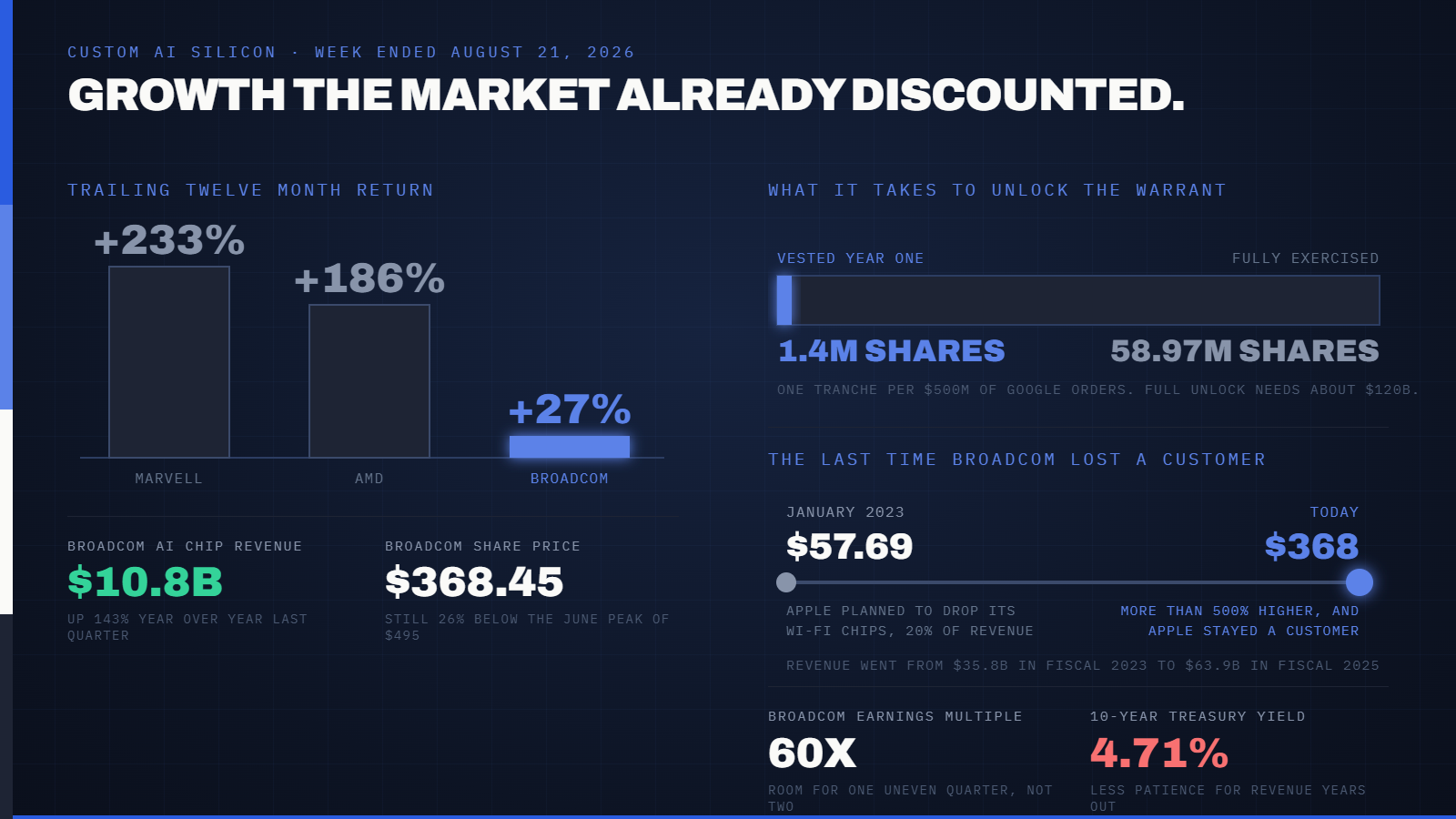
The mechanics matter more than the headline number. Google can buy up to 58.97 million Marvell shares at a fixed $206.58 apiece, but only 1.4 million of those shares vest in the first year. The rest unlock in blocks tied to actual revenue: for every $500 million in custom silicon Marvell books from Google through fiscal 2033, another slice of the warrant becomes exercisable. Google would need to spend roughly $120 billion on Marvell chips before the entire stake unlocks.
Marvell shares jumped as much as 10% the day of the announcement and kept climbing as analysts lifted price targets into the $250 to $350 range. That momentum reversed by Friday, when the stock gave back 5.6% to close at $237.04, a pullback traders attributed to profit-taking rather than any change in the deal's terms.
Broadcom told a different story. Shares fell roughly 5% the same day, to $359.66, before recovering some ground to close Friday at $368.45, still about 26% below the stock's June peak of $495. Marvell's win alone probably wouldn't have spooked investors this much. The bigger issue is what the deal implies about a relationship Broadcom thought it had locked down: a custom chip arrangement with Google, extended only four months earlier in April to run through 2031, that Wall Street had treated as Broadcom's alone to hold.
What Changed
Marvell's deal doesn't erase Broadcom's position at Google. It ends the assumption that Broadcom was the only company capable of designing chips at that scale for one of the world's largest cloud providers. Google is now the third major hyperscaler, after Amazon and Microsoft, where Marvell has a foothold, and the first where it's competing directly against Broadcom's custom silicon business rather than sitting in a separate product lane.
That distinction is why the stock reaction split the way it did. Broadcom's custom AI accelerator business, built largely around Google's own Tensor Processing Units, has been one of the clearest examples of a single supplier owning an entire product category. A second qualified vendor changes the negotiating leverage on every future contract, even if Google never migrates a single existing order away from Broadcom.
Why It Matters
Broadcom isn't short on evidence that losing a major customer doesn't sink a semiconductor franchise. In January 2023, Bloomberg reported Apple planned to drop Broadcom's Wi-Fi and Bluetooth chips by 2025, a business that made up close to 20% of Broadcom's annual revenue at the time. Broadcom's stock closed at $57.69 the day that story ran. It trades near $368 today, a gain of more than 500%, and Apple remained a Broadcom customer anyway through a separate multibillion-dollar radio frequency component agreement. Broadcom's revenue nearly doubled over that span, from $35.8 billion in fiscal 2023 to $63.9 billion in fiscal 2025, almost entirely on the strength of AI demand that had nothing to do with Apple's phones.
The current numbers complicate a simple repeat of that story, though. Broadcom's AI semiconductor revenue grew 143% year over year to $10.8 billion last quarter, a growth rate most companies would envy. And yet the stock is up only about 27% over the past year, badly lagging AMD's 186% gain and Marvell's own 233% run over the same trailing twelve months. Investors appear to be pricing Broadcom less on its current AI revenue and more on questions about durability: how much of its Google relationship survives a credible second supplier, how exposed its VMware business is to the security concerns that have followed that acquisition, and how much of the AI buildout it's financing sits off its own balance sheet. A recent industry analysis found nine major technology companies are carrying roughly $3 trillion in AI-related commitments their balance sheets don't show, and a separate estimate put Broadcom's own AI financing vehicle on the hook for as much as $370 billion in debt by 2029, even though Broadcom's direct exposure there is capped near $29 billion.
What to Watch Next
Whether Marvell can actually convert its warrant depends on execution, not paperwork. Only 1.4 million of the 58.97 million shares vest in year one, which means Google is buying an option on Marvell's ability to deliver at scale, not a guaranteed payout. The next real test of appetite for custom AI silicon spending arrives fast: Nvidia reports fiscal second-quarter earnings on August 26, and the guidance it gives on data center demand will color how investors read every custom-chip contract signed this year, Marvell's and Broadcom's included.
The macro backdrop isn't making that read any easier. The 10-year Treasury yield sits near 4.71%, and every basis point higher makes the market less patient with companies trading on a promise of AI revenue years out rather than revenue already booked. Broadcom trades near 60 times earnings, a valuation that can absorb one uneven quarter. It has far less room to absorb two.
The Pulse24 Take
The easy read here is that Broadcom just lost its moat. A more useful read is that the moat was probably never as wide as the market assumed, and Broadcom's underperformance against AMD and Marvell this year suggests investors had already started pricing that in before Google made it official.
Competition arriving in a market this large isn't automatically bad news for the incumbent. It can be a sign the market itself has grown bigger than any single supplier can serve, which was roughly what played out after Apple dropped Broadcom's Wi-Fi chip and the stock quintupled anyway. The difference this time is that Marvell isn't a bystander benefiting from Broadcom's other businesses. It's the other qualified vendor in the same product category, at the same customer, with a warrant structured specifically to reward it for winning volume Broadcom would otherwise have kept.
Investors don't need to pick a winner today. What's worth tracking is whether Google's cumulative chip spending with Marvell actually approaches the $120 billion required to unlock the full warrant. If it does, that confirms the custom silicon market is expanding fast enough for two suppliers to thrive side by side. If Marvell's revenue with Google stalls well short of that, the simpler explanation holds up: Broadcom's position was harder to dislodge than one week's stock move suggested.
How we read the data
Curious how we get from raw data to a take like this? Our Trader's Toolkit walks through the tools we lean on.
Explore the Toolkit