Pulse24 Original
JPMorgan Is Arranging $5 Billion in New Debt for a Data Center Company That Didn't Exist Seven Months Ago. Volta's Norway Campus Already Carries Up to $8 Billion in Contracted Revenue.
August 28, 2026
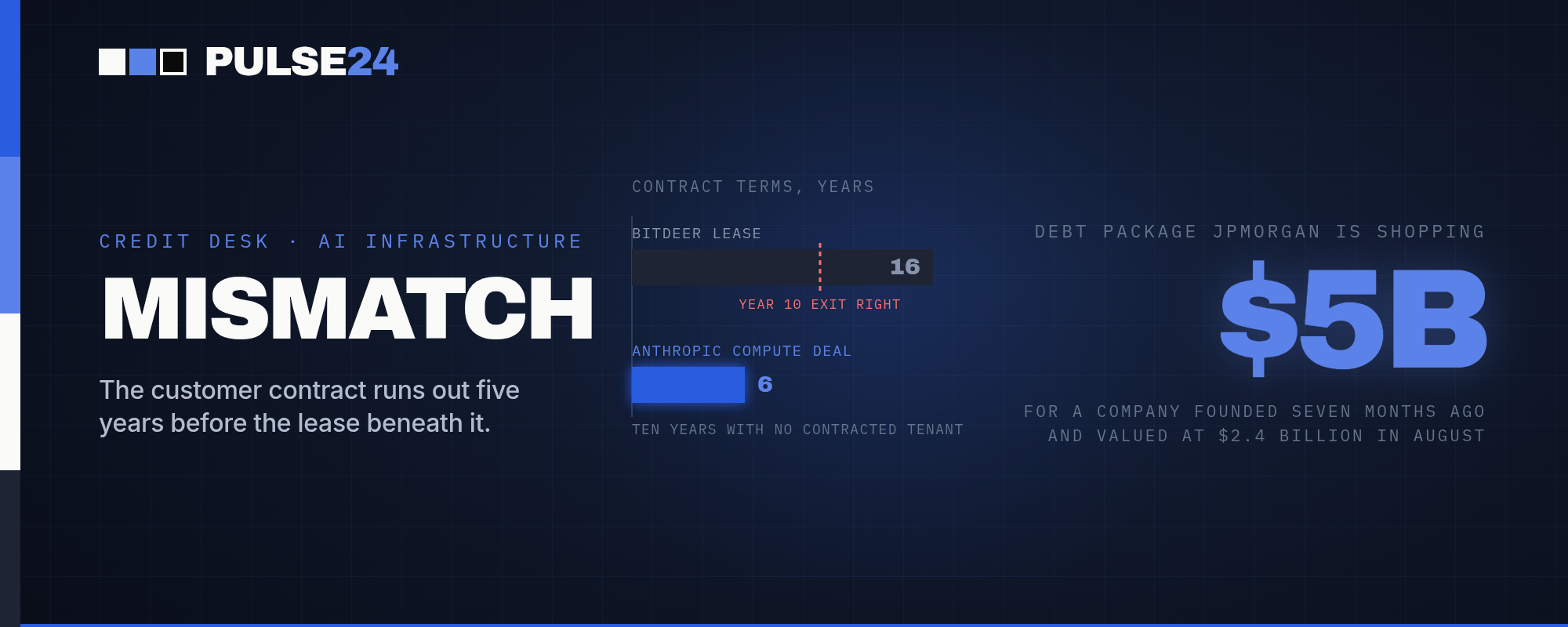
JPMorgan is shopping a $5 billion debt package for Volta, an AI data center startup that exited stealth mode less than a month ago. The deal is the latest sign of how far down the size ladder AI's debt-financed buildout has traveled, and how thin the collateral behind it can get.
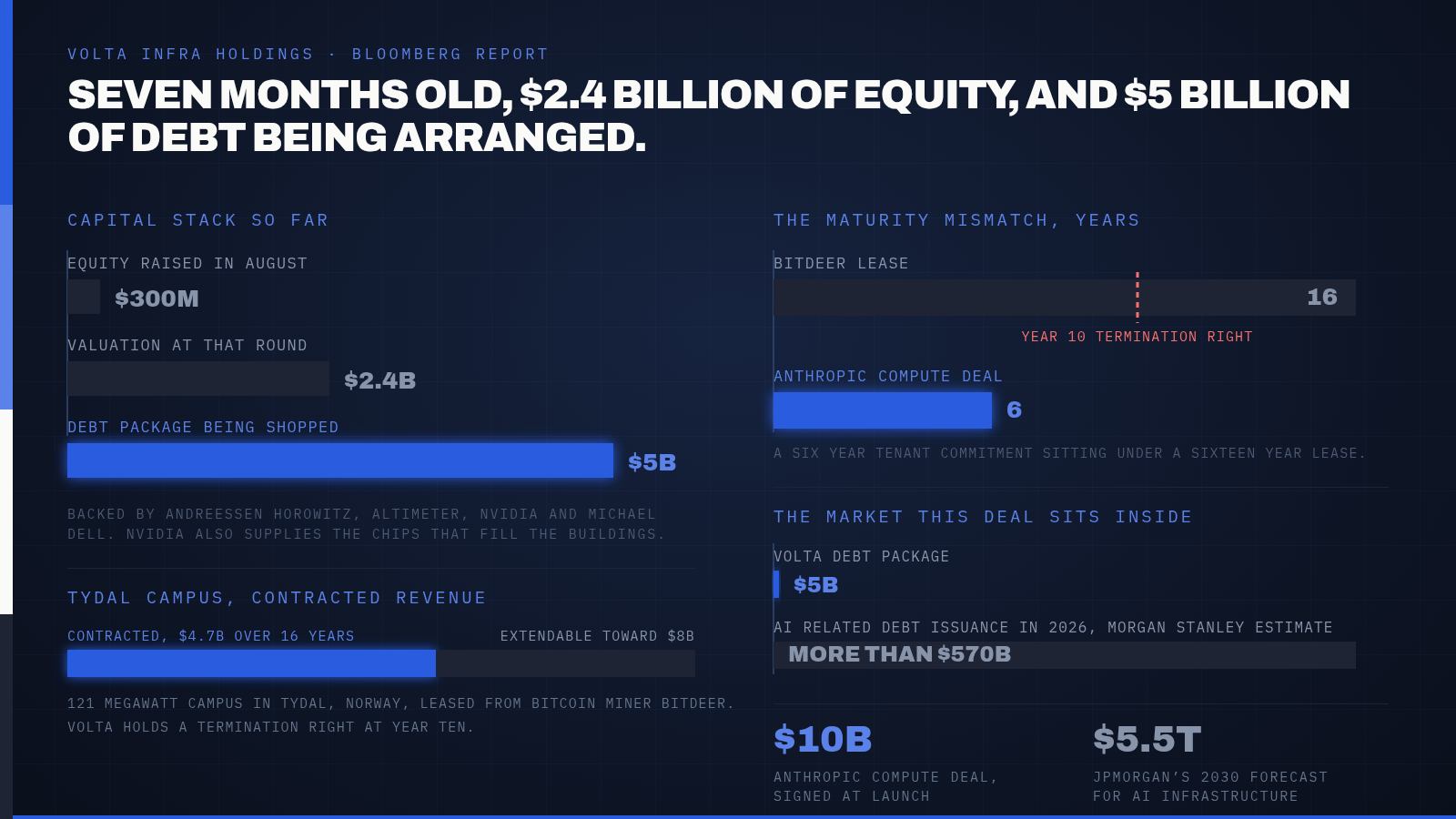
Volta Infra Holdings did not exist as a public entity in January. Now JPMorgan is talking to lenders about arranging as much as $5 billion in new debt for the company, according to a Bloomberg report published this week, on top of a $300 million venture round that valued the seven-month-old AI data center startup at $2.4 billion just weeks earlier.
Ricard Boada and Sofia Gumuzio, two former Brookfield infrastructure executives, founded Volta this year with a specific thesis: finance AI data centers the way an infrastructure fund finances a toll road or a power plant, with debt carrying most of the weight rather than equity. The August funding round was co-led by Andreessen Horowitz, Altimeter, and Nvidia, with Michael Dell also among the backers. Nvidia's presence on the cap table is worth sitting with. Nvidia is also the chipmaker whose hardware will likely fill the data centers Volta builds, a pattern that has repeated often enough across this AI cycle that analysts now have a shorthand for it: circular financing.
What Changed
The centerpiece of Volta's business is a 121-megawatt data center campus in Tydal, Norway, leased from Bitdeer Technologies, a company that started out mining bitcoin and has since repositioned large parts of its business as an AI infrastructure landlord. The lease is structured to generate roughly $4.7 billion in contracted revenue over sixteen years, a figure Volta says could extend toward $8 billion as the arrangement matures. One detail in that structure stands out: Volta holds the right to terminate the lease at year ten, four years before its own biggest customer commitment runs out.
That customer is Anthropic, which signed on almost immediately after Volta launched, agreeing to a six-year, $10 billion deal for dedicated compute capacity. The contract is what makes the whole structure financeable in the first place. Lenders underwriting a data center want a creditworthy tenant locked in for years, and an AI lab growing revenue as quickly as Anthropic has this year fits that requirement well. But a six-year customer contract sitting beneath a sixteen-year lease, with the landlord holding an exit option in the middle, is the kind of maturity mismatch that tends to surface in the fine print long before it surfaces in a headline.
There's also an open question about the money itself. Volta announced a separate $5 billion non-dilutive infrastructure program with the Spanish asset manager Azora in early August. Whether the debt package JPMorgan is now shopping is that same $5 billion, an additional tranche on top of it, or a distinct pool of financing hasn't been clarified by either party. Terms on the new package, including pricing, remain undisclosed, and JPMorgan is still at the stage of gauging lender interest rather than closing a deal.
Why It Matters
Five billion dollars is small next to the scale of AI debt financing overall. Morgan Stanley estimates AI-related companies will issue more than $570 billion in debt this year, and Pulse24 covered how that financing has already pushed Broadcom's and Oracle's cost of insuring their own debt to record levels, even as the broader junk bond market shows almost no stress at all. Volta is a far smaller, far younger company than either of those two, but it's running a similar playbook: keep the debt in a dedicated financing structure, lean on a single large AI lab as the anchor tenant, and let contracted future revenue substitute for the kind of balance sheet history most lenders would otherwise require.
There's a subtler effect worth watching too. Dallas Fed researchers estimate that investment-grade AI issuance alone could add as much as $360 billion in ten-year equivalent duration to fixed income markets this year, roughly an eighth of what the U.S. Treasury supplies through its own bond issuance. Data center operators using floating-rate private credit, the kind Volta is seeking, often add interest rate swaps on top to convert that debt into something closer to fixed-rate exposure, which pushes on swap spreads and, from there, on the broader yield curve. That's one more source of demand competing for the same pool of long-term buyers already absorbing a Treasury market carrying $40 trillion in national debt.
What to Watch Next
Whether JPMorgan can actually place this deal, and at what price, will say something about how much appetite still exists for pure neocloud debt. Broadcom and Oracle at least bring decades of cash flow and investment-grade ratings to the table. Volta brings a lease and a contract, both of which depend on Anthropic remaining a paying customer at roughly its current scale. If pricing on Volta's debt comes in noticeably wide of comparable investment-grade AI paper, that's a signal lenders are demanding real compensation for the difference.
Watch too whether other young infrastructure companies follow the same script. Nvidia taking small equity stakes in firms that then become large buyers of Nvidia chips is a dynamic Pulse24 flagged around Nvidia's $105 billion financing guarantee for OpenAI's Ohio data center, and Volta fits the same pattern on a smaller scale. If a rating agency eventually scrutinizes structures like this one the way S&P scrutinized Oracle, financing that looks cheap and plentiful this summer could get considerably harder to find.
The Pulse24 Take
Financing an infrastructure asset against a long-term revenue contract is not inherently reckless. Toll roads and power plants have been built this way for decades, and the model holds up when the contract, the asset, and the debt maturity roughly line up. What's worth watching in Volta's case is how many of those pieces don't quite line up yet: a ten-year exit option sitting inside a sixteen-year lease, a six-year customer contract underwriting both, and now a fresh $5 billion ask before the first financing program has even finished being placed.
None of that means the deal fails. Anthropic's revenue has grown quickly enough this year that a six-year commitment from it looks like solid collateral to plenty of lenders, and $5 billion barely registers against the trillions this buildout is expected to require. But Volta is a useful marker of how far down the size ladder this financing pattern has already traveled. A year ago, debt-heavy, contract-backed AI infrastructure was mostly a story about Oracle and Broadcom. Now it's a story about a company that was still in stealth mode a month ago.
How we read the data
Curious how we get from raw data to a take like this? Our Trader's Toolkit walks through the tools we lean on.
Explore the Toolkit