Pulse24 Original
The Fed Hiked Rates to 3.75%-4% Wednesday, Its First Increase in Over Three Years. The Vote Was Unanimous, a Reversal From July's 9-3 Split.
September 16, 2026
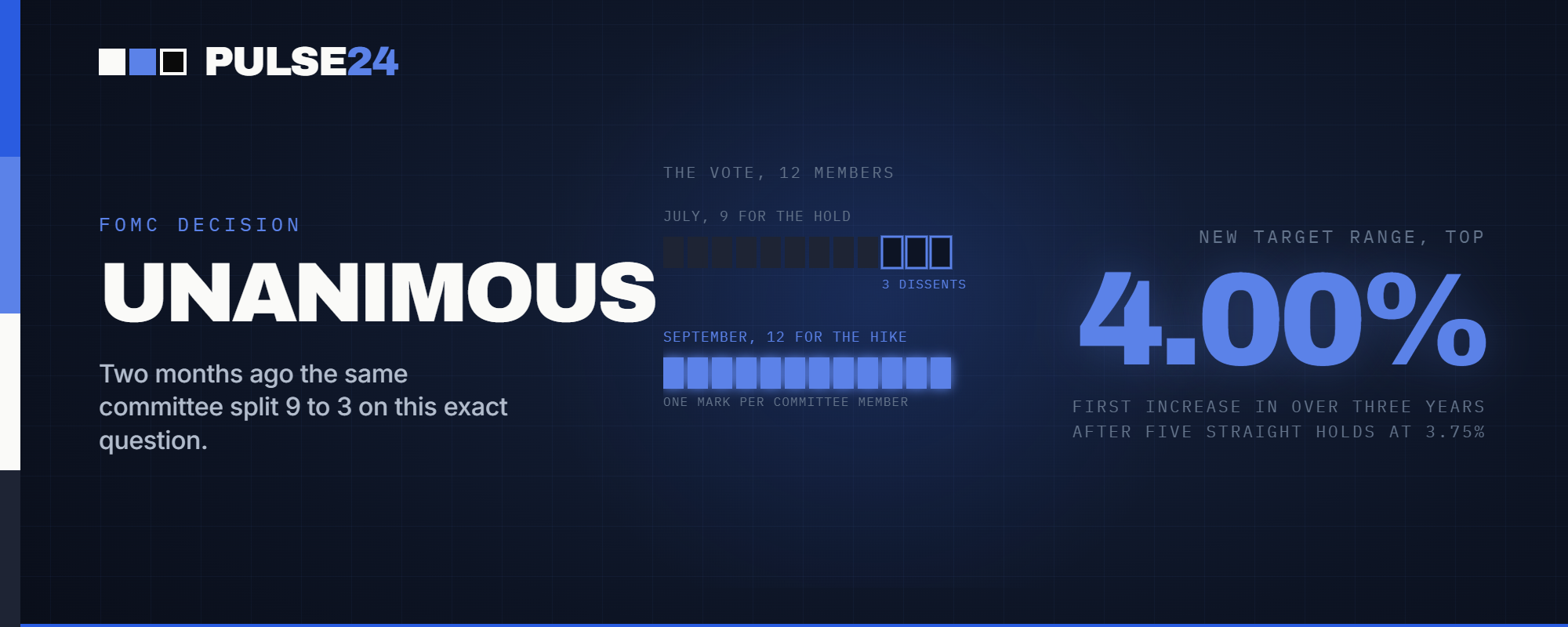
The Federal Reserve raised its benchmark rate a quarter point to 3.75%-4.00% Wednesday, the first hike in over three years. Officials now expect one more increase before the end of 2026 and none in 2027.
The Federal Reserve raised its benchmark interest rate by a quarter point Wednesday, lifting the target range to 3.75% to 4.00%. Fed Chair Kevin Warsh called the vote unanimous, a detail that matters almost as much as the number itself.
Two months earlier, the same committee had split 9-3 on this exact question. Three governors, Beth Hammack, Neel Kashkari, and Lorie Logan, wanted the hike the Fed just delivered. By September nobody on the committee was arguing the other side.
What Changed
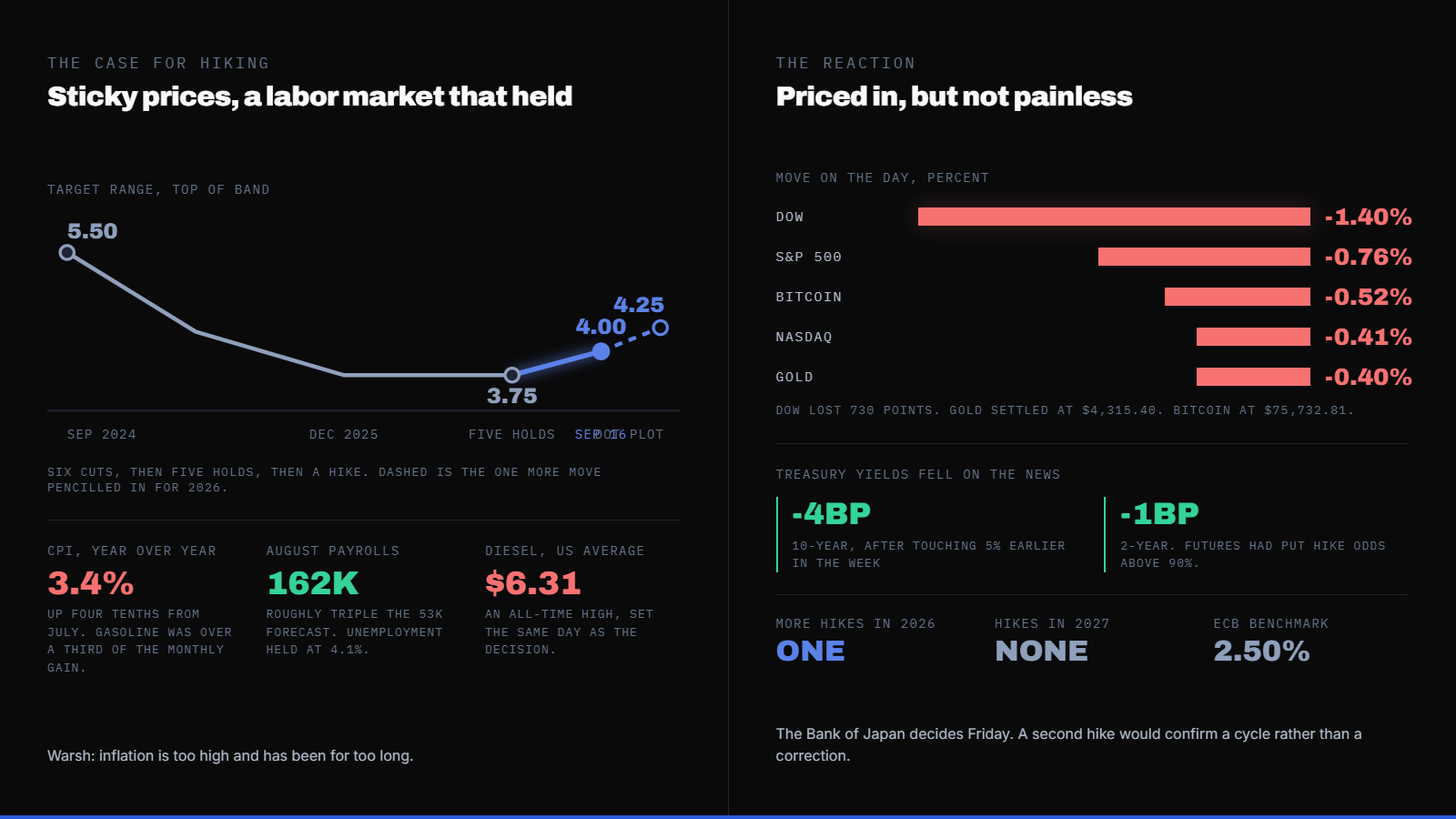
Wednesday's increase ends a run of five consecutive holds at 3.50% to 3.75%, a pause that stretched back to January. That pause itself followed a long easing cycle. Between September 2024 and December 2025, the Fed cut rates six times, trimming the top of its target range from 5.50% down to 3.75%. Wednesday's hike claws back a small piece of that retreat: the top of the range now sits at 4.00%, still a point and a half below its 2024 peak.
Inflation forced the reversal. August's consumer price index climbed 3.4% from a year earlier, a four-tenths of a percentage point jump from July, and gasoline alone accounted for more than a third of that monthly move. Diesel touched an average of $6.31 a gallon Wednesday, an all-time high that shows up in freight costs before it ever shows up in a CPI report. Some of that pressure traces back to geopolitical tensions in the Middle East that kept oil markets on edge over the summer, pushing gasoline higher well before Labor Day. Pulse24 covered the core CPI print that first moved the odds toward a hike back in August, when traders were still debating whether the Fed would actually pull the trigger.
The labor market gave Warsh room to act. August payrolls rose by 162,000, roughly triple the 53,000 economists had penciled in, and unemployment held at 4.1%. A Fed worried about tipping the economy into a downturn would struggle to point to that report as a warning sign. Sticky inflation paired with a labor market that refuses to crack is exactly the setup that makes a central bank comfortable tightening even as growth forecasts get shakier elsewhere.
Warsh didn't soften the message. "The plain fact is that inflation is too high and has been for too long," he said at Wednesday's press conference. He added that "this summer's inflation readings do not tell me that underlying trends have meaningfully improved." The line echoes what he told an audience at Jackson Hole in August, when he said "the responsibility for 65 months of sustained, elevated inflation sits squarely with the central bank." It's an unusual admission for a sitting Fed chair, one that reads as much like a break from his predecessor's legacy as a policy statement.
Why It Matters
The bond market had already priced most of this in. Ten-year Treasury yields touched 5% earlier this week for the first time since 2023, with futures markets putting the odds of Wednesday's hike above 90%. When the decision matched expectations almost exactly, yields actually fell slightly rather than spiking, dropping about 4 basis points on the 10-year and roughly 1 basis point on the 2-year. That's the sound of a market that had already done its repricing in advance.
Equities took the hawkish undertone harder than the headline number. The Dow fell 730 points, a 1.4% drop, while the S&P 500 lost 0.76% and the Nasdaq slipped 0.41%. Gold eased 0.4% to $4,315.40 an ounce and Bitcoin dropped 0.52% to $75,732.81, both moving alongside a firmer dollar. None of those are dramatic swings on their own, but they mark a shift in direction after a summer when hike odds kept climbing and gold and Bitcoin sold off together on rate fears more than once.
The Fed also isn't hiking alone. The European Central Bank raised its own benchmark to 2.50% earlier this month, and Pulse24 flagged at the time that the Fed and Bank of Japan could both follow within days. The Fed got there first. The Bank of Japan decides Friday, and after a yen rally that didn't survive eight days, a Fed hike this synchronized with other major central banks raises the stakes for that decision too.
What to Watch Next
The dot plot points to one more quarter-point increase before the end of 2026, which puts the next live meeting under real scrutiny for whether the committee follows through or pauses again the way it did for five straight meetings earlier this year. Watch the Bank of Japan's decision Friday for confirmation that this is becoming a genuinely global tightening move rather than a US-specific one. And watch gasoline prices into the fall: if diesel and pump prices ease from their current records, the inflation argument for another hike gets noticeably weaker, and Warsh's 2027 pause becomes easier to defend. If they don't, the 65-month clock Warsh referenced keeps running, and so does the pressure to keep tightening.
The Pulse24 Take
A unanimous vote after a 9-3 split two months ago tells you the committee didn't struggle with this decision. Inflation data and a resilient labor market made it close to automatic. What's more interesting is the tone: a Fed chair who took office in May openly pinning blame for five-plus years of inflation on his own institution isn't just describing a data point, he's setting up the case for why more tightening might be necessary even if it's unpopular. Markets shrugged off Wednesday's move because it was expected, but the real test comes at the next meeting, when a second hike would confirm this is a cycle rather than a one-off correction. For now, the message from the Fed is straightforward: rates are going up because inflation didn't come down fast enough, and the committee would rather act than wait for more evidence.
How we read the data
Curious how we get from raw data to a take like this? Our Trader's Toolkit walks through the tools we lean on.
Explore the Toolkit