Pulse24 Original
The ECB Hiked Rates to 2.50% This Week. The Fed and Bank of Japan Could Both Follow Within Days.
September 13, 2026
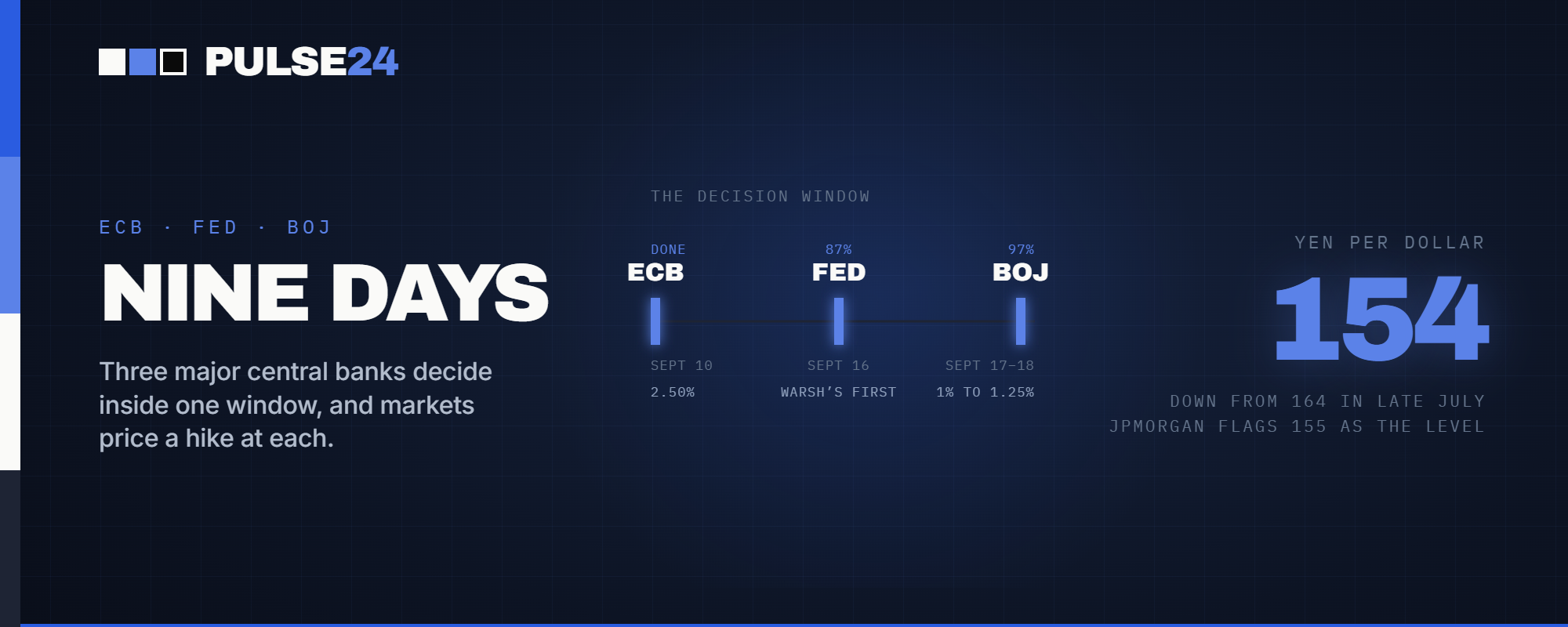
The European Central Bank raised rates on September 10, and the Federal Reserve and Bank of Japan are both scheduled to decide policy within the same week, with markets pricing hikes at each one. That kind of alignment across three major central banks is rare, and it is already showing up in the yen and in global bond yields.
Christine Lagarde raised interest rates in Frankfurt on September 10. Four days later, Kevin Warsh may do the same thing in Washington, in what would be his first hike since becoming Federal Reserve chair in May. By September 18, Kazuo Ueda could follow from Tokyo, with markets pricing a Bank of Japan move at roughly 97% odds. Three of the world's most consequential central banks are set to make policy decisions within a single nine-day window, and the last time major central banks moved this close together, currency and bond markets did not handle it quietly.
What Changed
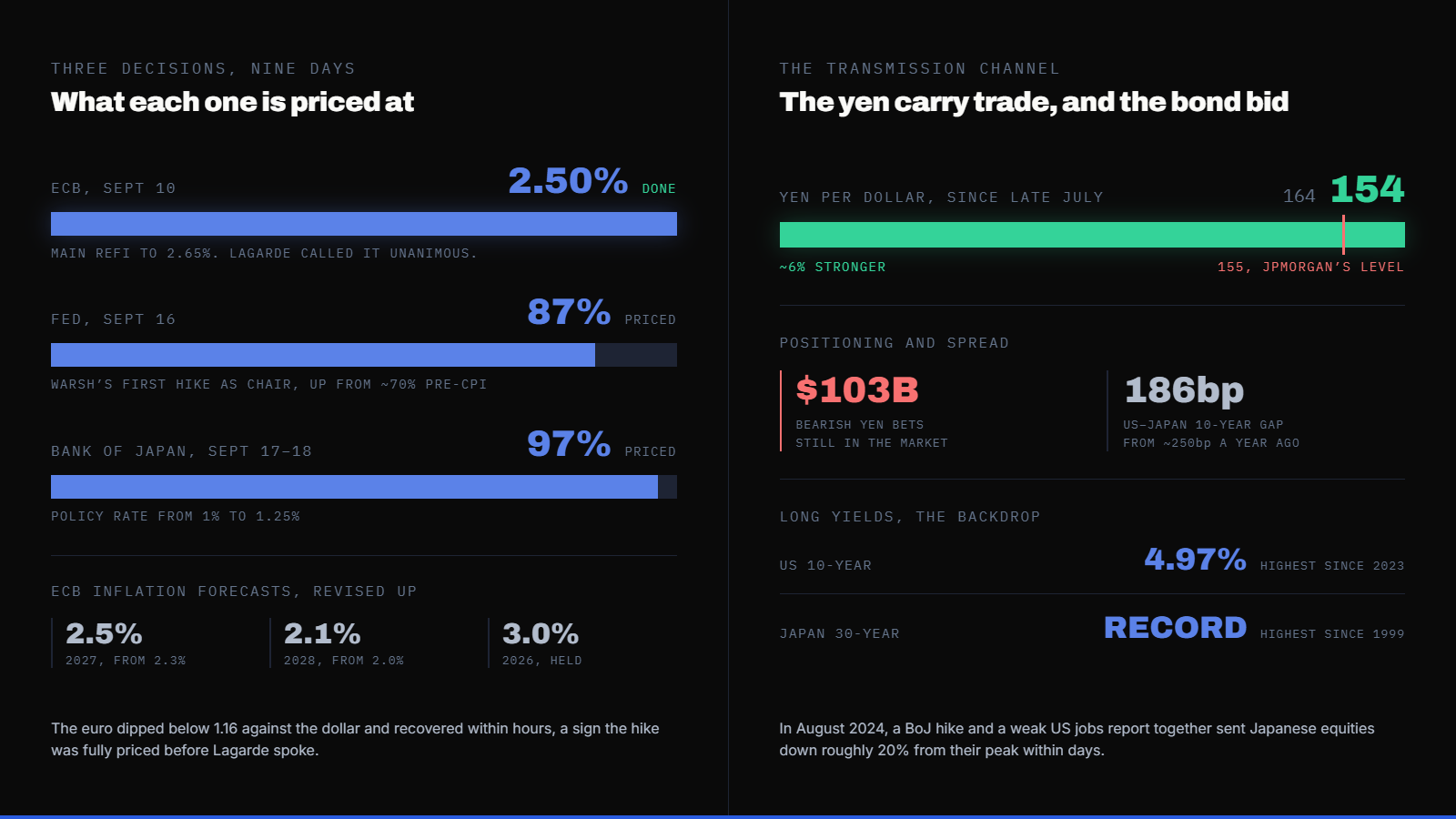
The ECB's move was the least surprising of the three. Its deposit rate rose a quarter point to 2.50%, with the main refinancing rate following to 2.65%. Policymakers also nudged up their inflation forecasts, to 2.5% for 2027 from 2.3% previously and to 2.1% for 2028 from 2.0%, while holding this year's estimate at 3.0%. Lagarde called the decision a unanimous "no-brainer" and left the door open to further increases without committing the Governing Council to any specific path beyond the next meeting. The euro barely moved, dipping below 1.16 against the dollar before recovering within hours, a sign that traders had already priced the hike well before Lagarde spoke.
The Fed is a different story, mostly because of who is now running it. Kevin Warsh took over as chair in May after Senate confirmation, and Pulse24 covered the CPI report that pushed hike odds toward 90% earlier this month. CME's FedWatch tool has settled at roughly 87% odds heading into Wednesday's decision, down slightly from that post-CPI peak but still far above the coin-flip pricing that prevailed in August. A hike would be the first of Warsh's tenure and would arrive alongside dot-plot projections that, as of the Fed's June meeting, already showed half the committee open to raising rates before year-end.
The Bank of Japan rounds out the trio, and arguably has the most riding on its decision. Governor Ueda has spent the past two weeks signaling that a move is likely, and markets are pricing a quarter-point increase to 1.25% at roughly 97% odds heading into the September 17-18 meeting. Japan's bond market has already been pricing that shift for weeks, with the 30-year JGB yield trading near its highest level since the tenor was introduced in 1999.
Why It Matters
The mechanical reason this matters is the yen. Pulse24 flagged the currency's six-month high in early September as a strain on the roughly $2.35 trillion yen carry trade; since then the strengthening has continued. The dollar has fallen from its late-July peak near 164 yen to around 154, a drop of roughly 6%, putting it within striking distance of the 155 level JPMorgan analysts have called a tipping point, warning that below it, "the risk cannot be ruled out that selling could beget further selling." The bank estimates roughly 16 to 17 trillion yen, or about $103 billion, in bearish yen bets are still sitting in the market, positions that would need to unwind quickly if the currency keeps climbing.
The carry trade itself is under pressure from both ends. Investors borrow cheaply in yen and invest the proceeds in higher-yielding assets elsewhere, a trade that works only as long as the interest rate gap stays wide and the yen stays weak. The gap between US and Japanese 10-year yields has narrowed from about 250 basis points a year ago to roughly 186 basis points now, even as the yen strengthens on the other side of the equation. RSM's chief economist Joseph Brusuelas has pointed to August 2024 as the precedent worth watching: after the Bank of Japan last raised its policy rate, a weaker-than-expected US jobs report combined with that move to send investors unwinding their yen positions and risk assets tumbling within days.
Bond markets are feeling it too. The 10-year Treasury yield touched 4.97% this week, a level not seen since 2023, part of a broader climb across developed markets. Pulse24 has tracked a liquidity gauge that turned negative back in June, and a synchronized round of central bank tightening is not the kind of backdrop that gauge needs to turn around. State Street's Cayla Seder has described the mood heading into the meeting as one of "overall nervousness that has to be priced into the market," pointing to rising yields alongside rising hike expectations as forces investors are struggling to reconcile at once.
What to Watch Next
Wednesday's Fed decision is the first checkpoint. A quarter-point hike is close to fully priced, so the bigger swing factor is what Warsh says afterward. BNY Wealth's Alicia Levine has put it plainly: the market has already put "the weight...on a hike in September," but if the Fed signals a sustained cycle rather than a single adjustment, "I don't think it's going to be great for the market."
The Bank of Japan follows within days, and the yen's reaction matters more than the rate decision itself. A hike that comes with hawkish guidance on further moves could push the currency through the 155 level JPMorgan has flagged, testing whether the remaining bearish positioning unwinds in an orderly fashion or all at once. The last time the market got that wrong, in August 2024, a smaller BOJ move helped send Japanese equities down roughly 20% from their peak within days and rattled markets well beyond Tokyo.
Worth tracking alongside both decisions: whether the euro, yen, and dollar all firm at once, an unusual outcome that would say more about global liquidity tightening broadly than about any single currency pair.
The Pulse24 Take
Three major central banks rarely lean hawkish in the same nine-day stretch, and when they have in the past, currency and funding markets have usually been the first place the stress showed up rather than stock markets themselves. That is worth remembering here. None of this week's decisions is likely to surprise anyone watching futures pricing, but the combination is the kind of setup that turns an otherwise orderly rate hike into something that moves markets well outside the country doing the hiking.
The yen carry trade is the clearest transmission channel, and it has already been flagged twice by Pulse24 in the past two weeks. What is different now is timing: three decisions inside nine days leaves less room for markets to adjust gradually than a string of decisions spread across separate months would. Whether that produces an orderly repricing or something closer to August 2024 probably depends less on what any single central bank decides and more on how much of that remaining bearish yen positioning gets unwound in a hurry rather than at its own pace.
How we read the data
Curious how we get from raw data to a take like this? Our Trader's Toolkit walks through the tools we lean on.
Explore the Toolkit