Pulse24 Original
Japan's 10-Year Bond Yield Hit a 30-Year High This Week. Britain, Germany, and France Are Setting Records of Their Own.
September 3, 2026
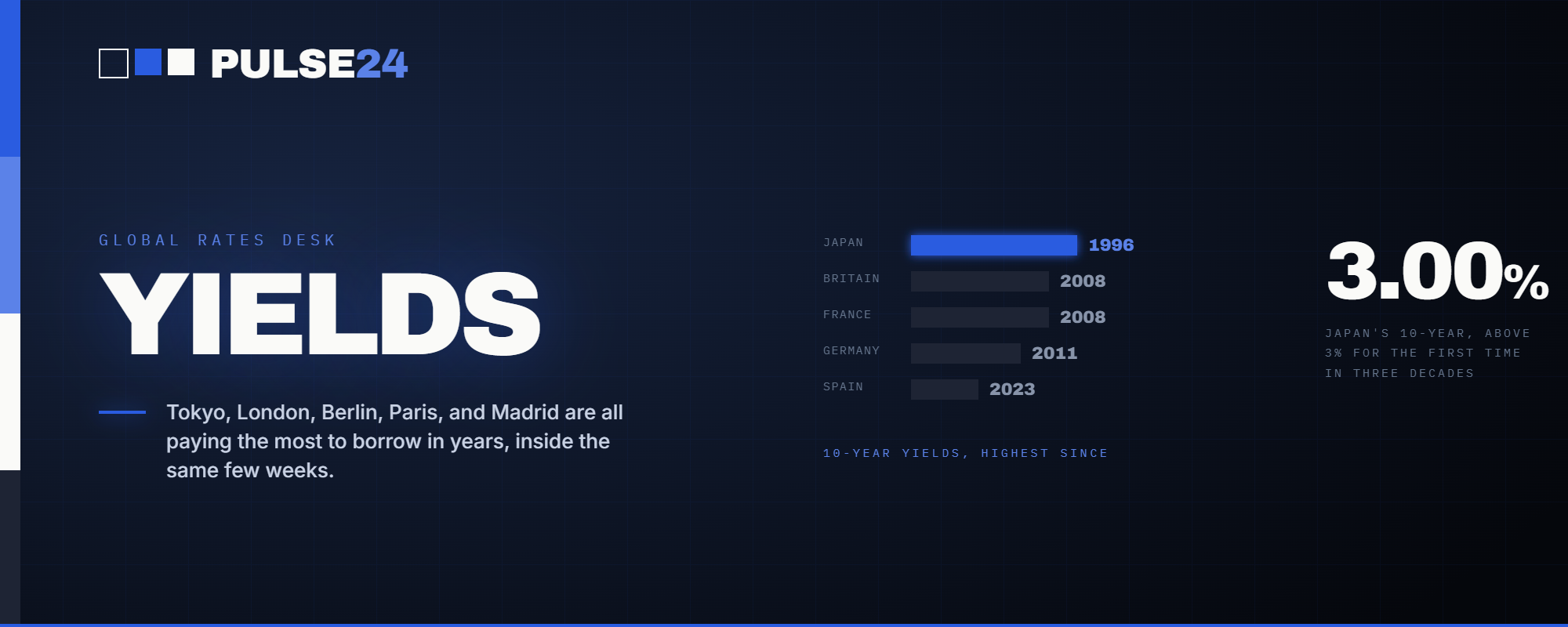
Government bond yields are climbing to multi-year and multi-decade highs from Tokyo to London to Berlin at the same time, and it isn't really about any single central bank anymore. Deficits, AI-driven debt issuance, and a run of hawkish policymakers are pulling global yields in the same direction all at once.
Japan's 10-year government bond yield closed above 3% this week for the first time since 1996. On its own, that would be a significant story for a country that spent most of three decades pinned near zero. Instead it's one line in a much bigger one: government borrowing costs are climbing to multi-year or multi-decade highs in Tokyo, London, Berlin, Paris, and Madrid, all inside the same few weeks.
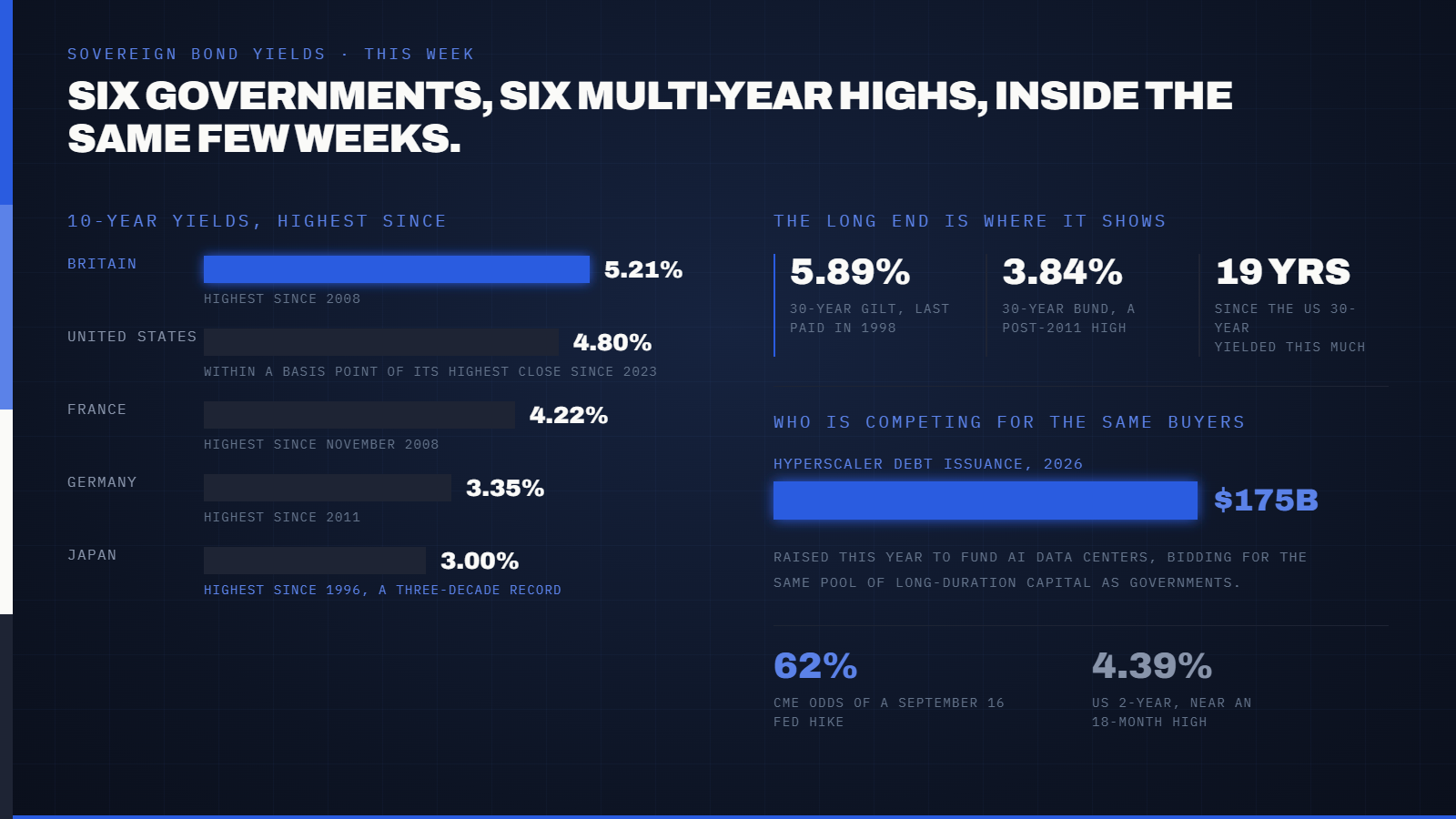
Britain's move might be the sharpest of the group. The 10-year gilt yield climbed to 5.21% on Tuesday, its highest since 2008, while the 30-year gilt touched roughly 5.89%, a level London hasn't paid since 1998. Germany's 10-year bund rose to about 3.35%, its highest since 2011, and the 30-year bund cleared 3.84%, also a post-2011 high. France's 10-year OAT climbed to 4.215%, a mark last seen before the 2008 financial crisis, and Spain's benchmark yield pushed above 3.80% for the first time since November 2023. None of these moves is small on its own. Viewed together, they describe a bond market repricing almost everywhere at once.
What Changed
The US hasn't been spared, either. Its 10-year Treasury touched close to 4.80% this week, a hair below its highest close since 2023, and the 2-year note, the maturity most sensitive to near-term Fed policy, pushed to about 4.39%, near an 18-month high. That's the same yield move that knocked gold down $103 in a single session earlier this week. The 30-year sits near its highest level in nineteen years, a climb that's tangled up with hyperscalers borrowing an estimated $175 billion this year alone to fund AI data centers, competing directly with governments for the same pool of long-duration buyers.
Central banks are pulling in the same direction almost everywhere. Fed Chair Kevin Warsh has used every public appearance since Jackson Hole to argue inflation risk isn't resolved, and CME futures now price the odds of a September 16 hike just above 62%, though that number has swung enough this week to suggest the market hasn't fully settled on it. In Japan, a Bank of Japan board member's public case for a jumbo 75 basis-point hike helped drag the yen and JGB yields in opposite directions at once. The European Central Bank is widely expected to raise its deposit rate at its next meeting after eurozone inflation climbed to 3.3% in August, a third straight monthly increase.
Why It Matters
Individually, each of these reads like a domestic story: a Fed chair worried about sticky inflation, a BOJ finally normalizing after decades near zero, an ECB responding to its own price data, a UK government facing skeptical bond buyers. Stacked on top of each other, the pattern looks like something else. Strategists have started using language that hasn't meant much since the 1990s: a bond vigilante moment. Economist Ed Yardeni has argued that investors are pushing yields higher in protest over government deficits that keep growing regardless of which party is in charge. State Street's Michael Metcalfe has made a related point, that the selloff has stopped being purely about the next rate decision and started reflecting longer-run doubts about how much debt these governments can keep issuing.
That distinction matters for more than bond traders. Every government on this list is running a deficit large enough that higher borrowing costs compound quickly. Higher long-term yields also raise the discount rate applied to future earnings, which is exactly the mechanism that makes growth stocks, AI infrastructure names included, more sensitive to a rate move than a stable utility would be. Mortgage rates, corporate borrowing costs, and emerging-market debt servicing all move off the same curve. When six major bond markets reprice in the same direction inside a few weeks, the ripple travels well past government auctions.
What to Watch Next
Friday's US jobs report is the next scheduled catalyst, arriving before the Fed's September 16 decision. A soft print would likely pull that 62% hike probability back down and give Treasury yields room to ease, much the way a weak report could reverse this week's move in gold. Should the report run hot instead, US yields would probably push further into territory the market hasn't tested since 2023.
The ECB meets shortly after, and a quarter-point hike is close to fully priced already. Japan is the less settled piece: another hawkish signal from the BOJ's board, or a weaker follow-through than the record $96 billion Tokyo already spent defending the yen this year, could keep JGB yields climbing even if the Fed and ECB decisions land as expected. Auction results are worth watching too. Weak demand at any of this month's long-bond sales, in the US, Japan, or Europe, would confirm this is closer to a genuine buyers' strike than a short-term repricing around known meeting dates.
The Pulse24 Take
Most weeks, a UK gilt story and a Japanese government bond story and a US Treasury story are three separate items with three separate explanations. This week they aren't, and that's the part worth paying attention to. Deficits that keep growing, AI-driven debt issuance competing for the same buyers, and central bankers who have run out of patience with above-target inflation aren't specific to any one country, which is why the yield moves in Tokyo, London, and Washington are lining up instead of canceling each other out. That doesn't mean a crisis is imminent. Bond markets have repriced sharply before and found their footing without much drama. But when three governments set multi-year yield records in the same month, the more useful question isn't which country's story explains it best. It's what happens to equity valuations, mortgage rates, and government budgets if this turns out to be the new range rather than a temporary spike.
How we read the data
Curious how we get from raw data to a take like this? Our Trader's Toolkit walks through the tools we lean on.
Explore the Toolkit