Pulse24 Original
Eurozone Inflation Climbed to 3.3% in August, a Third Straight Monthly Rise. The Euro Fell to $1.1568 Anyway, Because the Fed Is Every Bit as Hawkish.
September 2, 2026
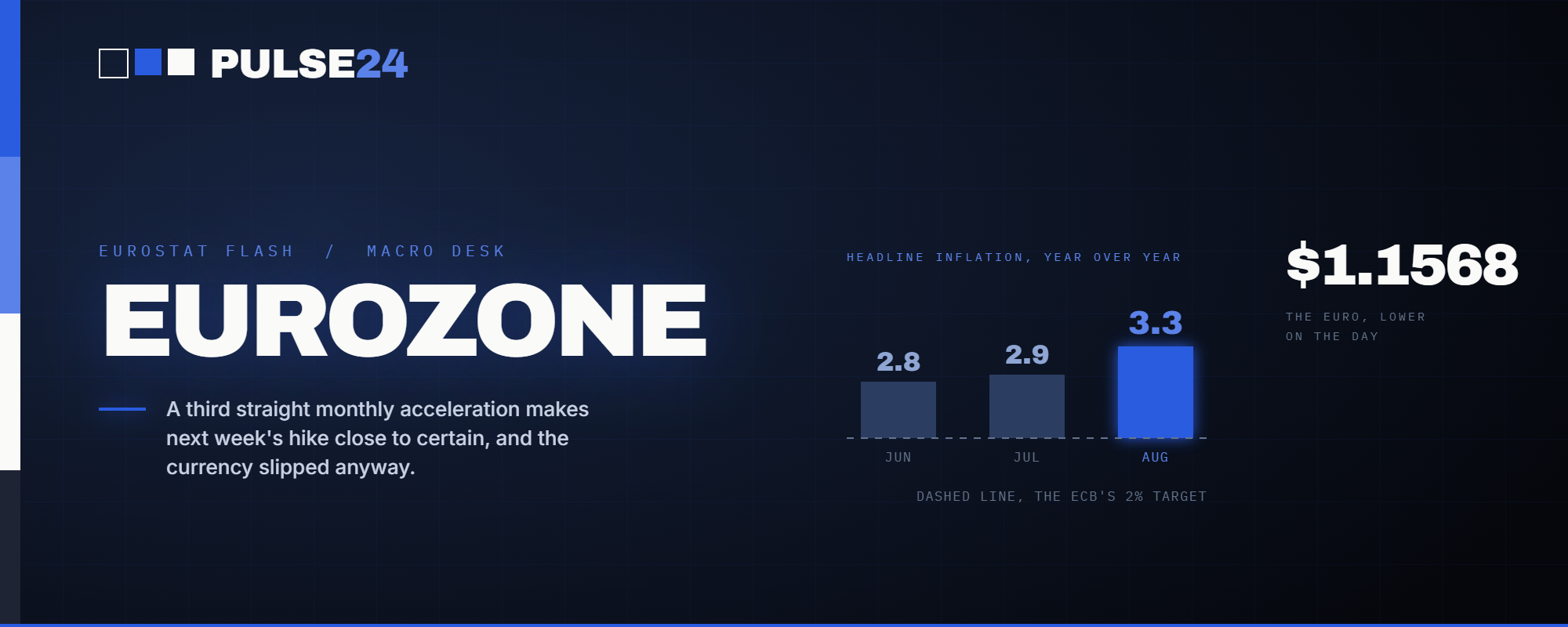
Eurozone inflation hit 3.3% in August, its third straight monthly acceleration and firmly above the ECB's target, making a rate hike at next week's meeting look close to certain. The euro slipped anyway, a sign traders think Washington's hawkishness matters more right now than Frankfurt's.
Eurozone inflation came in at 3.3% in August, according to Eurostat's flash estimate. That's up from 2.9% in July and 2.8% in June, the third straight monthly increase, and more than a full percentage point above the European Central Bank's 2% target.
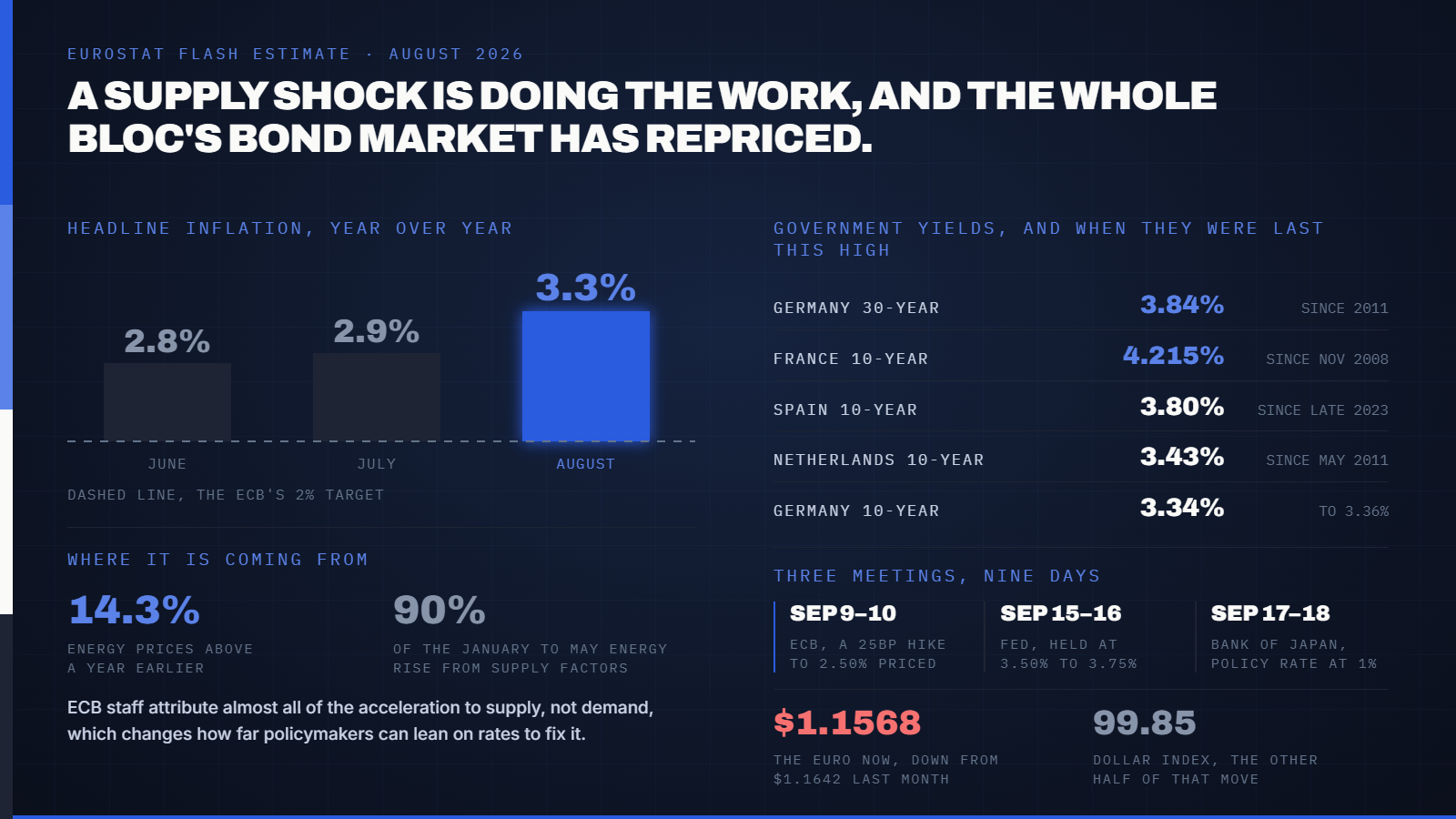
The number confirms what the ECB's own staff had already flagged. This isn't a demand-driven inflation problem like the one central banks fought in 2021 and 2022. Energy prices are now running 14.3% higher than a year ago, and ECB economists estimated that adverse supply factors accounted for roughly 90% of the increase in energy inflation between January and May alone. A supply shock is doing almost all of the work here, which changes how policymakers are likely to respond to it.
What Changed
Bond markets have been repricing for weeks, and August's print pushed that further. Germany's 10-year Bund yield is trading around 3.34% to 3.36%, and the 30-year has climbed above 3.84%, its highest level since 2011. France's 10-year OAT sits above 4.215%, a level the country hasn't seen since November 2008. Spain's 10-year is above 3.80%, its highest since late 2023, and the Netherlands' 10-year is at 3.43%, a level last touched in May 2011. These moves are happening across the currency bloc at once, not in one country's bonds alone, which is usually a sign that a market is pricing a shift in the entire policy path rather than one-off local factors.
What's less intuitive is what the euro did with all of this. A hawkish ECB should, in theory, support the currency, since higher rates make euro-denominated assets more attractive relative to dollars. Instead, the euro slipped to $1.1568, down slightly on the day and well off the $1.1642 high Pulse24 covered last month, when ECB Executive Board member Isabel Schnabel first made the public case for a September hike. The explanation isn't really about Frankfurt. It traces back to Washington. The dollar index has climbed toward 99.85, and futures markets are still working out how confident to be about the Fed's own hike on September 16. When two central banks are leaning hawkish at the same time, the exchange rate between them can end up moving less on either country's own data and more on whichever side's resolve investors trust further.
Why It Matters
The ECB's Governing Council meets September 9-10 in Berlin, and a 25-basis-point hike to 2.50% is close to fully priced at this point. That would mark the second increase since June, when the ECB raised rates for the first time in three years. What's notable is how little debate remains over whether the ECB moves at all. The argument has shifted to whether one hike is enough, or whether an energy shock this persistent forces a longer campaign. Eurozone growth has also been running ahead of forecasts, which removes one of the arguments policymakers might otherwise lean on to justify patience.
None of this is happening in isolation. The Fed's target range has sat at 3.50% to 3.75% for five straight meetings, the lowest it's been since November 2022, and the Federal Open Market Committee meets September 15-16, a week after the ECB. The Bank of Japan, which raised its own policy rate to 1% in June, its highest level since 1995, meets September 17-18, and bets on another hike there have built after a record currency intervention failed to hold the yen below 160, with Governor Ueda himself hinting this week that a September move is increasingly likely. Three of the world's most consequential central banks are converging on rate decisions inside an eight-day window, each pushed there by a different problem: an energy shock in Europe, a labor market the Fed isn't fully convinced is cooling on its own terms, and a currency Japan can't defend through intervention alone. That's a lot of simultaneous tightening risk for a market that spent most of 2024 and 2025 pricing rate cuts as the more likely path.
What to Watch Next
Three dates matter most from here. The ECB decides September 10, and the real question probably isn't whether it hikes, that part looks close to settled, but whether President Lagarde's press conference leaves the door open to a second move before year-end or closes it. The Fed follows on September 16, where a decision this close will still hinge on the jobs and CPI data landing in between. The Bank of Japan closes out the stretch on September 18. Watch German Bund yields and the euro together rather than in isolation. If the currency keeps falling even as yields keep climbing, that's a signal dollar strength, not eurozone weakness, is still the dominant force in currency markets right now. A reversal in that pattern, a stronger euro alongside higher Bund yields, would suggest the market is starting to price European tightening on its own merits again.
The Pulse24 Take
The headline number here, 3.3%, isn't the interesting part on its own. Inflation prints bounce around, and a single month rarely changes a central bank's course by itself. What's interesting is the pattern underneath it: three consecutive months of acceleration, a supply-side energy shock doing nearly all of the work, and a currency that isn't rewarding the central bank actually tightening into it. That last piece deserves the most attention. Investors have long assumed that whichever central bank hikes first, or hikes hardest, gets paid with a stronger currency. August's data is a reminder that relative hawkishness tends to matter more than absolute hawkishness, and right now the market seems to think Washington's resolve outweighs Frankfurt's.
For anyone tracking September's central bank calendar, the lesson isn't to bet on any single decision landing a particular way. It's to notice that three major economies are approaching monetary policy from three different starting points and arriving in similar territory anyway. Convergence like that doesn't happen often, and when it has in the past, it has tended to show up first in bond markets. The moves already underway in German and French yields suggest investors aren't waiting for confirmation before acting on it.
How we read the data
Curious how we get from raw data to a take like this? Our Trader's Toolkit walks through the tools we lean on.
Explore the Toolkit