Pulse24 Original
Eurozone Core Inflation Rose to 2.5% in July, Up From 2.4% in June. The ECB's Isabel Schnabel Says That's Reason Enough to Raise Rates Again in September.
August 27, 2026
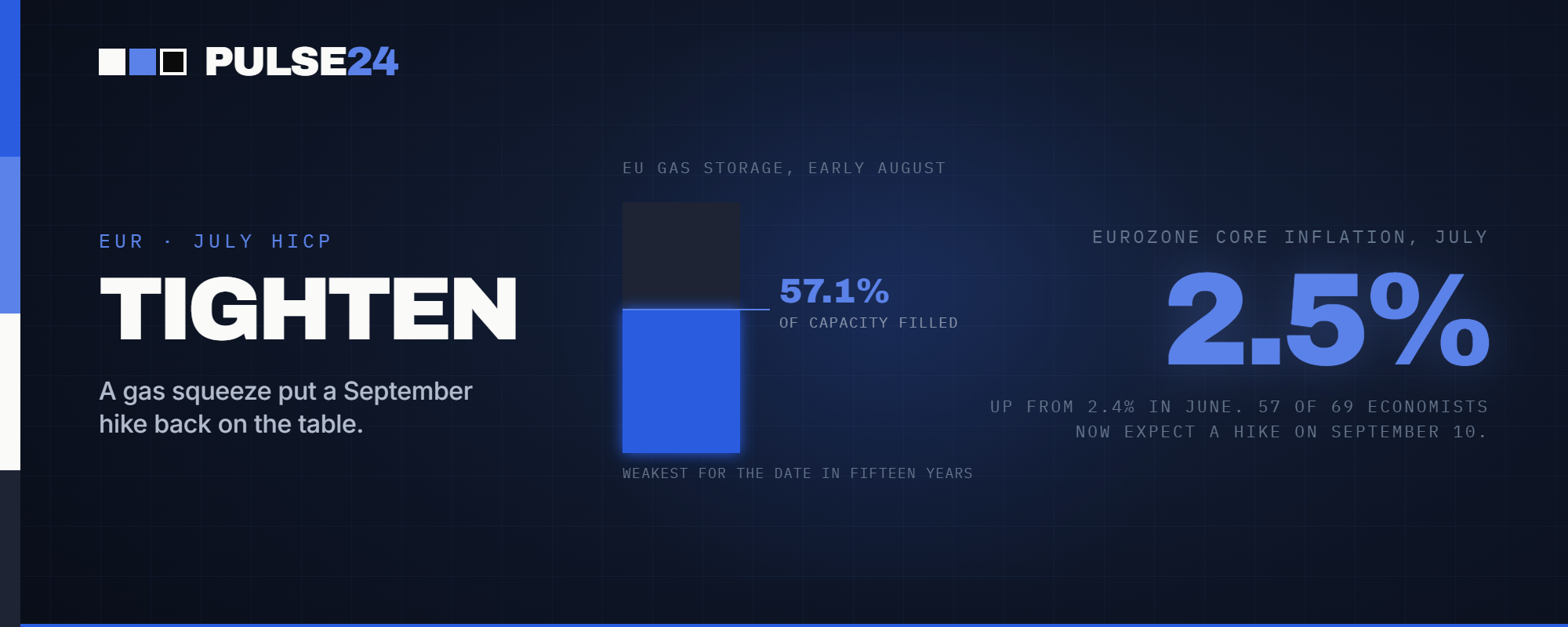
Eurozone core inflation accelerated to 2.5% in July and the ECB's Isabel Schnabel says the current policy rate still won't bring it back to target. A Reuters poll now shows most economists expecting a September hike, even as European gas prices climb toward their highest level since early 2023.
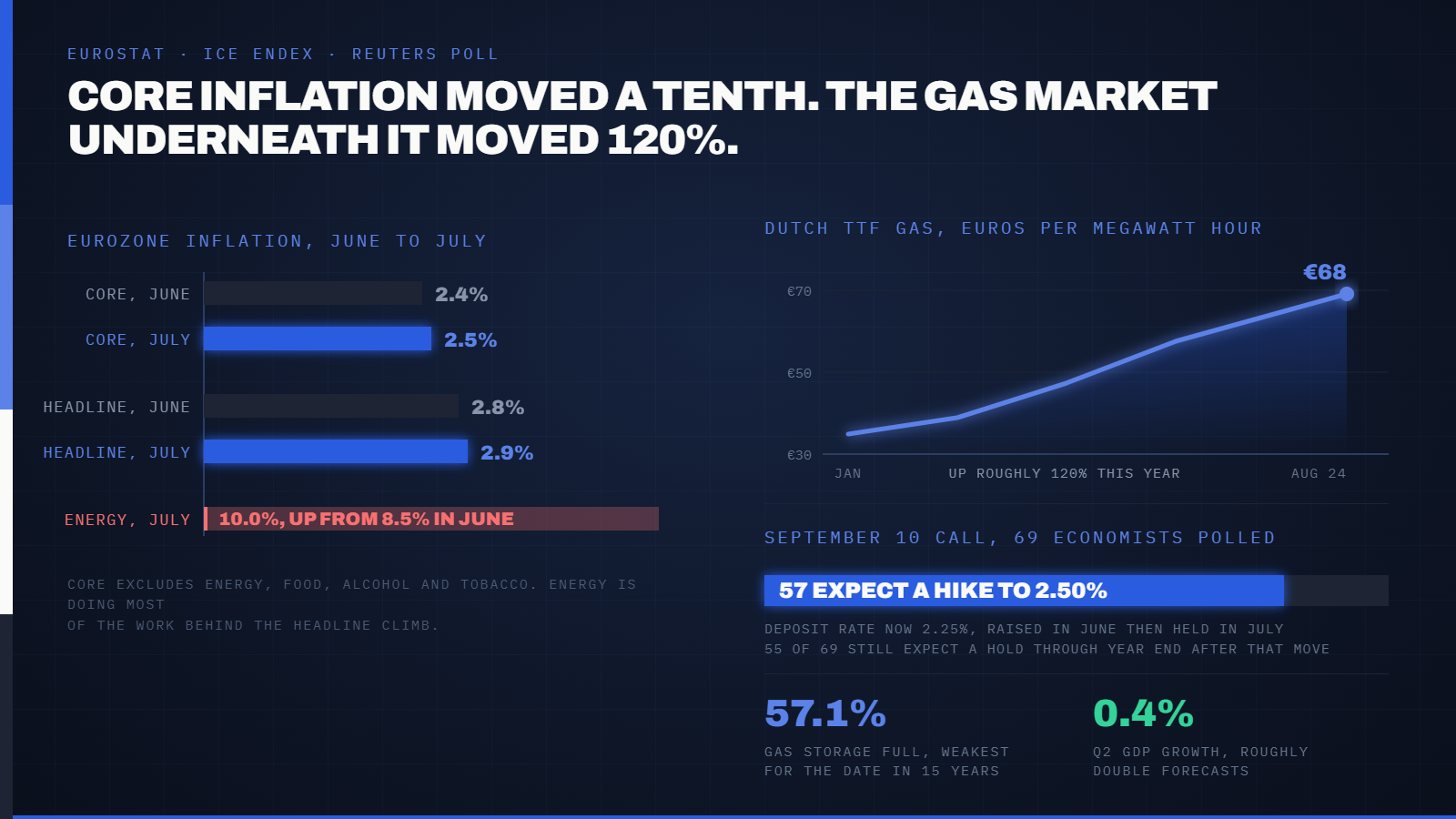
Eurozone core inflation climbed to 2.5% in July, up from 2.4% in June, according to Eurostat's confirmed reading. Headline inflation moved to 2.9% from 2.8% over the same month. Neither figure looks alarming in isolation. Together, arriving about a month after the European Central Bank paused following a June rate increase, they gave Executive Board member Isabel Schnabel enough room to make her most direct public case yet for raising borrowing costs again.
What Changed
The ECB raised its deposit rate by a quarter point in June, taking it to 2.25%, then held steady in July. At the time, policymakers pointed to softer inflation, cooling wage growth, and easing inflation expectations as reasons the urgency for another move had faded. That reasoning is now under pressure. Schnabel told Bloomberg this week that the current policy setting won't bring inflation back to the ECB's 2% target on a reasonable timeline, and that further tightening will be necessary. A Reuters poll published this month found 57 of 69 economists now expect that hike, up from prior surveys, which would take the deposit rate to 2.50%. Still, 55 of those 69 expect the ECB to hold there through the rest of the year rather than follow with a second increase, suggesting the live debate is about one move, not a new hiking cycle.
Two developments explain the shift. Eurozone GDP grew 0.4% quarter over quarter in the second quarter, roughly double what economists had penciled in, putting annual growth near 1%. An economy expanding faster than expected gives a central bank less reason to worry about tightening into weakness. The bigger driver is energy. Dutch TTF gas, the contract European utilities and industry actually price off, has risen about 120% since January and touched its highest level since January 2023 in late August. Storage across the bloc sat at just 57.1% full in early August, its weakest reading for that point in the calendar year in records stretching back more than 15 years. Norwegian field outages cut supply at an inconvenient moment, a summer drought reduced hydroelectric and nuclear output in several countries, and a heatwave pushed electricity demand higher, forcing utilities to burn gas that would normally be going into storage for winter. Energy inflation ran at 10% year over year in July, up from 8.5% in June, and it's doing most of the work behind the headline number's climb.
Why It Matters
A hike to 2.50% would extend a reversal that began with June's increase, the ECB's first rate hike since 2023, and would mark two moves in three months if policymakers follow through in September. Markets have started to reprice around that possibility. The euro has traded near $1.1642, its strongest level against the dollar since mid-May and up more than 2% over the past month. The dollar's own slide to a three-month low earlier this month is part of that story, but a more hawkish ECB adds an independent push higher for the currency, which in turn makes European exports less competitive and imported goods cheaper, a modest disinflationary offset to the energy shock. Germany's 10-year Bund yield sits around 3.24%, not far from the 15-year high just above 3.27% it touched last week, consistent with a market that has been pricing in a more hawkish ECB for weeks.
The timing lines up with a broader pattern this cycle. Investors have spent August recalibrating just how done central banks actually are with raising rates, not just in Frankfurt. The Fed's own July meeting produced its most hawkish dissent since 2016, with three regional presidents favoring a hike over a hold, and futures markets are pricing roughly one-in-three odds of a September increase there too. The ECB and the Fed are reaching similar territory from different starting points, one pushed by an energy shock and resilient growth, the other by a private-demand economy that keeps outrunning its headline growth figure. Neither institution is coordinating with the other, but a market that had spent most of 2025 pricing rate cuts across developed economies is now having to price the opposite scenario in more than one place at once.
What to Watch Next
The ECB's Governing Council meets September 9-10, and the Schnabel remarks make that decision considerably closer to a coin flip than it looked a month ago. Watch the flash eurozone inflation print due in the final week of August for confirmation that the energy-driven acceleration is holding, and watch whether gas storage keeps falling short of its seasonal norms heading into the heating season. September is shaping up as a crowded month for central banks more broadly: the Fed's Kevin Warsh delivers his first Jackson Hole address on Friday, the Fed itself decides on September 16, and the Bank of Japan has its own rate decision to navigate the same month. A eurozone hike wouldn't happen in a vacuum. Whether the ECB actually follows through, or whether cooler August data gives it room to wait one more cycle, will say a lot about how much conviction sits behind Schnabel's comments versus how many of her colleagues actually agree with her.
The Pulse24 Take
What's notable here isn't that a single ECB board member wants higher rates. Hawks exist on every rate-setting committee, and Schnabel has been one of the more consistent voices for vigilance since well before this cycle. What's notable is the speed of the reversal in the ECB's own stated reasoning, from citing reduced urgency in July to describing further tightening as necessary about a month later, without a dramatic single event forcing the change. A slow-burning gas storage shortfall and an upside growth surprise did the work instead, and both are the kind of unglamorous, unshowy data points that rarely make headlines on their own but add up to a real shift in policy risk.
For markets, the practical takeaway is that the era of assuming global rate paths only point one direction is over, if it was ever true to begin with. A stronger euro and higher Bund yields are the more immediate, tradable consequences here, but the more useful lesson is about how quickly a central bank's own framing can flip when the underlying data moves. Whatever the Fed decides in September, and whatever Warsh says at Jackson Hole, the ECB has just demonstrated that about a month of unfavorable inflation and growth data is enough to turn a pause back into a live hike debate. That's a dynamic worth watching everywhere rate-setters are currently telling markets they're on hold.
How we read the data
Curious how we get from raw data to a take like this? Our Trader's Toolkit walks through the tools we lean on.
Explore the Toolkit