Pulse24 Original
The Dollar Index Just Sank to a Three-Month Low of 98.65, Down Nearly 1% This Week. The Treasury's Bond Buybacks Were Supposed to Calm Yields, Not Break the Currency.
August 21, 2026
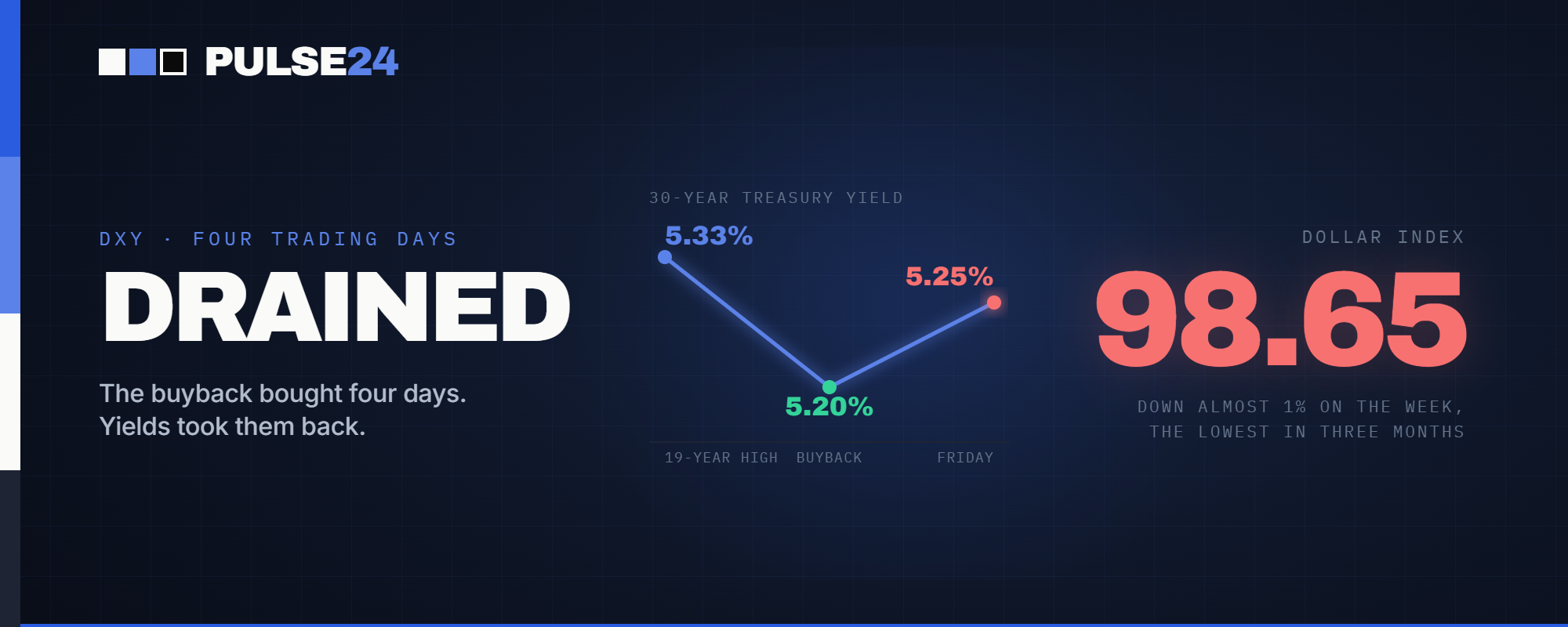
The Treasury doubled its bond buybacks six days ago to cool a 5.3% yield on the 30-year. Now that yield is creeping back toward 5.25%, the dollar just touched a three-month low, and gold is on pace for a third straight weekly gain.
Six days ago, the Treasury doubled the minimum size of its long-bond buybacks to pull the 30-year yield back from a fresh 19-year high near 5.33%. It worked, for about four trading days. By Friday morning the 30-year was back near 5.25%, the Dollar Index had slipped to roughly 98.65, its weakest level in three months, and gold was trading above $4,540 an ounce on pace for a third straight weekly gain. The bond market got its reprieve last week. This week the currency market is absorbing the bill.
What Changed
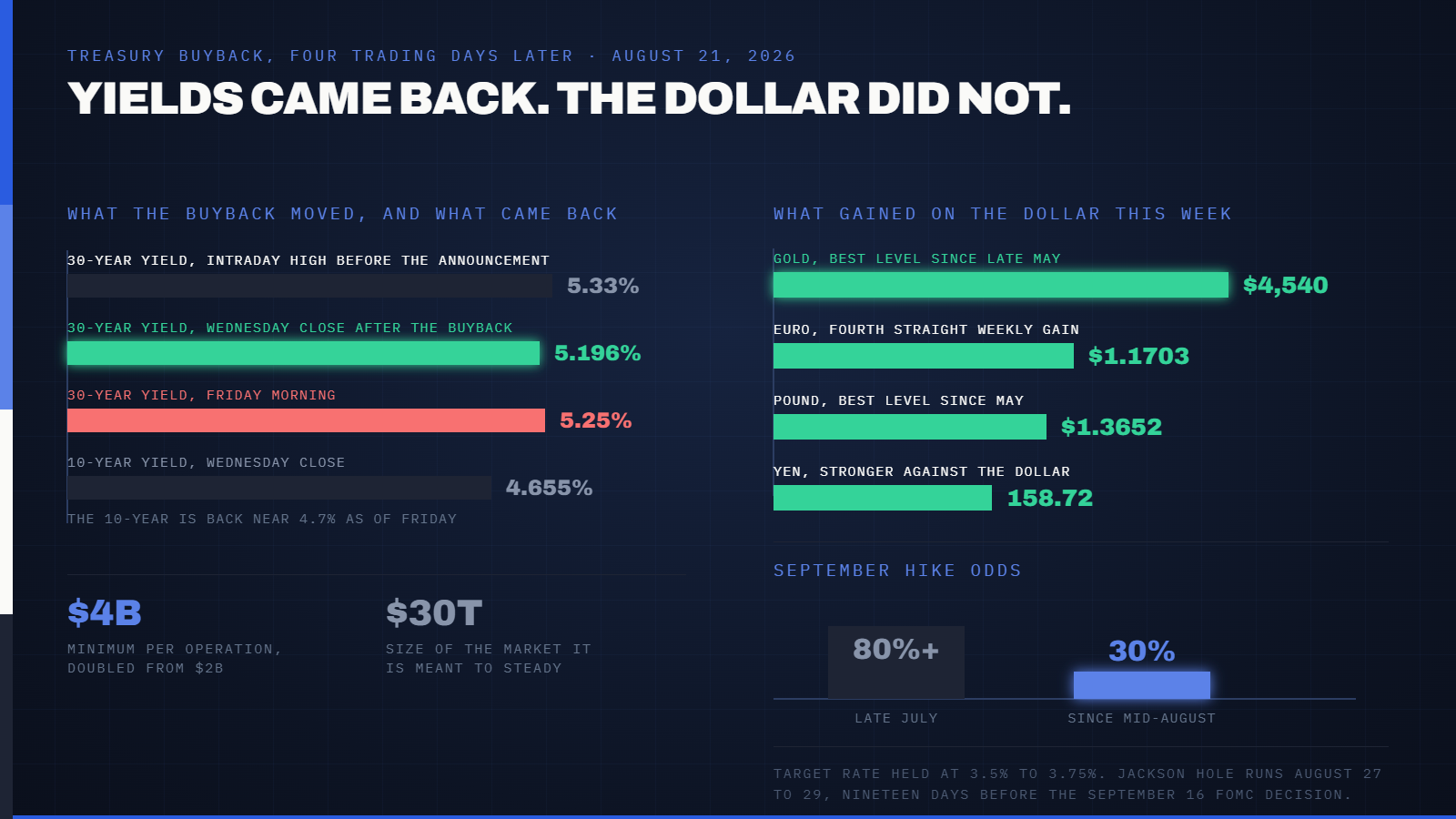
Treasury's move last Wednesday doubled the minimum size of its liquidity support buybacks for 10-to-20-year and 20-to-30-year debt, from $2 billion to at least $4 billion per operation, starting September 9. The announcement landed outside the normal quarterly refunding calendar, and it had an immediate effect. The 30-year yield, which had touched an intraday high near 5.33%, a level not seen since 2007, reversed to close near 5.196% that same session. Gold jumped more than 3%, the dollar eased, and Bitcoin cleared $68,000.
Four trading days later, most of that relief has drained back out. The 30-year climbed to roughly 5.25% by Friday morning, and the 10-year, which had eased to 4.655% on Wednesday, was holding near 4.7%. The Dollar Index kept sliding even as yields firmed back up, a combination that doesn't usually happen together. Higher yields are supposed to attract foreign buyers into dollar assets and support the currency. This week they didn't.
Why It Matters
Capital Economics' Jonas Goltermann summed up the currency market's read on the whole episode: "When it comes to the dollar, even the hint of financial repression and more unconventional policy is unhelpful." The concern was never really about the size of the operation. Four billion dollars a session barely registers against a Treasury market worth roughly $30 trillion. What unsettled traders was the timing, a government stepping outside its own refunding calendar to lean on long-end yields, and what that might signal about where policy goes next if borrowing costs keep climbing.
DBS Group Research made a related point about the limits of the tool itself. Without a real change to the fiscal trajectory, the bank argued, tweaks to buyback size can only have a small, transient impact on markets. That's close to what happened. The relief in yields lasted a matter of days, and the pressure simply resurfaced somewhere else, first in gold and Bitcoin last Wednesday, now in the dollar itself.
Gold has been the steadier beneficiary of the two. It's extended a rally that had already carried it from around $4,419 an ounce a few weeks earlier, and Friday's price near $4,540 puts it within reach of its best level since late May. A softer dollar makes gold cheaper for holders of other currencies, and any hint of unconventional Treasury intervention gives investors another reason to hold an asset nobody can print more of. Other currencies picked up ground too. The euro rose to $1.1703, its fourth straight weekly gain, the pound climbed to $1.3652, its best level since May, and the yen strengthened to roughly 158.72.
What To Watch Next
Friday's flash PMI releases out of the US, UK, and eurozone are the next data point with a real shot at moving yields, and by extension the dollar, in either direction. A soft reading would reinforce the idea that growth is cooling even as inflation stays elevated, the kind of combination that keeps real yields pinned down regardless of what the Fed does with its own policy rate.
St. Louis Fed President Alberto Musalem addressed the tension directly on Thursday, telling reporters the bond market's recent pain doesn't reflect any loss of confidence in the Fed's credibility. That argument gets a bigger test next week. The Kansas City Fed's Jackson Hole symposium runs August 27 through 29 in Wyoming, and new Fed Chair Kevin Warsh delivers his first keynote there on Friday the 28th, just 19 days before the September 16 FOMC decision. September hike odds, which topped 80% in late July, have settled near 30% since mid-August after a weak July jobs report, and whatever Warsh says about the deficit, the dollar, and the pace of future hikes will move all three markets covered here at once.
The Pulse24 Take
This week's lesson has less to do with whether the Treasury's buyback failed and more to do with what a $4 billion operation could realistically fix: a problem rooted in deficits, issuance volume, and a buyer base asking to be paid more to hold long-dated government debt. Yields eased for a few days because the announcement carried information, not because the underlying math changed. Officials in Washington are uncomfortable with 5.3% on the 30-year, and markets priced that discomfort in before the number drifted back toward where it started.
What's shifted is where that discomfort is showing up. Last week it appeared in bond yields. This week it's the dollar and gold carrying the signal instead, even with Musalem's Fed still leaning hawkish and the target rate unchanged at 3.5% to 3.75%. That combination, a hawkish Fed and a weakening currency at the same time, is unusual, and it's worth watching whether it holds or whether one side gives way once Warsh takes the stage at Jackson Hole. Either the dollar stabilizes as the market recalibrates around Fed rhetoric, or the currency move turns out to be the more accurate read on where fiscal pressure is actually headed. Next week should start to answer that.
How we read the data
Curious how we get from raw data to a take like this? Our Trader's Toolkit walks through the tools we lean on.
Explore the Toolkit