Pulse24 Original
The Yen Slid Back to 159 to the Dollar, Giving Up Nearly All the Ground a $59 Billion Intervention Bought It. Now the BOJ's September Rate Decision Has to Do What the Currency Purchase Couldn't.
August 23, 2026
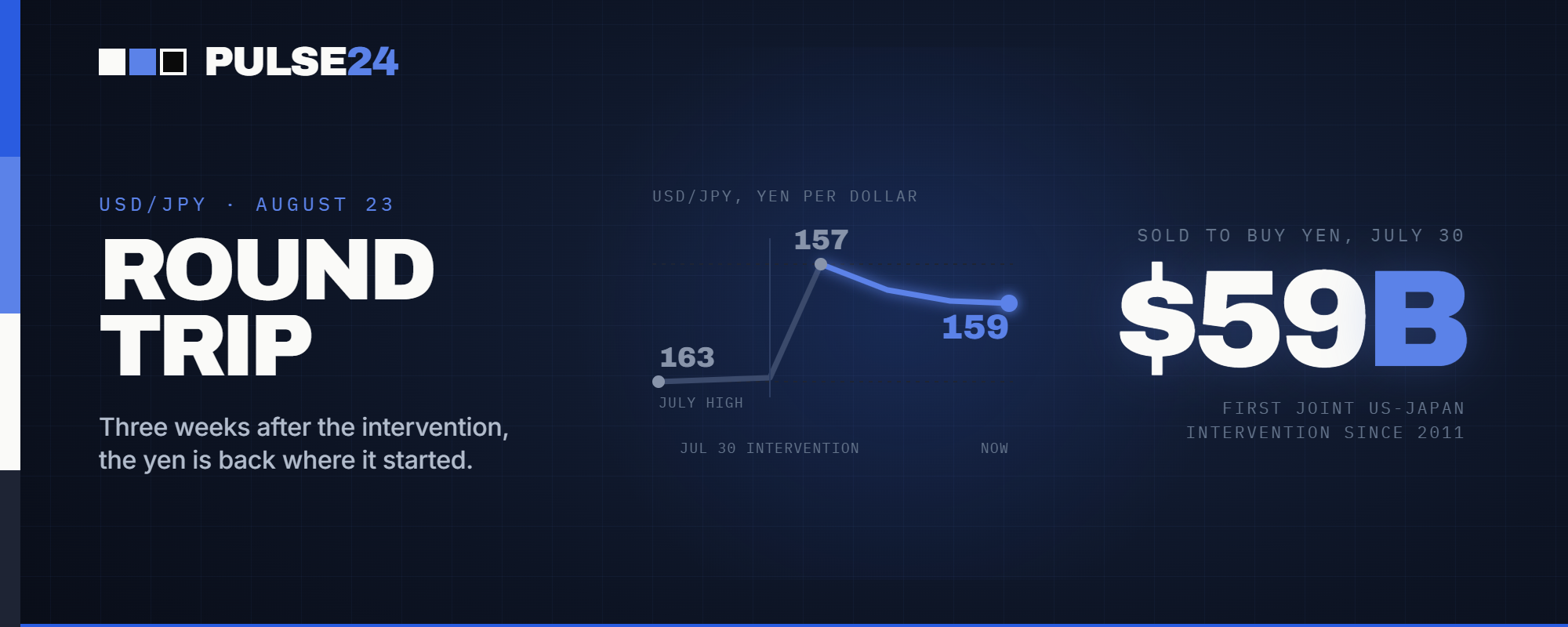
The yen has drifted back to roughly 159 per dollar, giving up nearly all the ground a $59 billion Japan-US intervention bought it three weeks ago. The Bank of Japan's September rate decision now carries the added weight of a carry trade unwind that broke markets the last time this happened, in August 2024.
The yen traded at roughly 159 to the dollar this week, just below where it stood three weeks ago before Japan's finance ministry spent an estimated $59 billion trying to push it higher. That intervention, joined by the US Treasury for the first time since 2011, bought the currency about four good trading days. Most of the move has already come back out.
What Changed
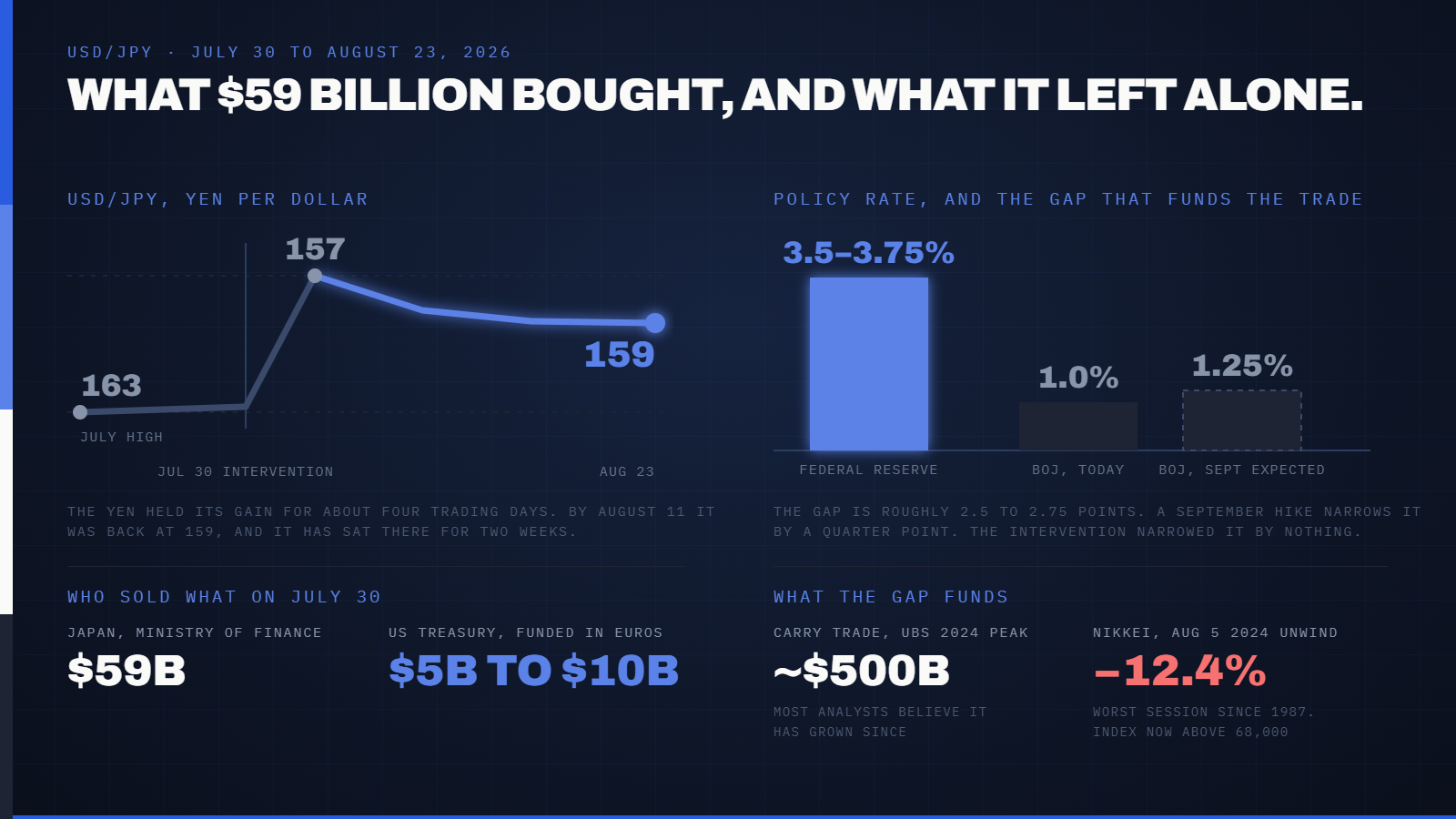
Japan's Ministry of Finance sold roughly $59 billion on July 30 to buy yen, pulling the dollar down from a July high near 163 to about 157 within days. Washington's involvement was smaller but unusual. Treasury Secretary Scott Bessent's own notes put the US contribution at $5 billion to $10 billion, and the Treasury funded its share by selling euros rather than dollars, a workaround meant to limit how much of its own currency it had to part with.
The relief didn't last long. Japan's 10-year bond yield, already sitting at its highest level since 1996 on questions over how Tokyo pays for a proposed food tax cut and a 370 trillion yen investment plan, kept climbing even as the currency briefly stabilized. By August 11 the yen had slid back to 159. It has held roughly there for two weeks since.
Why It Matters
The math behind the slide hasn't changed. The Federal Reserve's target rate sits at 3.5% to 3.75%, versus 1.0% at the BOJ, and that gap is what funds the carry trade: borrow cheap yen, invest it in higher-yielding dollar assets, pocket the spread. Estimates of the trade's total size vary widely and shift with the currency itself. UBS pegged the dollar-yen carry trade at roughly $500 billion at its 2024 peak, and most analysts believe it has grown since, though nobody has a precise current figure. A one-time currency purchase doesn't close that gap. Goldman Sachs analysts described the intervention's likely effect as buying time rather than fixing anything structural.
That's why the September 17-18 BOJ meeting matters more than a typical rate decision. Traders are positioning for a hike that would take the policy rate to roughly 1.25%, narrowing the funding gap and, in theory, taking some pressure off the yen. The last time the BOJ raised rates into a stretched carry trade, in August 2024, a 25 basis point increase helped trigger the Nikkei's worst single session since 1987. The index has more than recovered since then, trading near record territory above 68,000 in mid-August, and that recovery is itself part of the risk. A bigger index has more room to fall if unwinding leveraged yen positions forces a scramble for liquidity.
What To Watch Next
Whether USD/JPY holds below 160 through early September is the level Tokyo is watching most closely. Dollar weakness has shown up elsewhere too, with the broader Dollar Index recently touching a three-month low, so a fresh leg down in the greenback could do some of the BOJ's work without it lifting a hand. If the pair pushes back toward 163, expect louder talk of a second intervention, and possibly the FIMA repo facility expansion Bessent has been requesting from the Fed to make future yen purchases easier to fund.
The BOJ's own communication in the run-up to September 17 will matter almost as much as the decision itself. After the 2024 episode, officials learned that a hike delivered without clear signaling can catch leveraged positions flat-footed. Governor Ueda's public remarks between now and the meeting are the market's best clue for how the central bank plans to avoid a repeat.
The Pulse24 Take
Currency intervention is a stalling tactic more than a solution. It rarely addresses the reason the currency fell in the first place. Japan and the US spent tens of billions of dollars combined to push the yen up, and within two weeks the currency had given most of it back, because the underlying force, a nearly three-point gap between American and Japanese interest rates, was never touched by the purchase itself.
The BOJ hiking rates in September isn't the surprise. Markets have priced that in for months. What matters more is whether the meeting avoids the timing problem that made August 2024's hike so damaging, a rate increase landing on a carry trade that was already stretched thin. Watch how the yen and Japanese equities behave in the two weeks before the decision, not just the decision itself, for the clearest read on whether this one goes more smoothly.
How we read the data
Curious how we get from raw data to a take like this? Our Trader's Toolkit walks through the tools we lean on.
Explore the Toolkit