Pulse24 Original
Three Fed Presidents Dissented for a Rate Hike in July, the First Time That's Happened Since 2016. The Minutes Explaining Why Landed Nine Days After the Data That Undercut Their Case.
August 19, 2026
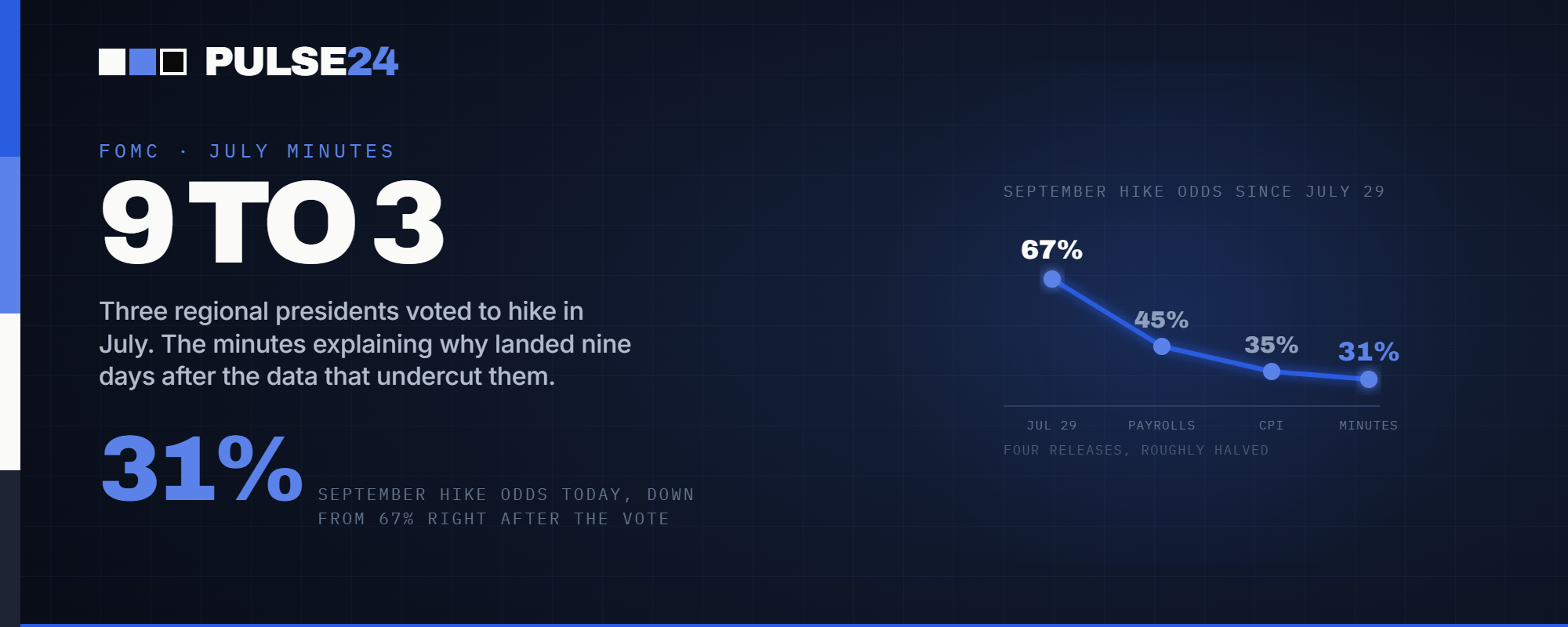
The Fed held rates at 3.50% to 3.75% in July by a 9-3 vote, the first time three officials have dissented in the same direction since 2016. Minutes released Wednesday show the hawkish case ran deeper than the vote count, even as a month of weak data has cut September hike odds roughly in half since the meeting.
Three of the Federal Reserve's twelve voting officials wanted to raise interest rates on July 29. Nine wanted to hold. That basic math has been public since the meeting itself, but the reasoning behind it stayed sealed until Wednesday, when the Fed released the minutes, three weeks after the vote and, more tellingly, nine days after a jobs report that quietly undercut the dissenters' case.
Beth Hammack of the Cleveland Fed, Neel Kashkari of Minneapolis and Lorie Logan of Dallas each pushed for a quarter-point increase to the federal funds rate, which stayed at 3.50% to 3.75%. No Washington-based governor joined them. Three regional presidents dissenting in the same direction on the same day hasn't happened since 2016, which is part of why traders had been waiting for these minutes to explain what those three were seeing that the other nine weren't.
What the Minutes Revealed
The text suggests the hawkish lean wasn't confined to three seats. Participants said policy tightening "would likely be necessary if inflation did not decline," and some felt financial conditions weren't restrictive enough to bring inflation back to the Fed's 2% target. A few members went further, arguing an immediate hike "would likely help forestall the need for a steeper and potentially more costly sequence of tightening moves at a later stage." That's a committee weighing compounding risk, not just reacting to one report.
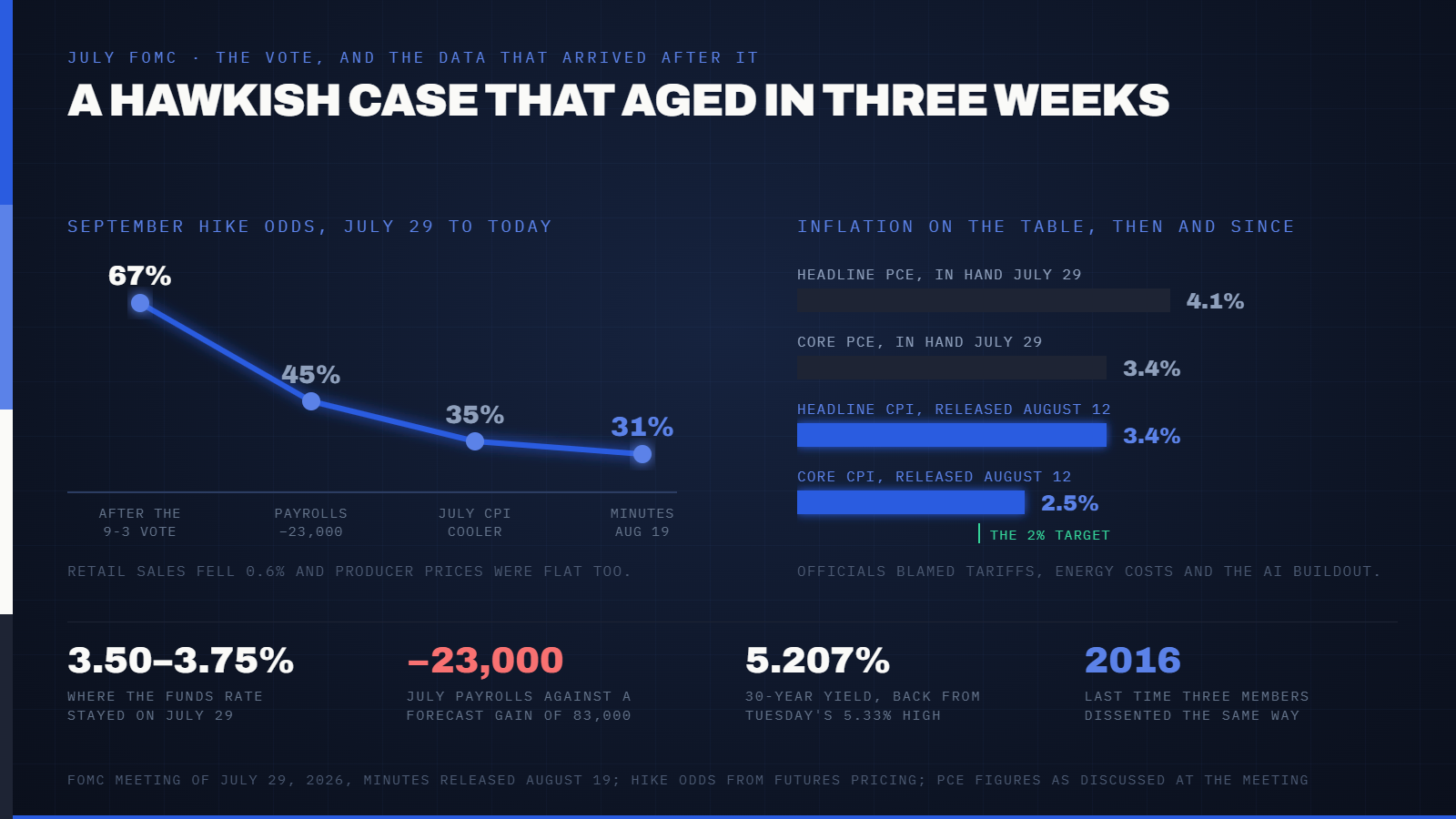
The inflation numbers on the table that day explain the concern. Core PCE inflation, the Fed's preferred gauge, ran at 3.4% in the May reading policymakers had in hand, with headline PCE at 4.1%. Officials cited tariffs, elevated Middle East energy costs and price pressures tied to AI infrastructure, from data-center materials like chips and steel to consumer electricity costs, as forces that could keep those numbers sticky. Fed Chair Kevin Warsh has framed the stakes plainly in public remarks this month: there is no soft version of the Fed's inflation target, only the 2% line itself.
The Data That Overtook the Vote
Timing is the whole story here. Four reports landed after the July meeting adjourned and before Wednesday's release, and each one chipped away at the case Hammack, Kashkari and Logan were making. July payrolls came in at negative 23,000, a sharp miss against a forecast gain of roughly 83,000. July's CPI report, released August 12, showed headline inflation at 3.4% and core at 2.5%, both cooler than the figures the committee had discussed weeks earlier. Producer prices were flat, and retail sales fell 0.6%. None of that existed when the three presidents cast their votes.
Traders adjusted in step. September hike odds stood near 67% right after the July meeting. Weak payrolls knocked that into the 40s, and the CPI report trimmed it further still. By the time the minutes actually arrived, pricing had settled around 31%, roughly half of where it started, extending a drift Pulse24 has tracked since retail sales alone cut the odds to 29% last week.
Markets Barely Blinked
What stands out about Wednesday has less to do with the minutes themselves than with how quietly markets absorbed them. A document confirming three hawkish dissents and a broader internal tightening debate would normally be expected to push yields higher, not lower. Instead, the 10-year Treasury yield fell to 4.65% and the 30-year to 5.207%, down from Tuesday's fresh 19-year high of 5.33%, an escalation from the 5.29% level it touched Monday.
A separate announcement turned out to be the bigger catalyst. Hours after the minutes dropped, the Treasury Department said it would double the size of its long-bond buyback operations, to at least $4 billion per transaction from $2 billion, running from September 9 through November 4. That's a direct attempt to soak up some of the long-dated supply that's been pushing yields higher for weeks, and traders treated it as the more actionable news of the two releases that landed Wednesday. The dollar index, meanwhile, sits at 99.65, still hovering near its weakest levels in months.
Minutes describe a meeting that ended three weeks ago. Markets trade on whatever changes the outlook today, and Wednesday handed them a Treasury Department more willing to intervene rather than fresh evidence about where the Fed is headed next.
What to Watch Next
The Kansas City Fed's Jackson Hole symposium runs August 27 through 29, with Warsh delivering his first keynote as chair on the 28th, less than three weeks before the Fed's September 16 decision. Investors will be listening for whether he leans on the minutes' hawkish undertone or acknowledges how much the data has shifted since July. The August jobs report, due in early September, carries outsized weight given how much July's miss already moved the odds. Hiring that rebounds would revive the case Hammack, Kashkari and Logan made. Another soft print would likely bury it for good.
The Pulse24 Take
Wednesday's minutes are easy to wave off as old news dressed up as a headline, and markets clearly treated them that way, especially once the Treasury's buyback news gave traders something more actionable to react to. But one detail is worth sitting with longer than the muted price action suggests. The hawkish argument inside that room ran well past the three officials who actually voted for it, which means the committee's center of gravity was closer to a hike than a 9-3 count implies. Four weeks of data arriving after the vote, not any change of heart among the doves, made the hawks' case harder to defend in public, even if some of them still believe it. Traders pricing a 31% chance of a September hike are betting that pattern holds. Hammack, Kashkari and Logan are betting the next jobs report proves them right instead.
How we read the data
Curious how we get from raw data to a take like this? Our Trader's Toolkit walks through the tools we lean on.
Explore the Toolkit