Pulse24 Original
US Consumer Sentiment Just Sank to 51.0, Badly Missing the 54.5 Estimate. Inflation Expectations Rose to 4.3% in the Same Report, Just as the Fed Leans Toward a September Hike.
August 16, 2026
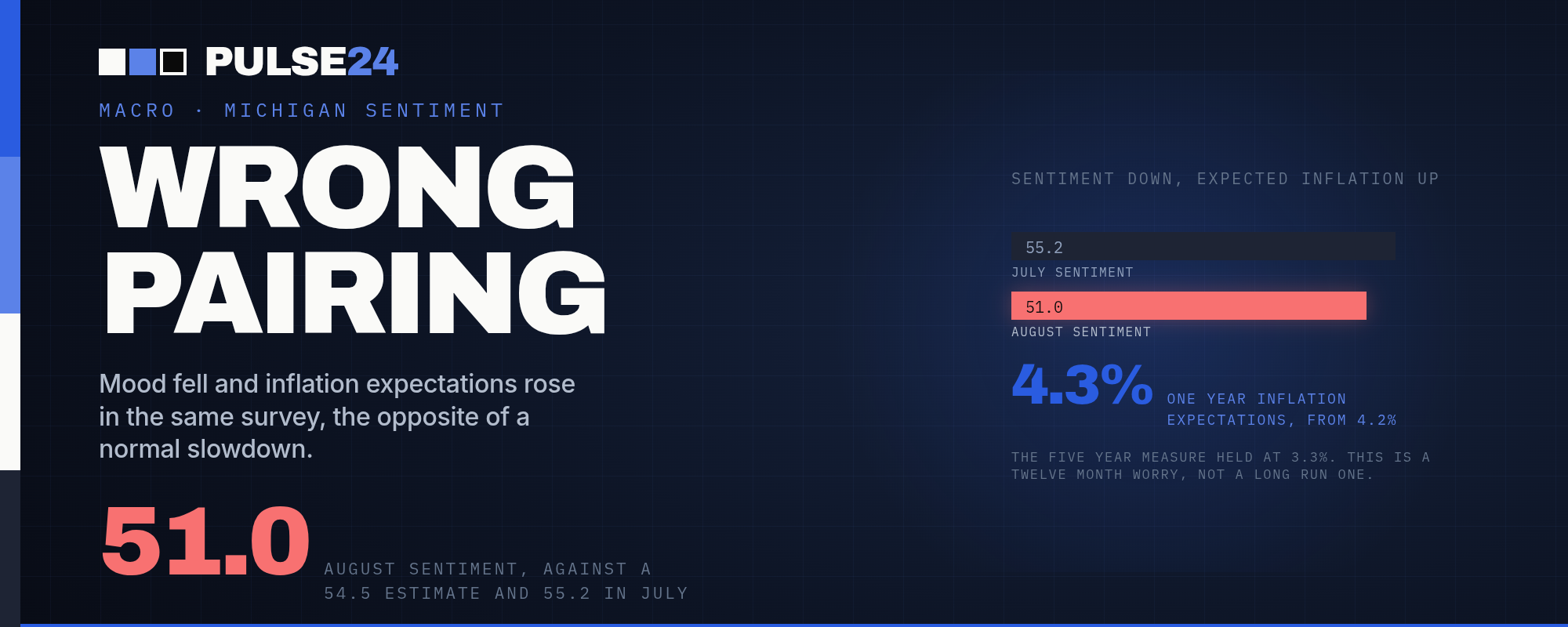
The University of Michigan's August survey reversed two months of recovery in a single report, and the inflation expectations buried inside it may matter more to the Fed than the headline drop. Target and Walmart earnings, then Fed Chair Kevin Warsh's first Jackson Hole keynote, are next up to confirm or contradict the signal.
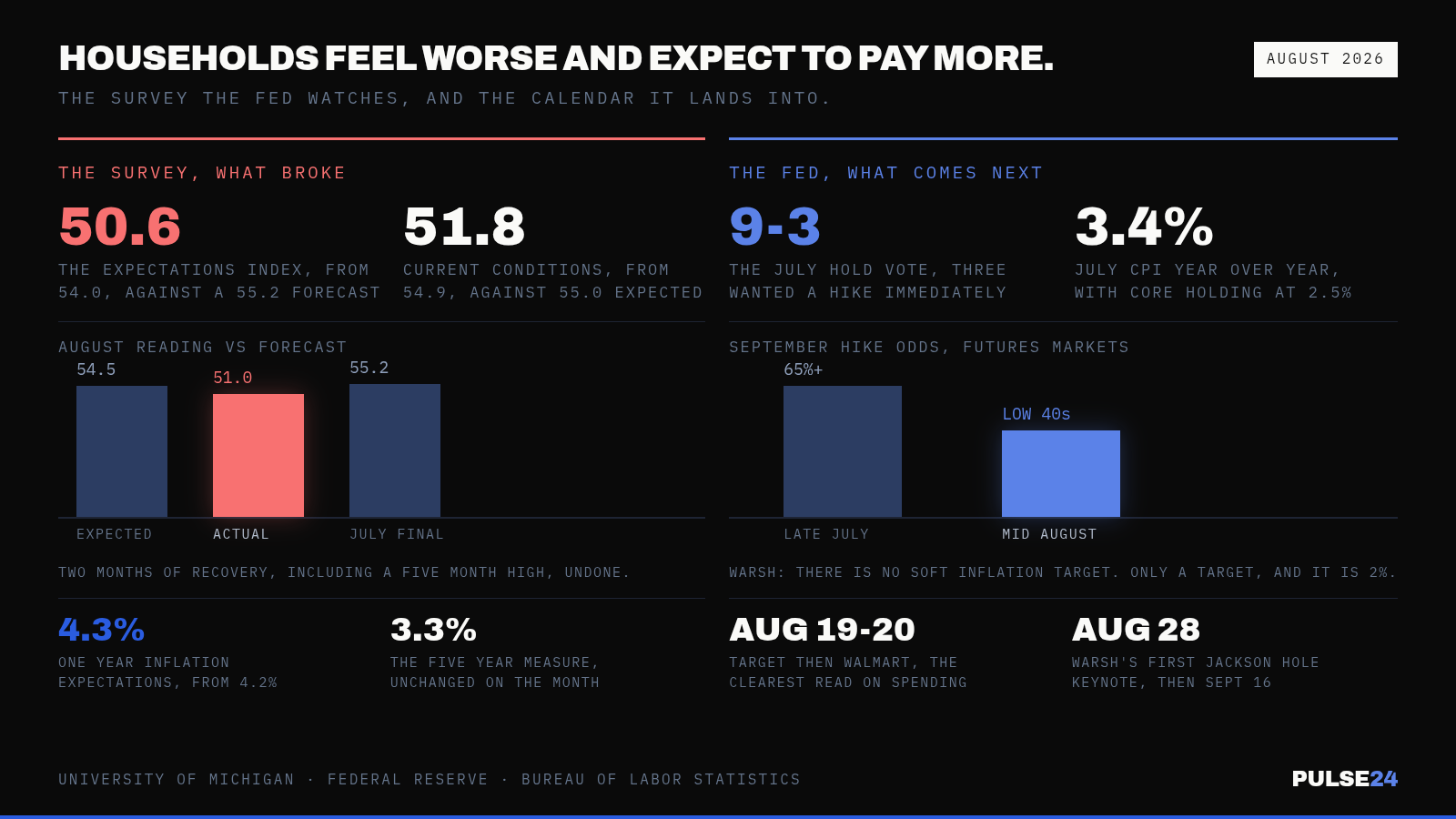
The University of Michigan's preliminary August consumer sentiment index came in at 51.0, well below the 54.5 economists expected and a sharp step back from July's final reading of 55.2. Two straight months of improvement, including a five-month high in July, unwound in a single report. Buried inside that same survey is a number that may matter more to the Fed than the headline print: one-year inflation expectations climbed to 4.3%, up from 4.2%.
What Changed
Both major sub-indices moved in the same direction. Current conditions fell to 51.8 from 54.9, missing a 55.0 estimate. The expectations index, which tends to lead consumer spending by a few months, dropped even harder, to 50.6 from 54.0, against a forecast of 55.2. Five-year inflation expectations held at 3.3%, unchanged, so the move wasn't a broad-based panic about long-run prices. It was concentrated in how households feel right now and over the next twelve months.
That timing matters. The reading landed the same week as a separate Commerce Department report showing retail sales posted their largest monthly drop in over a year, and a day after existing home sales fell 1.7% in July with homebuilders cutting prices for a 15th straight month. None of these releases individually forces the Fed's hand. Together, they describe a consumer who is spending less freely while expecting to pay more, an uncomfortable combination for a central bank that has spent the summer debating whether to raise rates further, not cut them.
Why It Matters
Fed Chair Kevin Warsh, confirmed by the Senate in May, has been unambiguous about where he stands on inflation. After the Fed held its benchmark rate at 3.50% to 3.75% in July on a 9-3 vote, with three officials pushing for an immediate quarter-point increase, Warsh made clear there is no room for interpretation on the target. "There is no soft inflation target," he said. "There is no soft implicit target, not on this committee's watch. There's only a target and it's 2%." July's CPI print came in at 3.4% year over year, with core inflation holding at 2.5%, both still above that line.
Rising inflation expectations complicate that math in a specific way. The Fed treats consumer inflation expectations as a leading indicator of whether price pressure is becoming embedded in the economy, separate from one-off shocks like tariffs or energy costs. A move from 4.2% to 4.3% is not large on its own. Paired with a sentiment collapse and a Fed chair who has staked his early tenure on hitting 2% without caveats, it gives the hawks on the committee a data point to point to heading into September. Futures markets priced the odds of a September rate hike in the low-to-mid 40% range through early and mid-August, down sharply from above 65% in late July, continuing a summer of odds swinging sharply in both directions as each new data point lands.
What to Watch Next
Two retailers will offer the market's clearest real-time read on consumer health before the Fed even meets. Target reports Wednesday, August 19, and Walmart follows on August 20. Walmart's own guidance, held unchanged after its first quarter at 3.5% to 4.5% sales growth and $2.75 to $2.85 in adjusted earnings per share, already reflected caution about spending among lower-income shoppers. Analysts expect roughly $186.9 billion in quarterly revenue and adjusted earnings near $0.73 a share, up about 7.4% from a year earlier. Anything softer than that, paired with this week's sentiment data, would strengthen the case that consumers are the weak link the Fed needs to worry about.
The bigger test comes at the end of the month. The Kansas City Fed's Jackson Hole symposium runs August 27 through 29, and Warsh delivers his first keynote as chair on the 28th, less than three weeks before the September 16 FOMC decision. The official topic is financial innovation in payments, but few in the audience will be there for that. Investors will be listening for whether Warsh treats this week's weak sentiment and soft retail data as reasons to pause, or whether he reiterates that the inflation target leaves no room for patience.
The Pulse24 Take
Consumer surveys have a mixed track record of predicting actual spending, and Michigan's index in particular has drawn criticism for reading as much on mood as economic reality. That skepticism is fair, but it doesn't make the inflation expectations component irrelevant, because that's the piece the Fed actually watches when it debates its own credibility. What makes this cycle unusual isn't the sentiment drop by itself. It's that the drop arrived alongside rising inflation expectations rather than falling ones, the opposite pairing of a normal slowdown, and squarely inside the window a hawkish Fed chair has to prove his target is more than a talking point.
None of this locks in a September hike. Fed decisions get made on the trend across several data points, not one soft survey, and Target and Walmart's earnings in the next week will carry real weight. But the setup into Jackson Hole is tighter than it looked a month ago, and investors positioned for a pause should treat this week's numbers as a reason to watch closely, not dismiss.
How we read the data
Curious how we get from raw data to a take like this? Our Trader's Toolkit walks through the tools we lean on.
Explore the Toolkit