Pulse24 Original
July CPI Landed at 3.4%, Matching Every Forecast on the Street. Markets Barely Moved, Because a Jobs Report Already Did the Work a Week Earlier.
August 12, 2026
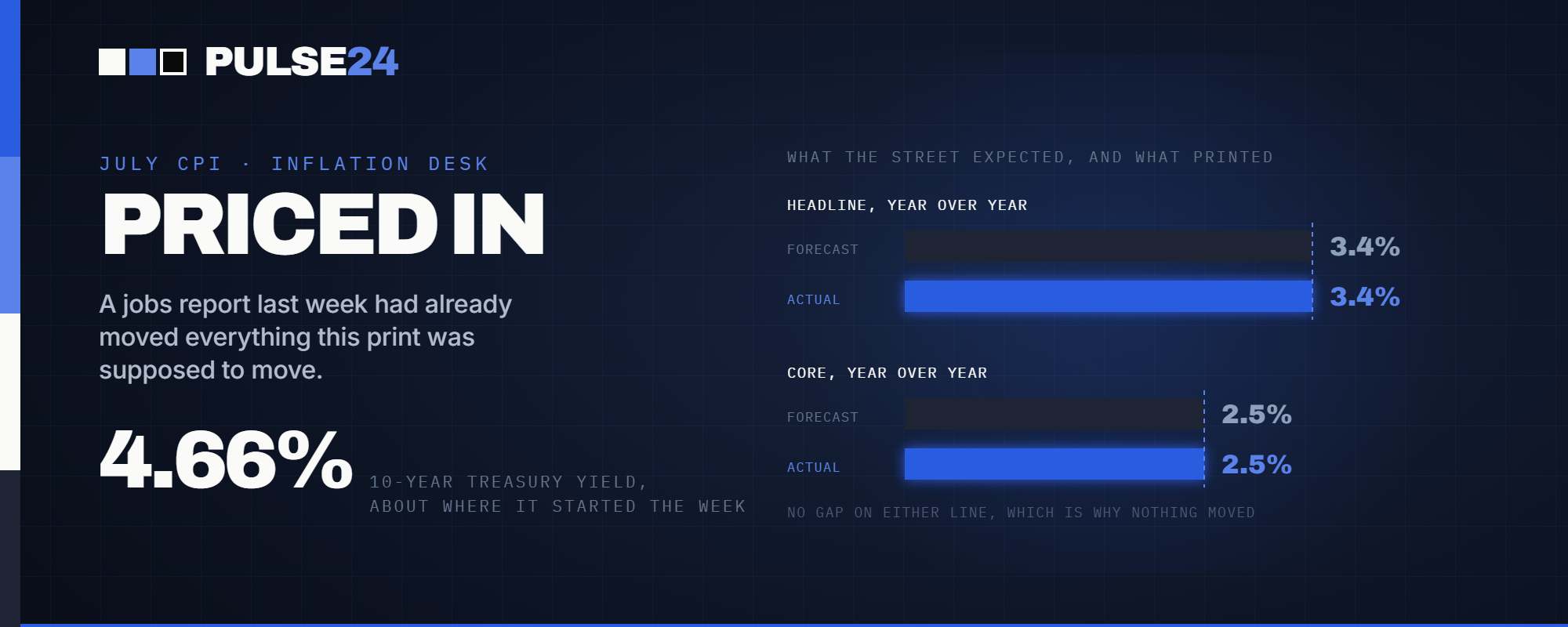
July's CPI report matched Wall Street's forecast almost to the decimal, and markets barely reacted. That's because a weak jobs report last week had already done most of the work of repricing the Fed's September odds.
The Bureau of Labor Statistics put July's headline inflation rate at 3.4% on Wednesday morning, one-tenth below June's 3.5% reading and exactly where economists surveyed ahead of the release had it penciled in. Core CPI, which excludes food and energy, came in at 2.5% year over year, down from 2.6%. Both numbers landed close enough to consensus that stock futures barely moved and the 10-year Treasury yield held near 4.66%, not far from where it started the week.
What Changed
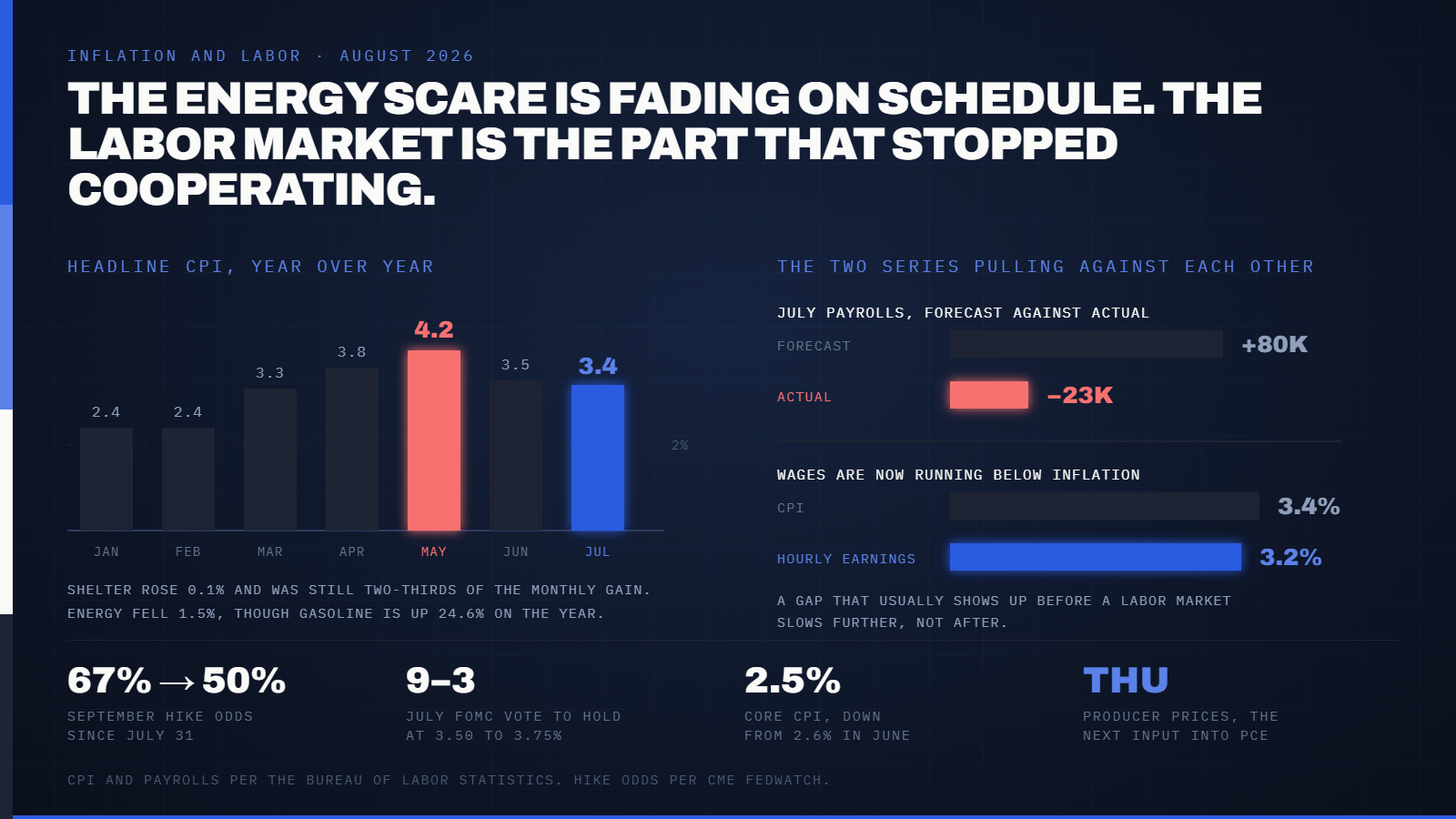
Shelter did most of the work again. It rose 0.1% in July and still made up roughly two-thirds of the total monthly increase, a reminder that housing costs keep anchoring the inflation math even as their pace of gains slows. Energy fell 1.5% on the month as gasoline pulled back 2.9%, though prices at the pump remain 24.6% higher than a year ago and the broader energy index is still up 14.7% annually. Grocery prices slipped 0.1%, led by a 0.7% drop in meat, poultry, fish and eggs, while food away from home rose 0.3%.
Stack the last seven months together and a pattern emerges. Headline CPI ran 2.4% in January and February, climbed to 3.3% in March, 3.8% in April and 4.2% in May, then eased to 3.5% in June and 3.4% in July. That is close to a textbook shape for an energy-driven inflation scare: a shock pushes the headline number up quickly, then it fades as base effects and softer gasoline prices work through the calculation.
Why It Matters
The more interesting story sits in what didn't move. CME Group's FedWatch tool had priced a 67% chance of a quarter-point hike at the Fed's September meeting as of July 31. That fell to 44.4% by August 7 and was close to a coin flip by Tuesday. Wednesday's data tilted the split slightly further toward a hold, but the shift was minor next to what last week's jobs report had already done. That report showed nonfarm payrolls falling by 23,000 against a forecast for an 80,000 gain, one of the sharpest misses since the pandemic began.
Wage growth has not kept pace either. Average hourly earnings are running at 3.2% year over year, below even July's cooling inflation rate, a gap that typically shows up before a labor market slows further rather than after. Fed Chair Kevin Warsh's committee held rates at 3.50% to 3.75% at its July meeting on a 9-3 vote, with three members pushing for a hike specifically because of elevated energy prices. Warsh told reporters afterward that there is no soft implicit target on his watch, only a 2% target, language that left little room to read the hold as anything but reluctant.
That combination, prices cooling while the labor market weakens, is not the setup investors usually want. Hiking into a softening jobs market risks making the slowdown worse. Holding or cutting while inflation still sits above target risks looking like the Fed backed off too early. The 10-year Treasury yield traded above 4.7% as recently as Tuesday on exactly that tension, before easing back toward 4.66% ahead of Wednesday's report.
What to Watch Next
Producer price data for July is due Thursday morning, and it feeds fairly directly into the Fed's preferred inflation gauge. Gold has already priced in some of the uncertainty, trading near a two-month high above $4,400 an ounce heading into this week's data. Whether that holds or fades now that CPI has come and gone without a surprise is worth watching.
The bigger swing factor might not be a scheduled release at all. Reaccelerating energy prices would hand the three dissenting Fed officials a stronger case for a September hike, regardless of what the labor market does. A confirmation of July's job weakness in August's report, rather than a reversal, would make the case for a hold, or even a cut, considerably easier. Right now the Fed is caught between two data series pointing in different directions, and neither this week's CPI nor last week's payrolls report settled the argument.
The Pulse24 Take
An in-line CPI print sounds like a non-event, and today it mostly was. But the muted reaction is itself informative. Traders had already priced in a softer Fed path before this report landed, based on labor data that arrived a week earlier. Inflation reports do not move markets in isolation. They move alongside the jobs numbers that share the same Fed reaction function, and right now those two data sets are pulling in opposite directions. Whichever one wins that argument by September will matter more for yields, the dollar and risk assets than today's decimal point ever could.
How we read the data
Curious how we get from raw data to a take like this? Our Trader's Toolkit walks through the tools we lean on.
Explore the Toolkit