Pulse24 Original
Existing Home Sales Fell 1.7% in July. Homebuilders Have Now Cut Prices for 15 Straight Months, the Longest Stretch Since 2012.
August 15, 2026
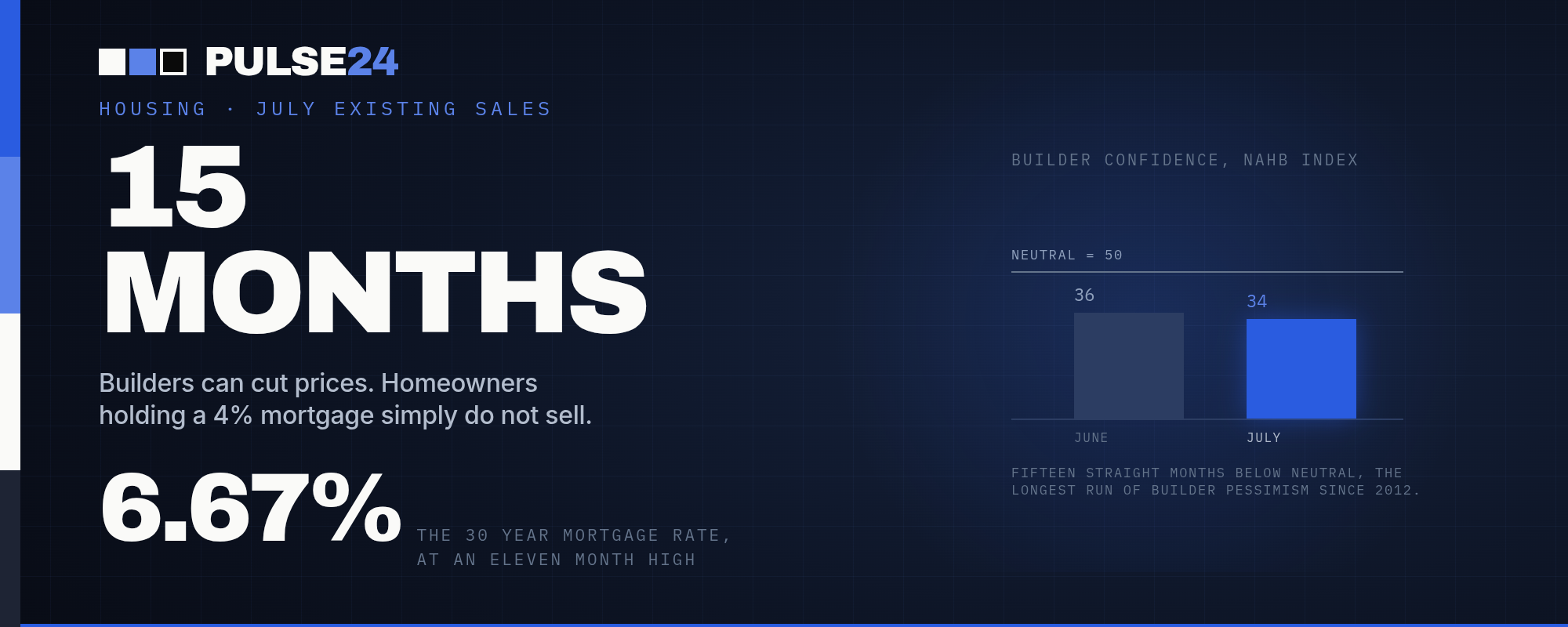
July's existing home sales slipped to a 4.06 million annual pace as the 30-year mortgage rate held near 6.67%, an 11-month high. Builder confidence sank to 34, its 15th straight month below the neutral 50 mark, and more than a third of builders are now cutting prices just to move inventory.
Four million and change. That's roughly where existing home sales have sat, give or take a few hundred thousand units, for most of the past three years, and July did nothing to move that needle. The National Association of Realtors reported Thursday that sales fell 1.7% from June to a seasonally adjusted annual rate of 4.06 million units, a report that landed in the same week the 10-year Treasury yield pushed back above 4.68%, keeping mortgage rates parked well north of 6.5%.
What Changed
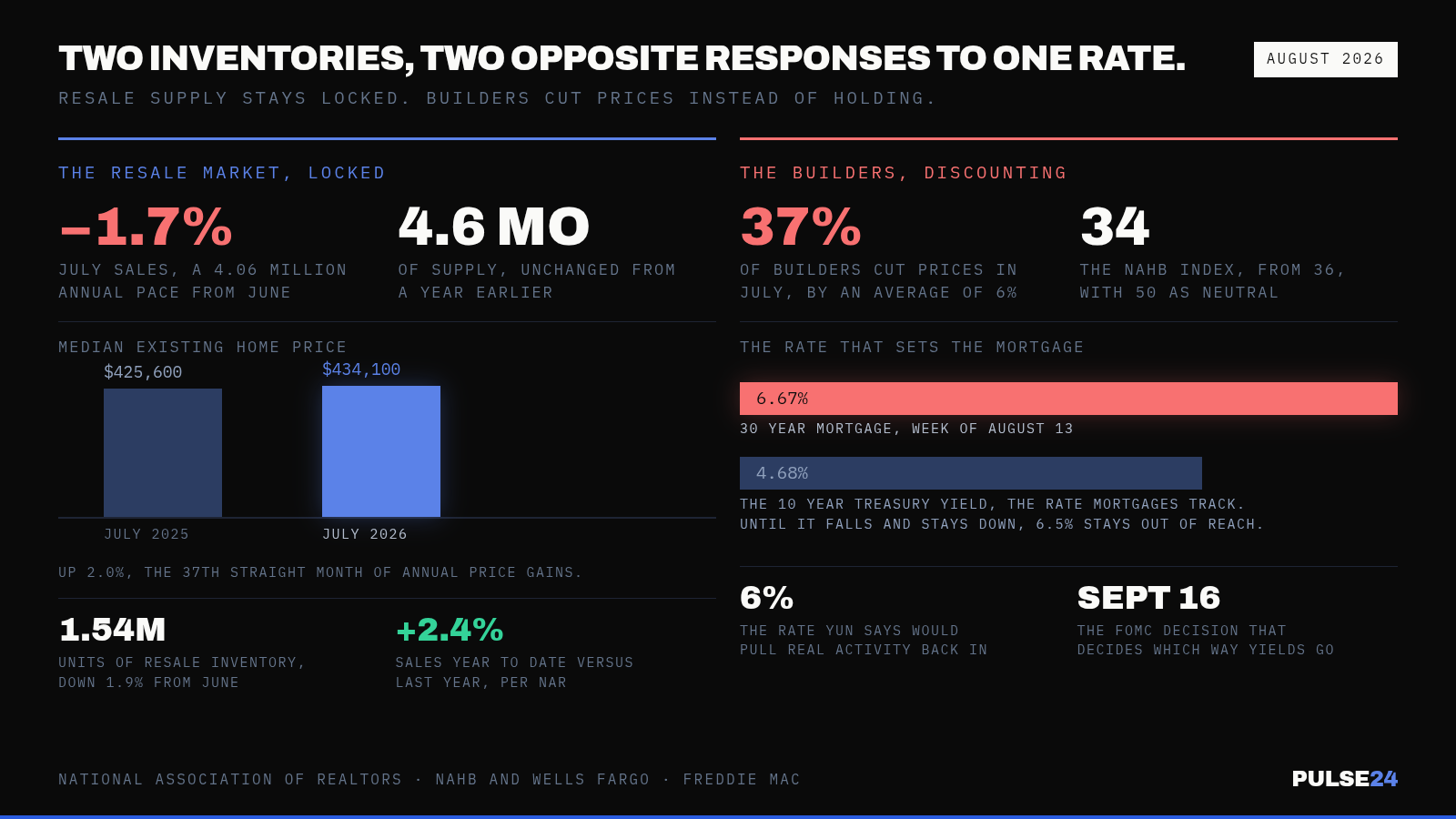
The numbers behind July's report describe a market that's stable mostly in the sense that it has stopped moving. NAR chief economist Lawrence Yun called it "remarkably stable, even amid the rising mortgage rate environment of the past few months," and pointed out that sales are still running 2.4% ahead of last year's pace through the first seven months of the year. Prices, meanwhile, keep climbing regardless. The median home now costs $434,100, up 2.0% from a year ago and the 37th consecutive month of annual price gains. Behind that number sits the 10-year Treasury yield's climb back above 4.68% this week, which has kept the 30-year mortgage rate anchored at 6.67%, according to Freddie Mac's latest weekly survey. That's just two basis points below the prior week and only nine basis points below where the rate sat twelve months ago.
Builders are feeling the squeeze from the other direction. The NAHB/Wells Fargo Housing Market Index slid to 34 in July from 36 in June, extending a run of 15 straight months below the neutral 50 level, the longest stretch of builder pessimism the index has recorded since 2012. NAHB chief economist Robert Dietz said affordability "remains the home building industry's primary challenge," pointing to elevated mortgage rates, costly land, rising material prices and persistent skilled labor shortages. More than a third of builders, 37%, cut prices in July, trimming them by an average of 6% just to keep buyers interested.
Why It Matters
Two different inventories are behaving in two different ways, and that gap explains most of what's happening in this market. Existing homeowners who locked in mortgages below 4% during 2020 and 2021 have little reason to sell and take on a new loan near 6.7%, so resale supply stays tight at 4.6 months, unchanged from a year ago. Builders don't have that option. They're carrying finished homes and land they've already paid for, so when demand slows, a price cut is often cheaper than holding an unsold house through another quarter. Rate, more than buyer appetite, is doing the rationing here.
That split also explains why sales can sit near multi-decade lows in raw volume while the median price keeps grinding higher. Fewer transactions are closing, but the buyers who do close still skew toward those with enough income or existing equity to absorb a 6.67% rate, which props up the price figure even as overall volume stays weak.
Mortgage rates haven't moved much because the bond market hasn't given them room to. Weak July retail sales pushed the odds of a September Fed rate hike down to 29% earlier this week, but lower hike odds aren't the same as falling rates. The Fed's benchmark has sat at 3.50% to 3.75% since late July, and the 10-year yield, the rate mortgages actually track, is still near 4.68%, closer to its highs of the year than its lows. Until that yield comes down and stays there, Freddie Mac's weekly survey is unlikely to show much movement below 6.5%.
What to Watch Next
Yun's comment about stronger activity emerging if rates fall "toward 6%" is the number worth tracking. Mortgage applications for purchase have ticked higher during the small pullbacks in rates seen earlier this summer, which suggests there's real demand waiting just below the current level rather than an economy that has lost interest in buying homes.
On the builder side, watch whether July's price cuts show up as margin compression when Lennar, D.R. Horton and PulteGroup report quarterly results in the coming weeks. A sector that has protected margins so far through incentives and smaller floor plans may find that harder to do if 37% of builders cutting prices becomes 40% or more. August's NAHB index, due out in the third week of the month, will show whether builder sentiment stabilized at 34 or kept sliding toward the cycle low.
The Pulse24 Take
None of this looks like a housing crash, and it doesn't look like a recovery either. Existing sales sit within a percentage point of where they were a year ago, prices keep rising by low single digits, and builders are trimming margins rather than slashing them to the bone. That's a market absorbing a 6.67% mortgage rate about as well as it reasonably can, which isn't the same thing as a healthy market.
What would actually move the needle is the 10-year yield, and that comes back to the Fed. If September's meeting delivers even a token hike, expect mortgage rates to hold near 7% and builder sentiment to keep testing new lows. If the Fed holds instead, or inflation data due before then comes in soft enough to pull yields lower, this market has already shown it can find buyers quickly. Yun's own numbers say sales are running ahead of last year even at current rates. The next month of Treasury trading will likely decide which of those paths July's data was actually measuring.
How we read the data
Curious how we get from raw data to a take like this? Our Trader's Toolkit walks through the tools we lean on.
Explore the Toolkit