Pulse24 Original
Japan Spent a Record $96 Billion Defending the Yen. Days Later, It Broke Back Above 160 Anyway.
August 30, 2026
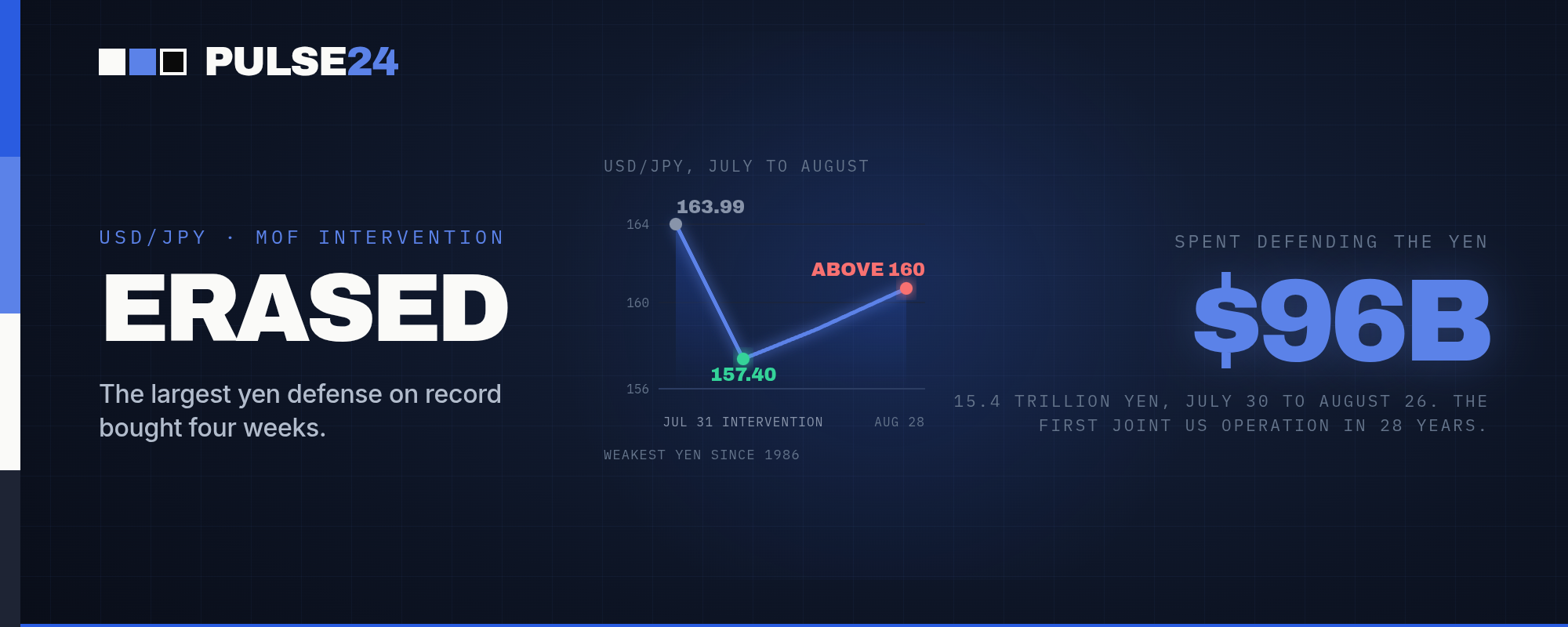
Tokyo and Washington spent 15.4 trillion yen over four weeks in the largest currency intervention on record, yet the dollar climbed back above 160 yen within a month. Economists increasingly doubt intervention alone can offset a widening gap between Fed and Bank of Japan rates.
Fifteen point four trillion yen. That's what Japan's Ministry of Finance confirmed it spent between July 30 and August 26 trying to keep the yen from collapsing, working out to roughly $96 billion and the largest monthly currency intervention the country has ever recorded. Four weeks later, the dollar is back above 160 yen, sitting almost exactly where it started.
What Changed
The intervention itself was unusual before it was expensive. On July 31, Japan's Ministry of Finance and the US Treasury carried out the first joint yen-buying operation between the two countries in 28 years, the prior one dating back to 1998. Treasury Secretary Scott Bessent reportedly had the US sell euros, not dollars, to buy yen, a structure meant to avoid forcing sales out of the Treasury's own bond holdings. Japan's finance ministry has since said future interventions will lean on the Federal Reserve's FIMA repo facility rather than asset sales, a detail that matters more than it sounds: it signals Tokyo expects to be back in the market again.
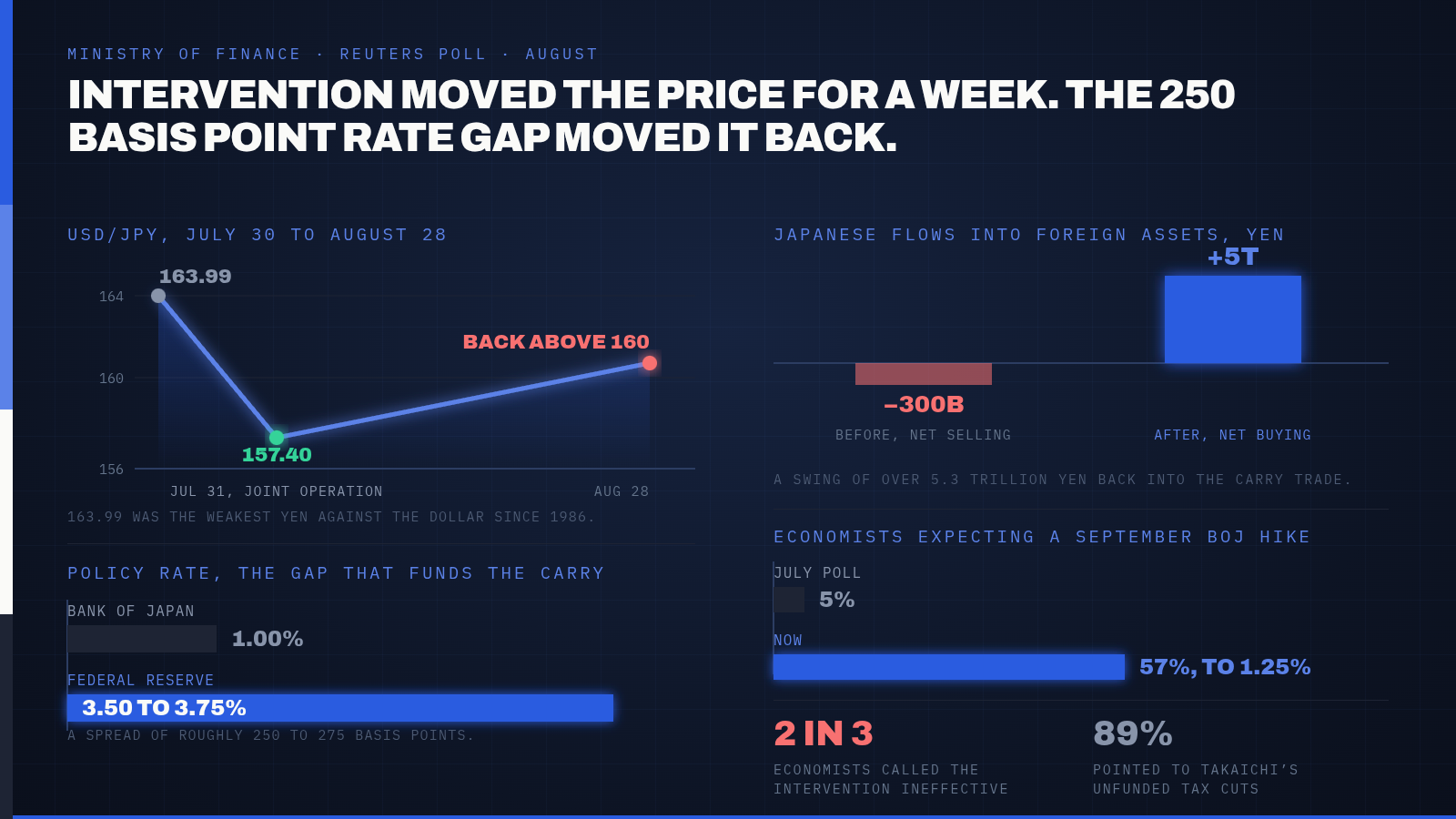
The first show of force worked, briefly. USD/JPY had touched 163.99 in late July, the weakest the yen has been against the dollar since 1986. The intervention pulled it down to 157.40, a reset that looked, for a moment, like it had broken the trend. It hadn't. By August 28, the pair had climbed back through 160, and Bloomberg reported the yen had given up most of what the intervention bought it. Kevin Warsh's first speech as Fed chair at Jackson Hole landed the same day and didn't help: he called inflation uncomfortably high and signaled the Fed isn't done tightening, a stance that widened rather than narrowed the gap pulling money out of yen and into dollars. Warsh's Jackson Hole debut pushed September rate-hike odds above 50 percent, and that same repricing has been a headwind for the yen ever since.
Why It Matters
Rate differentials, not intervention, are what actually move a currency pair this large. The Bank of Japan's policy rate sits at 1.00 percent, a three-decade high reached in June but still roughly 250 to 275 basis points below the Fed's 3.50 to 3.75 percent target range. That gap is what funds the yen carry trade: borrow cheaply in yen, invest in higher-yielding dollar assets, and pocket the spread. Intervention can shock the exchange rate for a session or two, but it doesn't touch the math that makes the trade profitable in the first place.
The speed of the reversal makes that point plainly. In the weeks that followed the intervention, Japanese investors flipped from net selling around 300 billion yen of foreign equities and bonds to net buying more than 5 trillion yen worth, a swing of over 5.3 trillion yen back toward the outflows that weaken the currency. The carry trade resumed almost as fast as the intervention could slow it down.
There's a fiscal layer underneath the rate story too. Roughly 89 percent of economists surveyed pointed to Prime Minister Sanae Takaichi's unfunded tax cut plans as a driver of yen weakness, worried that looser fiscal policy on top of a still-dovish central bank leaves Japan exposed on two fronts at once. A previous, smaller round of intervention in August, worth about $59 billion at the time, ran into the same problem: traders absorbed it and kept selling.
What to Watch Next
The next real test is the Bank of Japan's meeting on September 17 and 18. A Reuters poll of economists now puts the odds of a hike to 1.25 percent at 57 percent, up sharply from just 5 percent in July's survey, and nearly two-thirds of respondents expect the policy rate to reach at least 1.50 percent by March 2027. A hike that size would trim the Fed-BOJ gap to somewhere around 225 to 250 basis points, still wide enough to keep the carry trade attractive but narrow enough to matter at the margin.
The risk cuts both ways. Markets have priced in a September move so heavily that anything short of a hike could trigger the kind of disorderly yen selloff intervention is meant to prevent. If the Fed keeps tightening alongside a BOJ hike, as Warsh's Jackson Hole tone suggests it might, the rate gap could stay wide enough that no amount of spot intervention changes the trend. Worth watching alongside all this: Brent crude near $89 a barrel keeps Japan's import bill elevated, one more source of yen-selling pressure that has nothing to do with interest rates at all.
The Pulse24 Take
Intervention buys time, not direction. Japan and the US just proved that with $96 billion, and the yen erased the move in under a month anyway. The shock of coordinated action was enough to reset USD/JPY, if only temporarily. Whether that reset holds now depends on the Bank of Japan following through on September 17 with a hike real enough to close some of that 250-plus basis point gap with the Fed.
Until the two central banks' policy paths converge, spot intervention looks closer to a delay tactic than a fix, expensive theater that traders have started pricing around rather than fearing. The number worth watching isn't 160. It's whatever the BOJ actually does in three weeks, and whether Kevin Warsh gives it room to matter.
How we read the data
Curious how we get from raw data to a take like this? Our Trader's Toolkit walks through the tools we lean on.
Explore the Toolkit