Pulse24 Original
Kevin Warsh's First Jackson Hole Speech Pushed September Rate-Hike Odds Above 50%. Gold Fell Nearly 2% and the Dollar Jumped to a One-Week High.
August 28, 2026
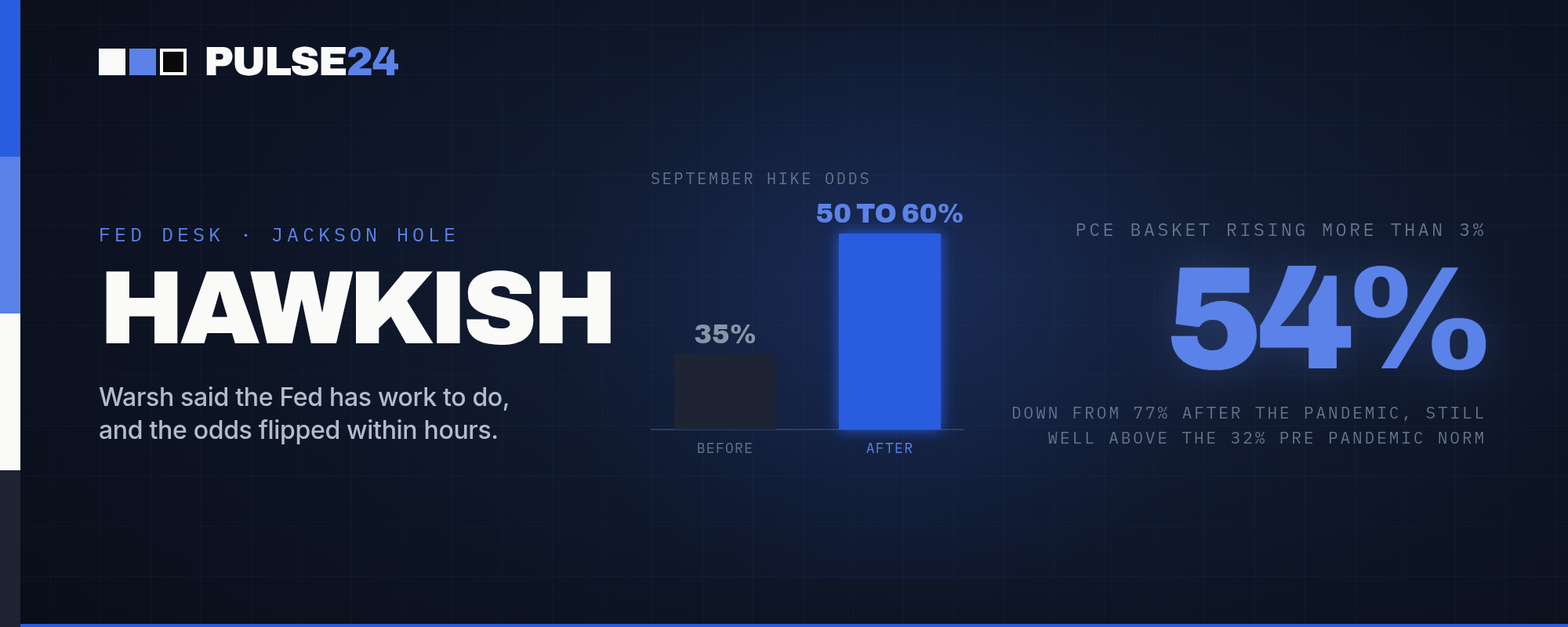
Fed Chair Kevin Warsh's debut Jackson Hole keynote leaned hawkish on inflation, and traders responded by pushing September rate-hike odds above 50%. Gold dropped roughly 1.5% and the dollar jumped to a one-week high, even as stocks closed modestly higher.
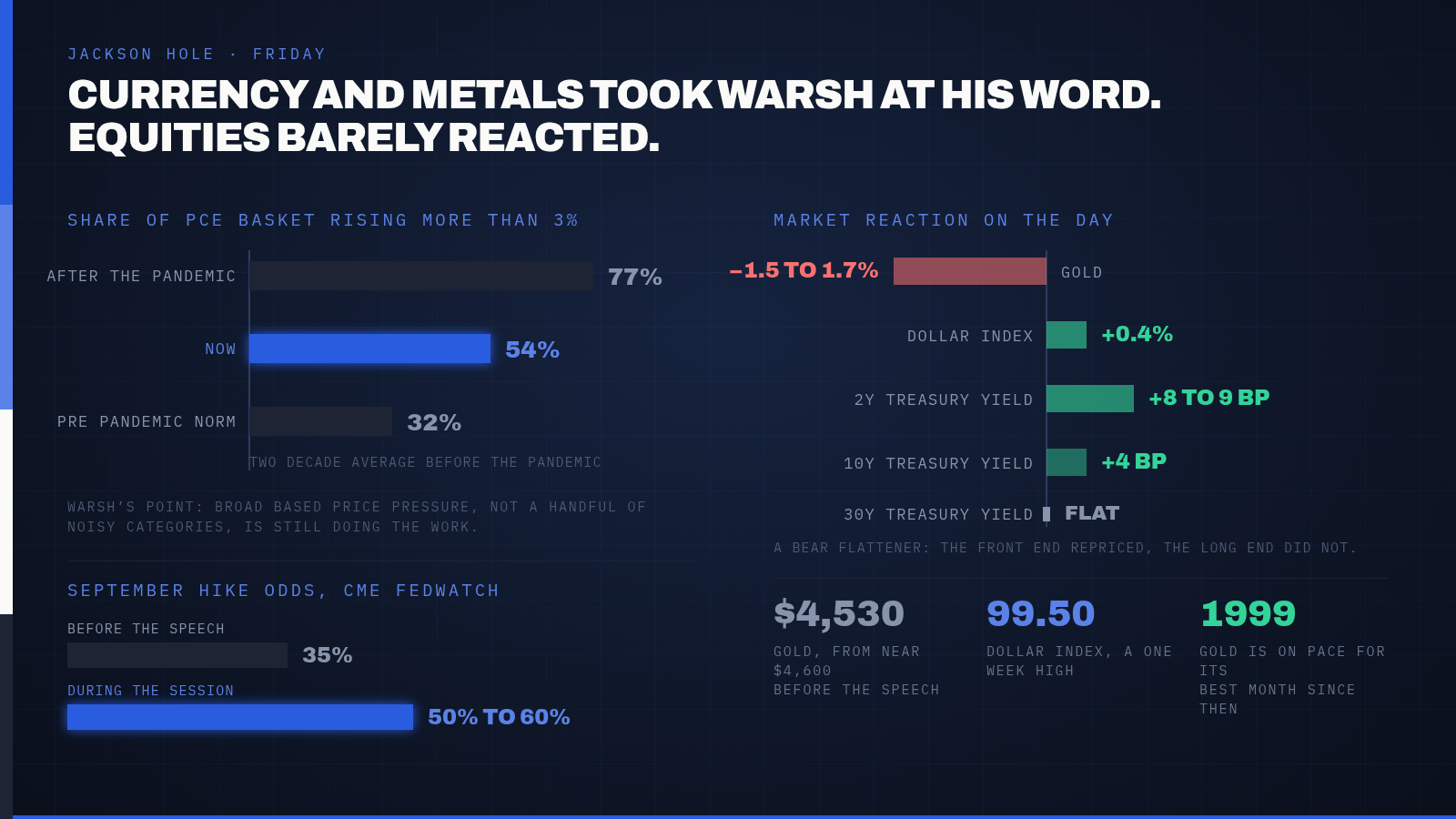
Kevin Warsh told the Jackson Hole Economic Policy Symposium on Friday that "we have work to do" on inflation, and currency and metals markets took him at his word even if stocks mostly shrugged. Within hours, the CME FedWatch Tool's implied odds of a September rate hike jumped from about 35% before the speech to a range spanning roughly 50% to 60% during the session. It was Warsh's first keynote since taking over as Fed chair, and the speech carried the weight a debut usually does. Pulse24 previewed the moment three days ahead of time, when the only certainty was that this week's inflation report would shape whatever he said.
What Changed
Warsh's remarks were his first extended public comments on monetary policy since he was sworn in as chair, and traders had spent the week guessing which version of him would show up: the inflation hawk from his earlier commentary, or a chair choosing caution for his debut. He picked the former. "We must be confident that underlying inflation is moving to our objective, clearly and at sufficient speed," he told the audience in Jackson Hole, Wyoming. "Otherwise, we have work to do."
The data behind that line matters as much as the line itself. Headline PCE inflation held at 3.7% annually in July, the same report Pulse24 covered when it landed, while the Fed's preferred core measure sat at 3.3%. Warsh went further than the headline number, telling the audience that 54% of the goods and services in the PCE basket have posted price increases above 3% over the past 12 months. That share has come down from about 77% in the immediate aftermath of the pandemic, he noted, but it remains well above the 32% average from the two decades before it. His point: broad-based price pressure, not a handful of noisy categories, is still doing the work.
Bond markets moved fast. Treasury yields rose across the front end and stayed close to flat further out, a pattern traders call a bear flattener: the 2-year note, most sensitive to near-term Fed moves, climbed roughly 8 to 9 basis points, while the 30-year bond held close to unchanged. Short-end investors bet on tighter policy soon. Long-end investors bet that tighter policy now means less inflation, and less need for higher rates, later.
Why It Matters
Two different corners of the market told two different stories on Friday. Stocks barely blinked. The S&P 500, the Dow, and the Nasdaq all traded modestly higher through the session, a muted reaction for what was, on its face, a hawkish debut from a new Fed chair. Equity investors appear to be reading Warsh's tone as vigilance rather than alarm, the kind of message a chair sends when he wants tighter financial conditions to do some of the Fed's work for him, through higher yields and a firmer dollar, without the Fed itself having to move first.
Gold and the dollar told the more conventional story, and it wasn't subtle. Gold fell by roughly 1.5% to 1.7% on the day, retreating toward the $4,530 area from a level closer to $4,600 before Warsh spoke, one of its sharper single-day drops this month. The dollar index jumped to a one-week high near 99.50, up about 0.4%. That's the textbook reaction to a hawkish surprise: higher expected rates raise the opportunity cost of holding an asset that pays no yield, and a currency backed by a central bank that just signaled it isn't done tightening tends to firm against ones that haven't. Even after Friday's drop, gold remains on pace for its best month since 1999, so the move looks more like a pause in a powerful trend than a reversal of it.
Put together, the split between equities and everything else suggests investors believe Warsh's hawkishness is real but contained. Stock markets aren't pricing in a Fed about to choke off growth. Currency and metals markets are pricing in a Fed that means what it says about September. Reconciling those two views is likely to be the market's central task between now and the September 16 decision.
What to Watch Next
The next scheduled inflation print, due before the September 16 decision, now carries more weight than it would have a week ago. A hot reading on top of Friday's rhetoric could push those newly repriced odds toward something closer to a lock, and could pull gold lower still. A cooler one would let Warsh's "quieter Fed" framing, the phrase he used to describe wanting to be more purposeful and less noisy in his communications, do the talking instead of an actual hike.
Also worth tracking: whether other Fed officials echo Warsh's tone in the coming weeks or push back on it. Three regional Fed presidents already dissented in favor of a rate hike at the July meeting, the first split of its kind since 2016, and Friday's speech reads as validation for that camp. If more officials line up behind them before September 16, gold and the dollar have more room to move well before the meeting itself.
The Pulse24 Take
New Fed chairs get one moment where markets don't yet know how to read them, and Warsh used his to sound like the inflation hawk his reputation suggested he'd be. Traders didn't shrug this one off. Rate-hike odds jumped, the dollar jumped with them, and gold gave back a chunk of what has otherwise been its best month since 1999. The one asset class that stayed calm was the one investors are usually most anxious about: stocks.
That split is worth sitting with. A market that sold gold and bought dollars on a hawkish speech is a market that believes the speech. A stock market that shrugged is either betting the Fed won't actually follow through in September, or betting that whatever tightening does happen will be manageable. Both bets get tested at the same meeting, and only one of them can be fully right.
How we read the data
Curious how we get from raw data to a take like this? Our Trader's Toolkit walks through the tools we lean on.
Explore the Toolkit