Pulse24 Original
USD/JPY Fell From 160 to 158.77 in Hours. A Bank of Japan Board Member's Push for a 75 Basis-Point Hike Is Why.
September 3, 2026
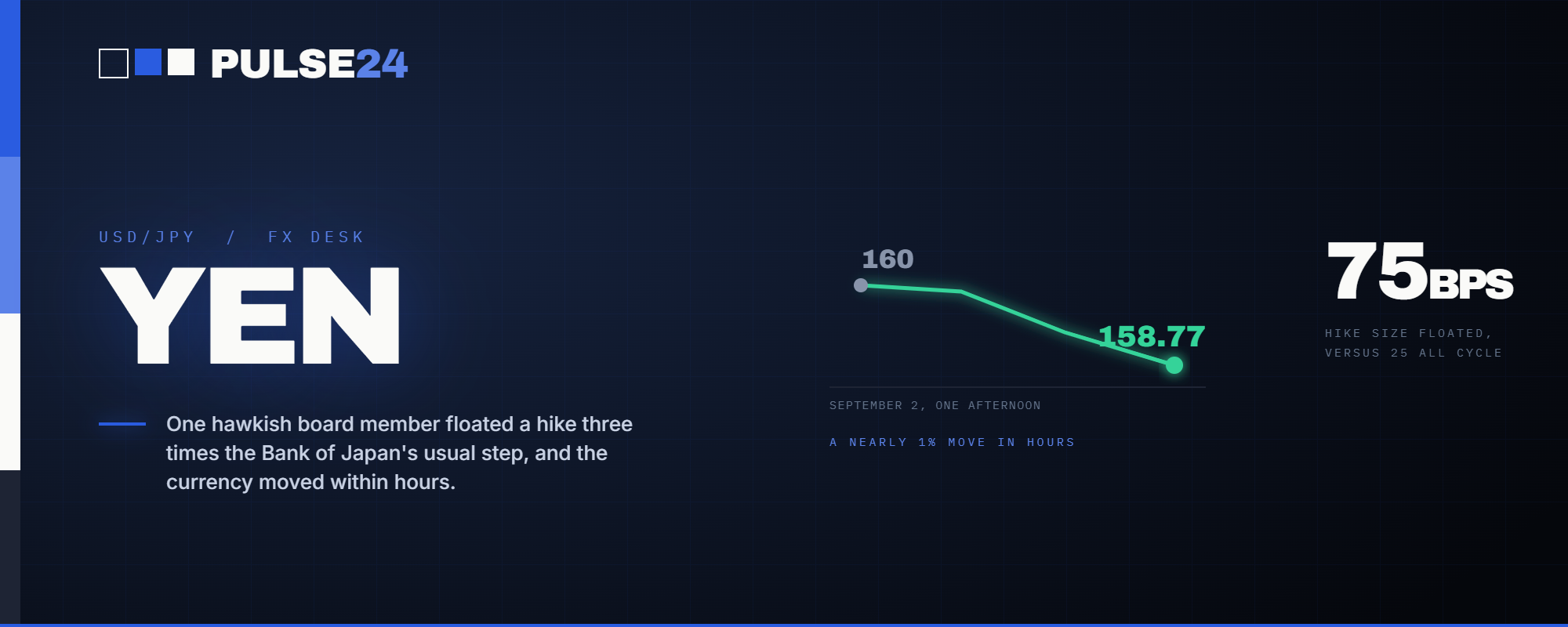
A hawkish Bank of Japan board member's push for a jumbo rate hike sent USD/JPY tumbling almost a percent in a single afternoon, and set up a rare back-to-back policy showdown with the Fed later this month.
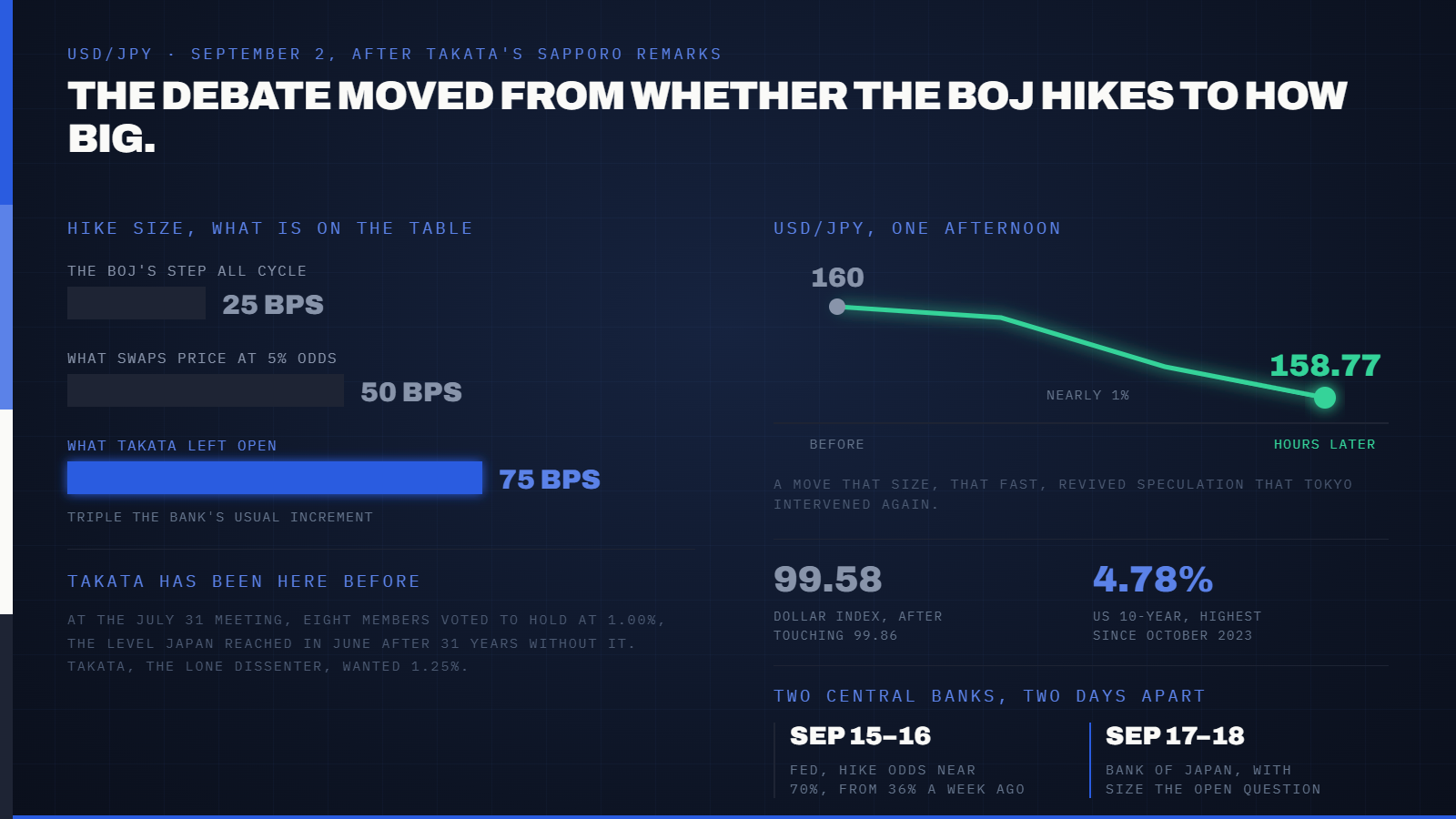
USD/JPY dropped almost a full percentage point in a single afternoon on September 2, sliding from just under 160 to 158.77. Nothing changed in Washington that day. The move traced back to Sapporo, where Bank of Japan board member Hajime Takata told a room of local business leaders that the central bank needs to act nimbly, and needs to start demonstrating its determination to stop prices from overshooting rather than merely coaxing them higher.
What Changed
Takata is not a new voice on this. He was the sole dissenter at the BOJ's July 31 meeting, where eight of his colleagues voted to hold the policy rate at 1%, the level Japan reached in June after 31 years without it. Takata wanted 1.25% then. Two months later, he is pushing the conversation further still, floating hikes of 50 to 75 basis points at the BOJ's September 17 and 18 meeting rather than the 25 basis-point steps the bank has used throughout this cycle.
Markets have not fully bought in. The swaps curve prices only about a 5% probability of a 50 basis-point move next month, according to Brown Brothers Harriman analysis, and Governor Kazuo Ueda has been more measured in public than Takata, saying only that the BOJ needs to pay "greater attention than before" to upside inflation risks. But the fact that a sitting board member is talking in increments three times the bank's usual size, and that traders reacted by pushing USD/JPY down almost a percent within hours, says something about how thin the market's patience with a weak yen has become.
Why It Matters
A weak yen has been Japan's problem and everyone else's convenience for the better part of two years. Cheap yen funding underwrites carry trades across global assets, and Tokyo's currency has already forced two rounds of coordinated intervention this year, including a record $96 billion defense that failed to keep USD/JPY below 160 for even a week. A BOJ that hikes in jumbo increments changes that calculus. Higher Japanese yields make holding yen assets more attractive and make unwinding a carry trade more urgent, which is exactly the kind of forced deleveraging that has rattled equity and bond markets before.
The timing compounds the risk. The Federal Reserve delivers its own decision on September 16, two days before the BOJ's, and Kevin Warsh's hawkish debut at Jackson Hole has pushed CME FedWatch odds of a Fed hike to roughly 70%, up from just 36% a week earlier. Add a 10-year Treasury yield sitting at 4.78%, its highest since October 2023, and investors are staring at two hawkish central banks moving in the same six-day window for the first time this cycle. That is a lot of policy tightening to price into currency and rates markets at once.
There is also a dollar side to this. The dollar index has pulled back to 99.58 after touching 99.86, its highest since mid-August, and the swing lower on September 2 lined up with speculation, still unconfirmed by Tokyo, that Japanese authorities either intervened directly or conducted a rate check on the yen. Whatever it was, the willingness of USD/JPY to move nearly a percent on rumor alone shows how little room the pair has left before someone official steps back in.
What to Watch Next
Two dates matter here. The Fed announces on September 16, and the BOJ follows on September 18, giving markets a rare back-to-back look at both hawks in the same week. A 25 basis-point BOJ hike is still the consensus, but Takata's rhetoric raises the odds of a surprise, and a 50 basis-point move alone would be double the size the swaps market currently expects. Watch USD/JPY's reaction around the 158 to 160 band in the days before both meetings. A break below 158 without new intervention would suggest markets are pricing in the jumbo scenario on their own, while a snap back above 160 would suggest Takata is still an outlier even within his own institution.
The Pulse24 Take
Central bank divergence used to be a slow-moving story. Now it moves markets in a single afternoon speech from a regional business lunch in Sapporo. The lesson from September 2 is not that the BOJ is about to shock the world with a 75 basis-point hike, that remains the minority view even inside the bank. It is that traders are no longer willing to assume the BOJ will keep dragging its feet, and every hawkish comment gets treated as a live possibility rather than background noise. With the Fed and the BOJ deciding policy four days apart this month, currency and rates markets have a genuine binary event on the calendar for the first time in a while, and Pulse24 will be watching both decisions as a single trade, not two separate ones.
How we read the data
Curious how we get from raw data to a take like this? Our Trader's Toolkit walks through the tools we lean on.
Explore the Toolkit