Pulse24 Original
August's Core CPI Ran Hot at 0.3%. Fed Rate-Hike Odds Jumped From 70% to 90% Within Hours.
September 11, 2026
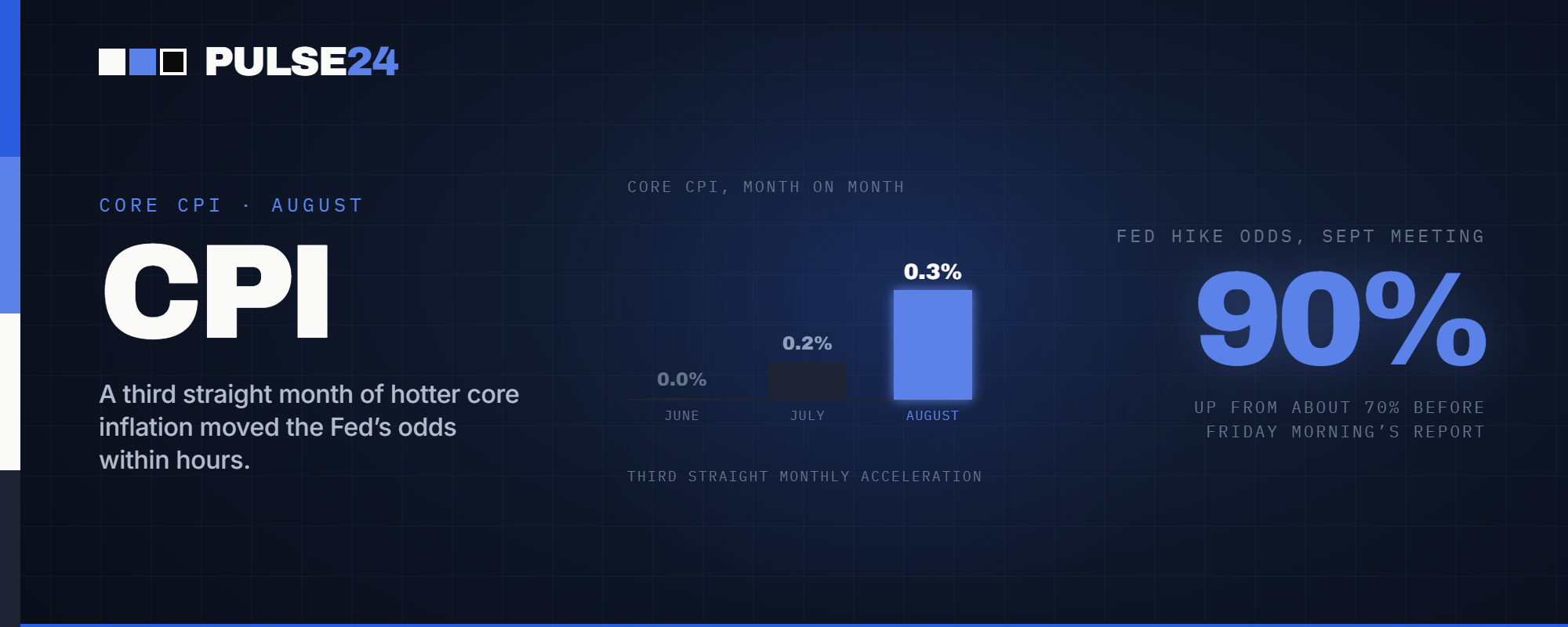
Core inflation accelerated for a third straight month in August, and Fed rate-hike odds for next week's meeting jumped from about 70% to near 90% within hours of the report. The 10-year Treasury yield hit its highest level since 2023 the same morning.
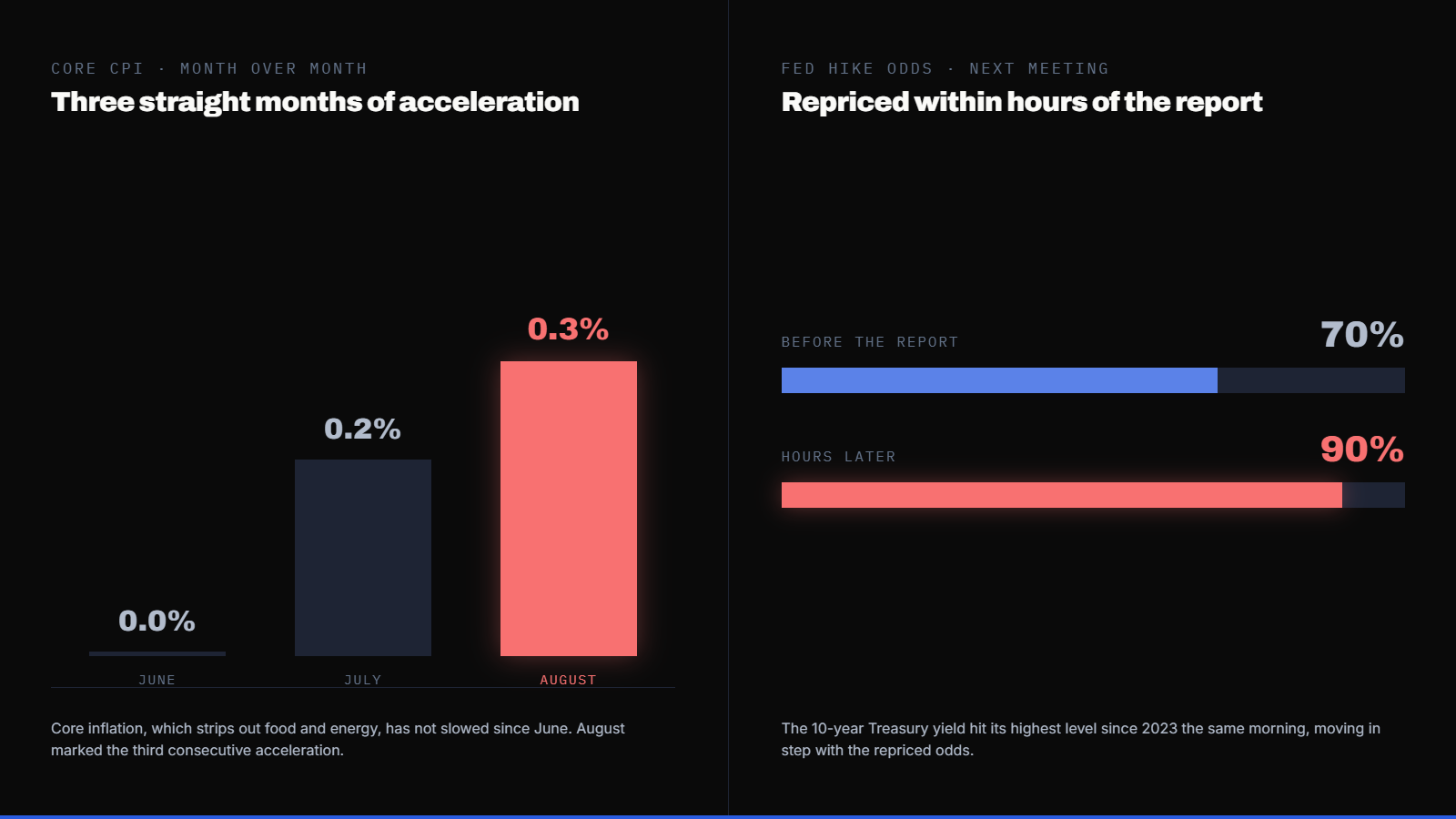
Core consumer prices rose 0.3% in August, the third straight monthly acceleration, according to Friday's Bureau of Labor Statistics report. That was enough to push Fed rate-hike odds for next week's meeting from about 70% to near 90% within a matter of hours, even as headline inflation held exactly where it stood in July, at 3.4% annually.
What Changed
Economists had penciled in a 0.2% monthly rise in core prices, matching July's pace. Instead, the reading came in at 0.3%, capping a slow reacceleration that has been building for months rather than showing up in a single bad print: 0.0% in June, 0.2% in July, 0.3% in August. Shelter costs, the largest single category in the index, picked up from 0.1% to 0.3% on the month. Core services excluding energy rose 0.3% as well. Medical care and motor vehicle insurance pulled the other way, falling 0.2% and 0.8% respectively, offsets that kept the total from running even hotter.
Energy did the heaviest lifting on the headline side. Gasoline prices climbed 3.9% for the month and 27.4% over the past year, alone accounting for more than a third of the entire monthly increase in the all-items index. Some of that traces back to renewed tension in the Middle East, which has kept a risk premium baked into crude oil for weeks, on top of the same dynamics Pulse24 flagged in Thursday's producer price report. But energy is a swing category by nature. What should worry the Fed more is the part of the report that has nothing to do with a barrel of oil: services and shelter inflation that just will not slow down.
Why It Matters
A hot core print with the Fed five days from a decision is about as unhelpful a combination as the September 15-16 meeting could have drawn. Pulse24 covered Thursday's selloff in silver and gold as traders pushed hike odds to 69.8% on the back of a hot PPI report. Friday's CPI number did the rest of the work. CME's FedWatch tool moved to 90% within hours, a level that treats a quarter-point hike less as a possibility and more as a formality, though Polymarket's contract moved by less, to around 79%, a reminder that different trackers are still pricing this differently.
Bond markets reacted first and loudest. The 10-year Treasury yield touched 4.96% Friday morning, its highest level since 2023 and up from 4.93% a day earlier, part of a broader climb that has added roughly 18 basis points over the past week. A global bond selloff already had Japan, Britain, and Germany setting yield records of their own this week, and Friday's report gave the US leg of that move fresh fuel.
The odds have moved a long way in under two weeks. Pulse24 tracked hike odds crossing 60% over the first weekend of September, up from a coin flip the Friday before that. That was already an unusually fast repricing. Getting from 70% to 90% inside a single session is faster still, and it leaves the Fed very little room to disappoint a market that has, in effect, already voted.
What to Watch Next
The Fed's decision lands September 16, and at this point the more interesting question may not be whether officials hike but what they say about the months after. A quarter-point move that markets have already priced at 90% probability is unlikely to move stocks or bonds much on its own. The bigger risk sits in the press conference: any signal that August's core print was not a one-off, that shelter and services inflation are settling into a higher run rate, would matter far more than the decision itself.
Stocks, for their part, shrugged off Friday's number, with futures pointing modestly higher into the report and major indexes holding up despite four straight losing sessions heading into the print. That resilience is worth watching too. A market pricing near-certain odds of a hike and still not selling off hard is either confident the Fed can manage a soft landing or simply worn out from a rough week. The next few sessions should clarify which.
The Pulse24 Take
None of Friday's report should surprise anyone who has been following the data all year. Core inflation cooling on an annual basis while reaccelerating on a monthly basis is exactly the kind of mixed signal that makes a Fed decision hard, and August's numbers deliver that mix about as cleanly as a report can. The annual figures let officials claim disinflation is intact; the monthly figures say otherwise.
What matters more than Friday's print is what comes after it. A rate hike priced at 90% odds is not a surprise anymore; it is close to consensus at this point. The real test for markets is whether the Fed frames this as a one-time adjustment to a stubborn inflation problem or the start of a longer tightening cycle. Shelter and services costs picking up for a third straight month suggest officials may not get to treat this as a single data point much longer.
How we read the data
Curious how we get from raw data to a take like this? Our Trader's Toolkit walks through the tools we lean on.
Explore the Toolkit