Pulse24 Original
The Yen's Six-Month High Didn't Survive Eight Days. The Fed Decides Today, the Bank of Japan Follows Friday.
September 16, 2026
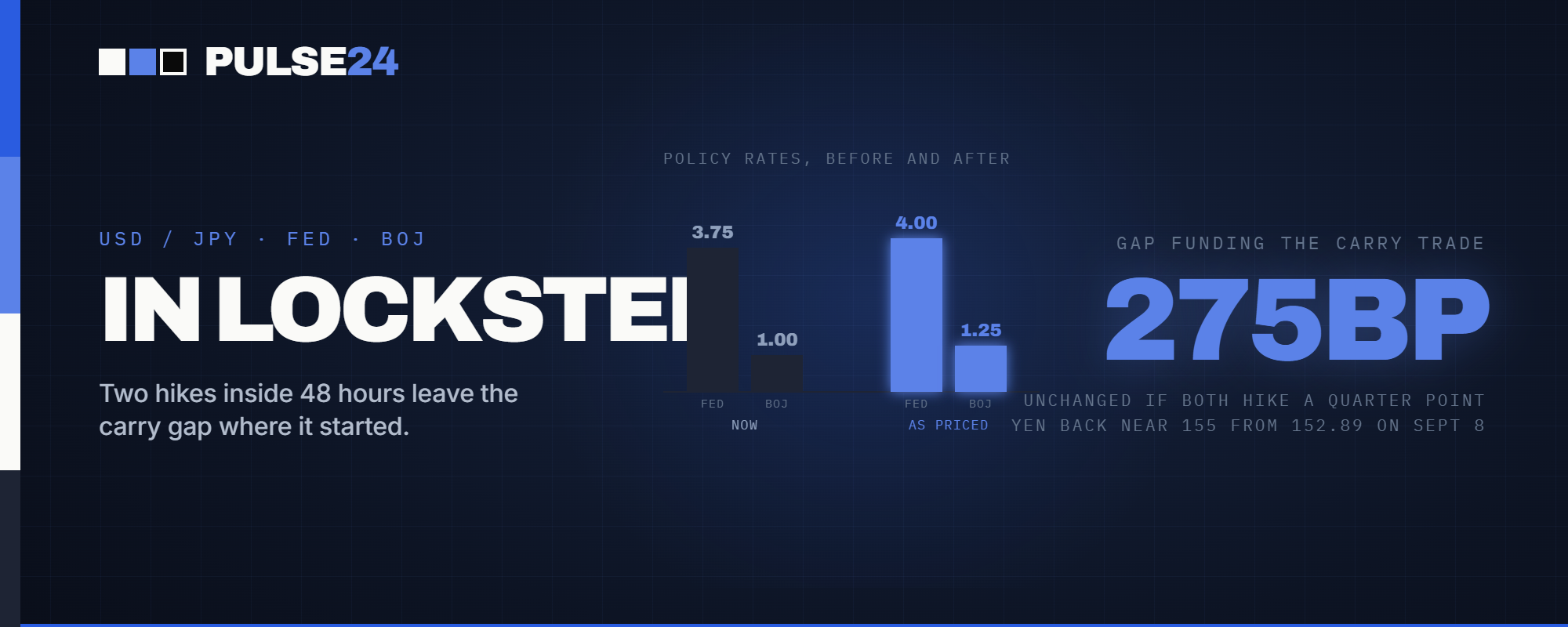
The yen's rally to a six-month high evaporated within eight days, and now the Federal Reserve and the Bank of Japan are both deciding rates within 48 hours of each other. The gap funding the carry trade barely moves even if both hike exactly as priced, which says more about this week than either decision alone does.
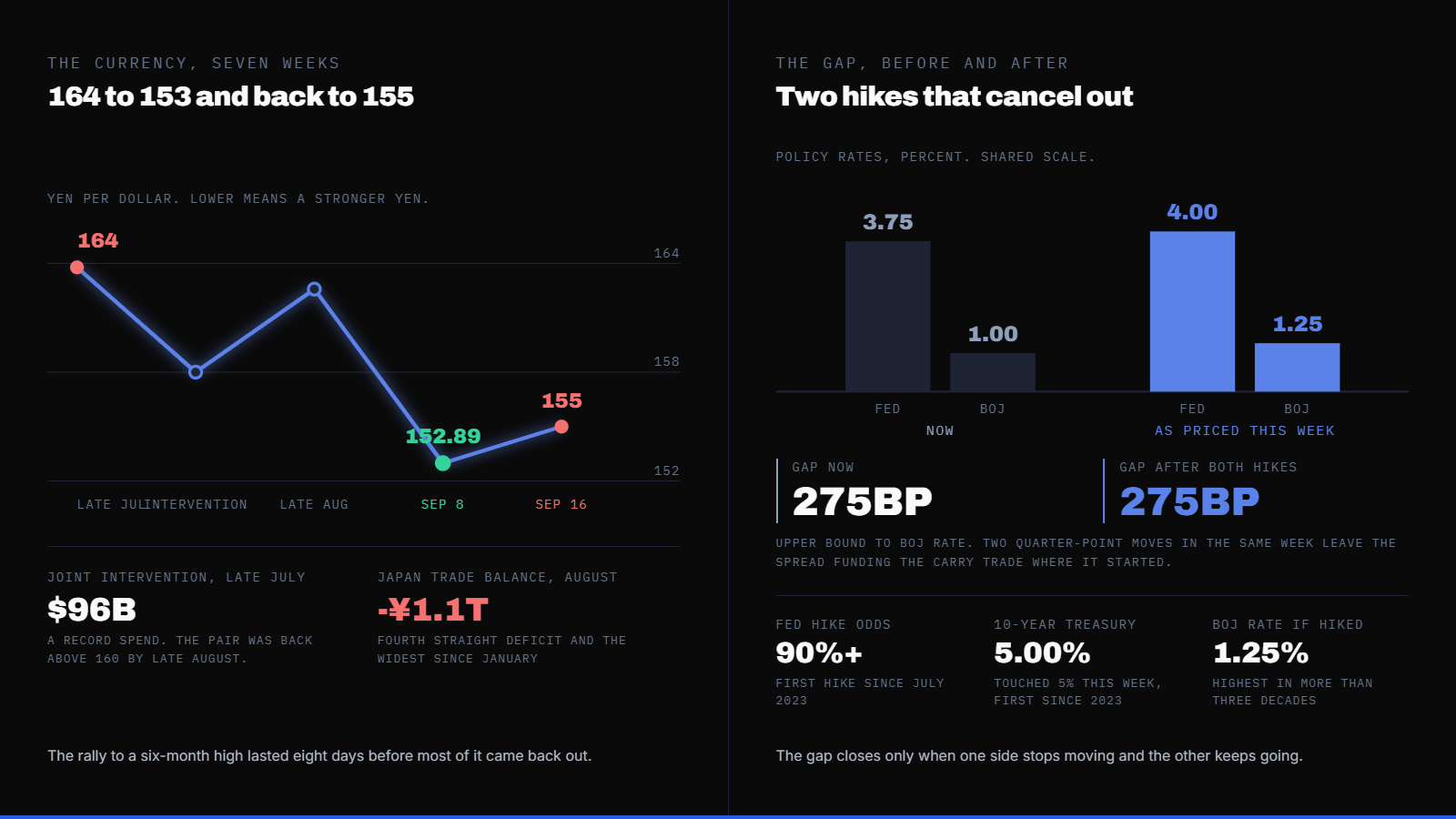
Eight days. That's how long it took for the yen's best rally in six months to unwind. On September 8, the dollar bought as few as 152.89 yen, the strongest the Japanese currency had been since the spring, as traders bet the Bank of Japan was finally closing in on a rate hike big enough to matter. By Wednesday morning the pair was back near 155, and most of that move had already come back out.
Two central banks are set to move within 48 hours of each other. The Federal Reserve announces its own decision this afternoon, expected to raise the federal funds rate a quarter point, from 3.50%-3.75% to 3.75%-4.00%, the first increase since July 2023 after a Fed that cut rates three times last year abruptly reversed course. The Bank of Japan follows two days later, meeting Thursday and Friday with markets pricing a hike of its own to 1.25%. Two central banks, moving in the same direction, land inside the same short window, after weeks in which the market spent most of its energy debating which one would blink first.
What Changed
Nine months ago the Fed was still cutting. It lowered rates three times through 2025, the last move coming in December, and penciled in just one more reduction for 2026. Then oil turned. Crude has climbed roughly 23% over the past month alone and now trades above $104 a barrel, adding fresh pressure to an inflation picture that was already running hotter than the Fed's 2% target. Wholesale prices jumped to 5.4% in August, and a hot core CPI reading in the same stretch pushed rate-hike odds from 70% to 90% within hours. Fed Chair Kevin Warsh spent his first Jackson Hole speech in August warning that policymakers still "have work to do" on inflation, and traders have been marking up hike odds ever since.
Japan's story moved on a different but related track. Tokyo and Washington carried out a rare joint currency intervention in late July, spending a record $96 billion to pull the yen back from a four-decade low near 164. The relief didn't hold. By late August the pair had climbed back above 160, erasing most of what the intervention bought, and the currency spent the following weeks caught between intervention fatigue and rising bets on a Bank of Japan hike. That tug of war produced September 8's spike to a six-month high. It also produced this week's retreat, as some of that positioning unwound before the actual decision even arrived.
Why It Matters
The obvious read is that both central banks tightening should shrink the gap between US and Japanese interest rates, the gap that funds the yen carry trade: borrow cheaply in yen, invest the proceeds in higher-yielding dollar assets, and pocket the spread. That read holds in absolute terms. It breaks down at the margin. The Fed's rate already sits roughly 250 to 275 basis points above the Bank of Japan's, and if both banks hike a quarter point on schedule this week, that gap barely moves. Two hikes delivered in the same short window cancel each other out almost exactly, which means the trade that has been funding a large share of global risk-taking stays about as attractive Friday as it was Tuesday.
That matters because the positioning behind it isn't small. Japanese investors hold trillions of dollars in foreign bonds and equities, much of it financed with yen borrowed at rates that stayed near zero for most of the past decade. A currency move sharp enough to force even a partial unwind of those positions has moved global bond markets before, and analysts have flagged the gap between US and Japanese yields narrowing past levels once considered a trigger for repatriation.
There's a trade angle too. Japan's widening deficit, ¥1.1 trillion in August alone, shows energy costs eating into the country's external accounts even as chip and AI-hardware exports hold up better than the rest of the economy. A weaker yen makes that import bill worse in local currency terms, part of why Tokyo has been willing to intervene directly in currency markets rather than simply waiting on the Bank of Japan to do the work.
What to Watch Next
Today's Fed decision is close to fully priced, so the more interesting signal is likely to come from Kevin Warsh's press conference and whether the Fed's updated quarterly projections show more tightening ahead or frame this move as one and done. The 10-year Treasury yield already touched 5% this week for the first time since 2023 on anticipation of today's move, and how that yield behaves after the announcement will say a lot about whether markets think the Fed is finished.
Friday's Bank of Japan decision carries its own risk. A hike delivered without a hawkish enough tone from Governor Kazuo Ueda could send the yen right back toward 160, undoing both the intervention and two months of tightening bets in a single session. A surprise on the size of the move, or an unexpectedly cautious statement, would likely shift the pair more than the decision itself. Either way, the gap between the two central banks' policy paths, not the headline hike, is the number that actually determines whether the carry trade keeps working.
The Pulse24 Take
The market has spent two months treating the Fed-BOJ gap like a countdown clock, as though closing it were simply a matter of getting both central banks into the same meeting room. This week is a reminder that two hikes moving in lockstep don't close a gap. They preserve it. The yen's round trip from 164 to 153 and back to 155 in about seven weeks looks less like a currency finding its footing and more like a market repricing the same uncertain outcome every time new data arrives.
The more durable question isn't whether the Fed and the Bank of Japan hike this week. Most of that is already in the price. It's whether either central bank signals it's done, because a gap this size only really closes when one side stops moving and the other keeps going. Until that happens, expect more weeks like this one: sharp currency moves that look decisive in the moment and mostly unwind before the next headline arrives.
How we read the data
Curious how we get from raw data to a take like this? Our Trader's Toolkit walks through the tools we lean on.
Explore the Toolkit