Pulse24 Original
Companies With 500 or More Workers Added 34,000 Jobs in August. Every Smaller Private Employer in the Country Combined Added Only 3,000.
September 2, 2026
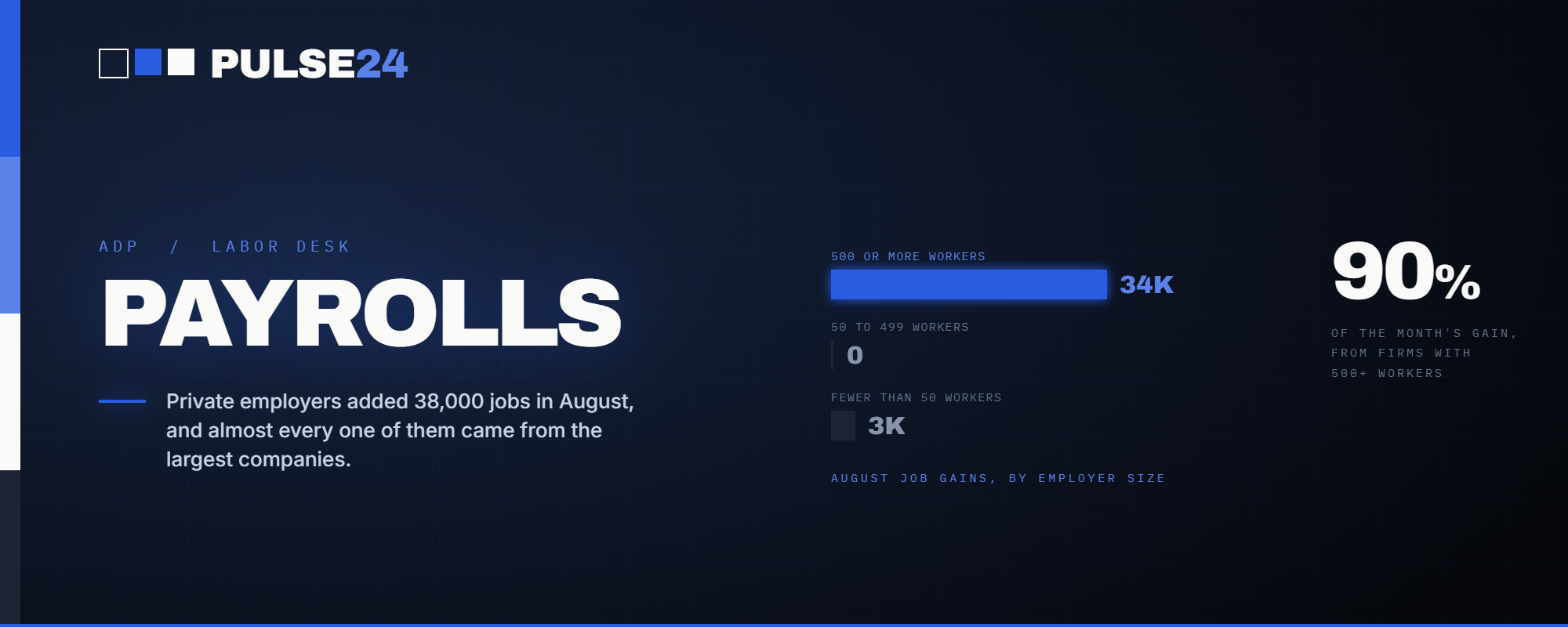
Private payrolls grew by 38,000 in August, missing forecasts, and companies with 500 or more workers accounted for nearly all of the gain. Small and mid-sized employers, which together make up most of the private economy, added almost nothing.
Thirty-eight thousand. That's how many private-sector jobs American employers added in August, according to ADP's National Employment Report released Wednesday, short of the 48,000 economists had penciled in. A modest miss like that wouldn't normally be much of a story on its own. What's underneath the headline number is more interesting: nearly all of the hiring came from one part of the economy, and almost none of it came from the part that usually leads a labor market higher or lower.
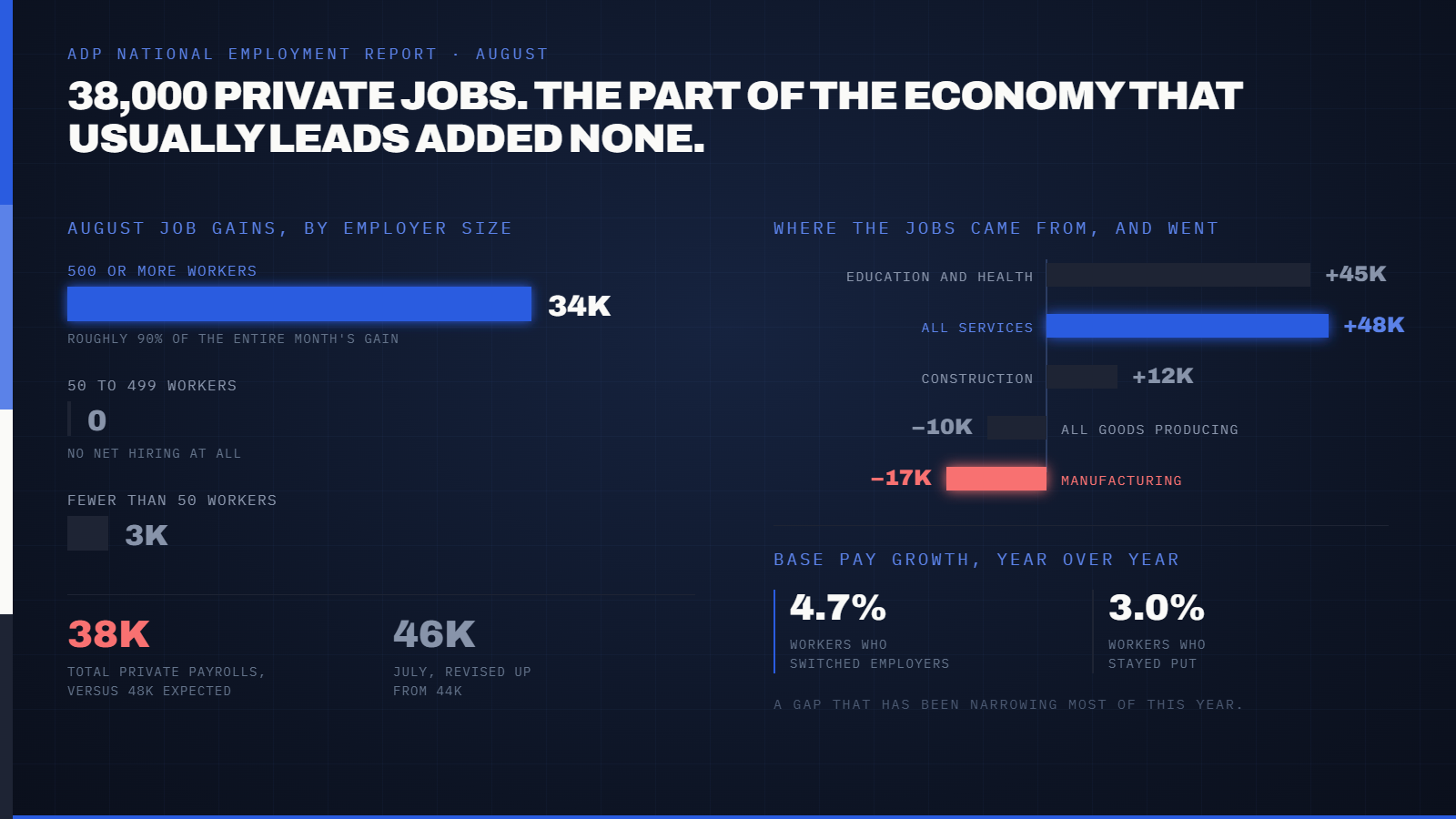
Break the report down by company size and the picture sharpens. Employers with 500 or more workers added 34,000 jobs last month, accounting for roughly 90% of the entire gain. Mid-sized companies, those with 50 to 499 employees, added zero net jobs. Small businesses, the ones with fewer than 50 workers, added just 3,000 combined. Put another way, the small and mid-sized employers that together employ tens of millions of Americans essentially sat on their hands in August while a handful of large corporations did nearly all the hiring.
What Changed
The sector breakdown tells a similar story of unevenness. Goods-producing industries lost 10,000 jobs in aggregate, dragged down by a 17,000 decline in manufacturing that construction's 12,000 gain couldn't fully offset. Service-providing industries added 48,000, but that total leaned heavily on two sectors: education and health services contributed 45,000 of it, and leisure and hospitality added another 16,000. Professional and business services, often a bellwether for corporate hiring confidence, shed 16,000 positions. Trade, transportation and utilities lost 5,000, and information lost 4,000.
Wage data adds another layer. Employees who stayed in their current jobs saw base pay rise 3.0% year over year in August, while those who switched employers saw base pay rise 4.7%, a gap of 1.7 percentage points. On a gross pay basis, which includes overtime and bonuses, the same divide widens to 7.3% for job-changers versus 4.4% for job-stayers. ADP Chief Economist Nela Richardson framed the report this way: 'Pay can tell us a lot about today's choppy hiring. To understand hiring patterns, you have to look deeply into where pay growth is accelerating,' and, separately, that wage trends have 'been overtaken by complexities of demographic change, persistent inflation, and AI's effects on jobs.'
Why It Matters
The timing matters here. The Federal Reserve's rate-setting committee meets September 15-16, and futures markets have spent the past week arguing over how confident to be in a hike. A single soft ADP print doesn't settle that argument, ADP's count and the official Bureau of Labor Statistics number have diverged before, but it fits a pattern that's been building. Earlier this year, the BLS's own annual benchmark revision showed the economy added 79,000 fewer jobs than first reported for the twelve months through March, evidence that the labor market has been running cooler than the initial monthly prints suggested all along.
That's the dovish half of the setup. The hawkish half is inflation, which hasn't cooperated nearly as much as the Fed would like. ISM's manufacturing survey showed its prices-paid index stuck at 71.1% in August, matching July's reading and sitting near a multi-year high, even as new orders in that same survey fell. Fed officials now have to weigh a labor market that's cooling, at least outside of the largest companies, against a cost environment that refuses to ease. That combination is why rate-hike odds have stayed elevated even as jobs data has softened, and it's why Friday's official report carries more weight than a typical monthly release.
What to Watch Next
Two dates matter most from here. Friday brings the official BLS employment report for August, the number that actually moves the Fed's thinking more than any private survey does. Economists will be watching whether the unemployment rate held steady and whether the government's own payroll count shows the same size-based split ADP just flagged. Then comes September 16, when the Fed announces its decision. If Friday's report confirms a labor market cooling unevenly by company size, hawks on the committee lose one of their stronger arguments for another hike. If it doesn't, expect this ADP report to get treated as a one-month blip rather than the start of something.
The Pulse24 Take
The 38,000 headline number is the least useful part of this report. Monthly ADP prints bounce around, and a 10,000-job miss against consensus isn't the kind of gap that should move anyone's Fed forecast on its own. What deserves more attention is where the hiring came from. When roughly 90% of a month's job gains sit with companies large enough to employ 500 or more people, and the small and mid-sized businesses that make up most of the private economy add almost nothing, that's not a random distribution. It usually means the companies with the deepest balance sheets are still willing to bet on growth, while everyone else is waiting for more clarity on rates, costs, or demand before committing to new hires.
That divide is worth watching independent of what Friday's payrolls report shows. A labor market where only the largest employers are still hiring behaves differently than one where hiring is broad and shared, even when the aggregate job count looks similar on paper. Small and mid-sized businesses tend to be the first to pull back when they're nervous and the first to hire again when they're not. Right now, they're doing neither, and that hesitation may be a more useful signal for where the economy is headed than the headline number most coverage will lead with.
How we read the data
Curious how we get from raw data to a take like this? Our Trader's Toolkit walks through the tools we lean on.
Explore the Toolkit