Pulse24 Original
The ISM's Prices Index Sat at 71.1% in July and 71.1% Again in August. New Orders Fell Three Points to 53.7% the Same Month, and the Fed Has to Reconcile Both by September 16.
September 2, 2026
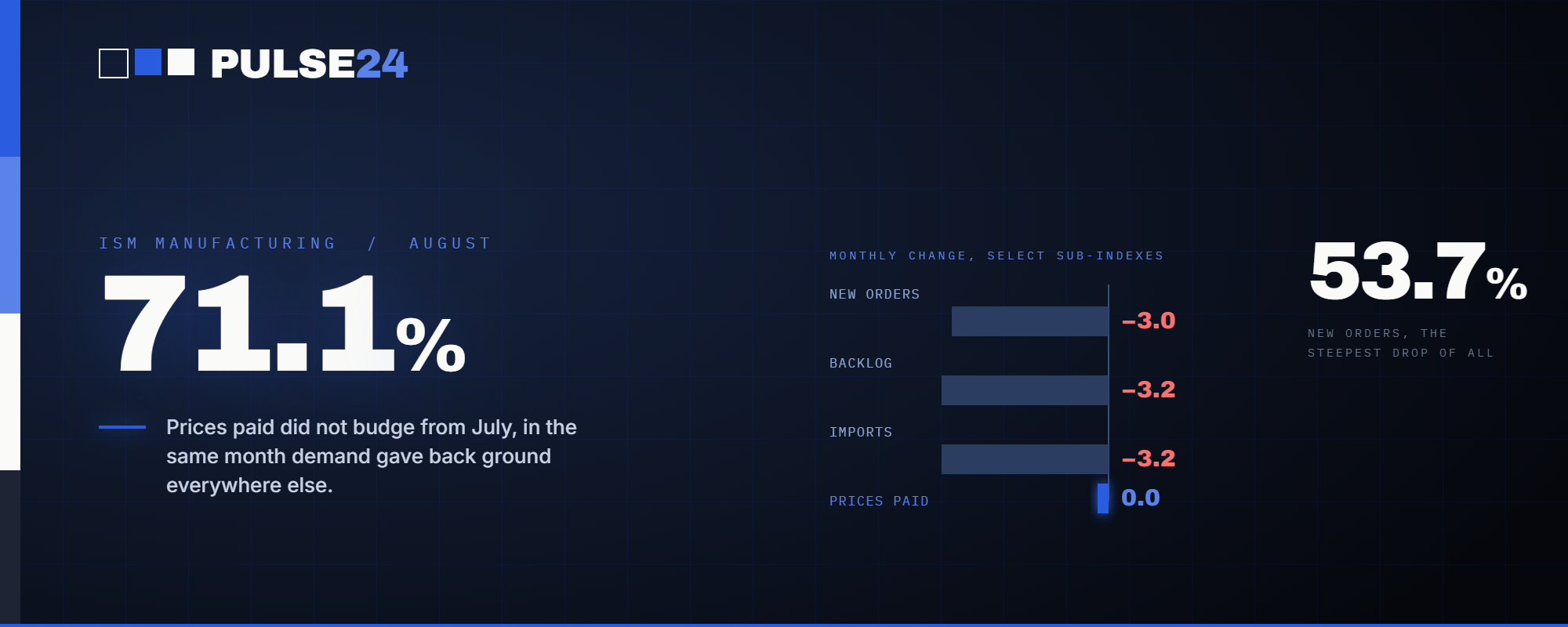
August's ISM Manufacturing survey found factory demand cooling fast, with new orders, backlog and imports each losing three points or more in a single month. Prices paid didn't move at all, stuck at a level ISM itself treats as severe, just as the Fed weighs its September rate decision.
Fifty-four point six. That's where the ISM Manufacturing PMI landed for August, a full point below July's 55.6% but still comfortably inside expansion territory for an eighth straight month. Look past that headline number and the report pulls in two directions at once. New orders dropped three points. Backlog and imports each fell more than three. Prices paid sat exactly where they sat a month earlier, at 71.1%, a level ISM's own committee treats as evidence of severe, widespread cost pressure. Demand is cooling. Prices aren't. That split arrives four days after Fed Chair Kevin Warsh used his first Jackson Hole speech to warn that the central bank still has work to do on inflation, and it lands on a Fed that has to decide by September 16 which half of the report to believe.
What Changed
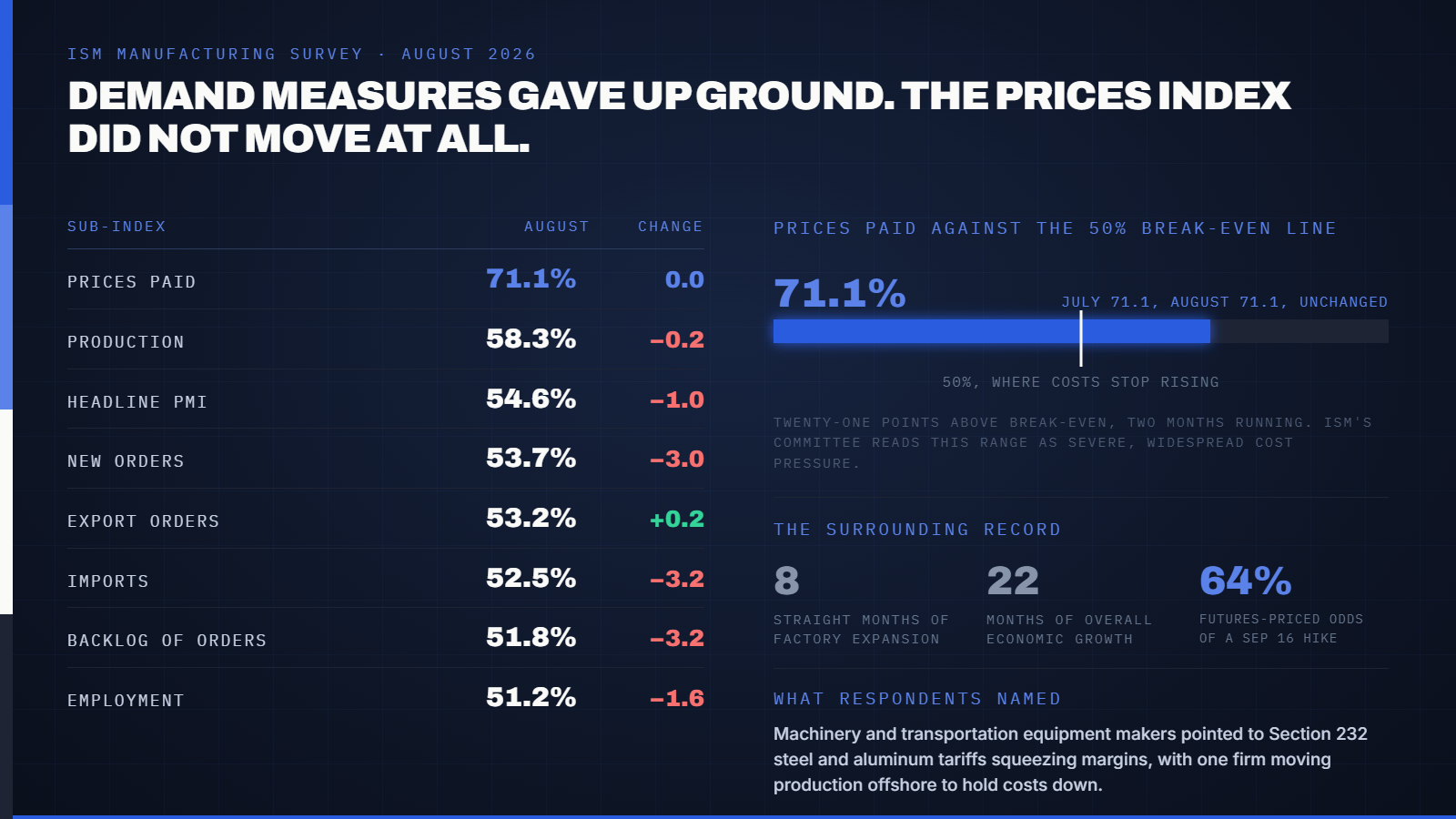
Ten sub-indexes make up the ISM Manufacturing report, and August's version reads like a survey pulling apart at the seams. New orders fell from 56.7% to 53.7%, a three-point drop that ISM chair Susan Spence flagged directly, noting the sector "has lost ground in a number of key measures, namely the new orders, backlog and imports indexes." Backlog of orders confirmed it, down 3.2 points to 51.8%. Imports fell the identical 3.2 points to 52.5%. Production held up better, slipping just 0.2 point to 58.3%, and export orders actually ticked up 0.2 point to 53.2%, so the softening looks concentrated in domestic demand rather than a broad collapse.
The Prices Index is the number that stands out precisely because it refused to move. At 71.1% for a second straight month, it sits far above the 50% break-even line that separates rising from falling costs, elevated enough that respondents across multiple industries named it their top concern. A machinery manufacturer reported prices "continue to rise on all goods" and said the company had "moved more products to offshore sources to try to minimize cost impacts." A transportation equipment maker pointed to elevated steel and aluminum prices tied to Section 232 tariffs as a direct hit to profitability. Pulse24 flagged the national ISM print as the next checkpoint to watch when Chicago's regional survey swung into contraction days earlier; the national data didn't repeat Chicago's contraction, but it echoed the same underlying tension between softening demand and inflation that won't quit.
Why It Matters
This is close to the setup the Fed likes least. A cooling-but-still-positive demand picture would normally argue for patience, maybe even room to ease. A prices index stuck near 71% argues the opposite, for tightening now before cost pressure works its way further into finished goods. Kevin Warsh's Jackson Hole speech leaned entirely on the second half of that equation, and traders responded by pushing September rate-hike odds above 50% within hours. By the time this report crossed the wire, CME futures had those odds sitting closer to 64%, even as some retail platforms were quoting figures as high as 90%, a gap between perception and pricing that hasn't fully closed.
The inflation side of the argument has real backing beyond one survey. Core PCE, the Fed's preferred gauge, held at 3.3% in July, exactly as forecast and still nearly two full points above target. Headline PCE ran at 3.7%. Put a Prices Index at 71.1% next to that and the case for a September hike gets easier to make, even with new orders and backlog both sliding. The 10-year Treasury yield touched 4.81% this week, and gold has fallen hard on the same jump in short-dated yields, both consistent with a market leaning toward tighter policy rather than looser.
Where the report cuts against the hike case is the demand trend itself. A three-point monthly drop in new orders, echoed by similar declines in backlog and imports, is the kind of signal that has historically made the Fed pause before adding restriction to an economy already showing cracks. Employment slipping to 51.2% adds to that side of the ledger. Neither number is a warning sign on its own. Together, in the same report, they're the reason this print didn't settle anything.
What to Watch Next
ISM's Services PMI is due later this week and will show whether the same pattern, cooling demand paired with prices that won't ease, extends beyond factories into the much larger services side of the economy. The August jobs report follows on Friday, and after July's benchmark revision cut 79,000 jobs from the prior year's count, another soft print would give the demand-side argument more weight heading into the Fed's meeting.
From there, the calendar narrows fast. The Fed's September 15-16 meeting will land with a full slate of the data investors have been trading all month: two PMI reports, a jobs number, and whatever core PCE reading arrives in between. Markets are currently pricing something close to a coin flip on a hike. A report this mixed does little to move that needle in either direction, which likely means the next single data point that breaks decisively one way carries outsized weight.
The Pulse24 Take
Stagflation is a word that gets reached for too easily. Any month where inflation and soft growth data show up together tends to invite it, and most of the time the label doesn't hold up once the next report arrives. This one has more going for it than most recent claims to the term: a Prices Index parked at a level ISM treats as severe for two straight months, sitting next to a demand picture that just posted its weakest new-orders reading since spring. Neither fact alone would carry much weight. Together, they're harder to wave off.
What makes this report worth watching isn't the headline PMI figure. Manufacturing staying in expansion for an eighth month is, on its own, a mildly reassuring data point. It's the internals, the gap between a prices gauge that hasn't budged and demand indicators that are all moving the same direction at once, that deserves the attention. The Fed has three weeks and at least two more major data releases to figure out which side of that gap matters more. Betting on the outcome before then is mostly a guess dressed up as conviction.
How we read the data
Curious how we get from raw data to a take like this? Our Trader's Toolkit walks through the tools we lean on.
Explore the Toolkit