Pulse24 Original
Chicago PMI Crashed From 57.6 to 47.1 in a Month, the Sharpest Miss of 2026. The Report Landed Minutes Before Kevin Warsh Told Jackson Hole the Fed Still Has Work to Do.
August 30, 2026
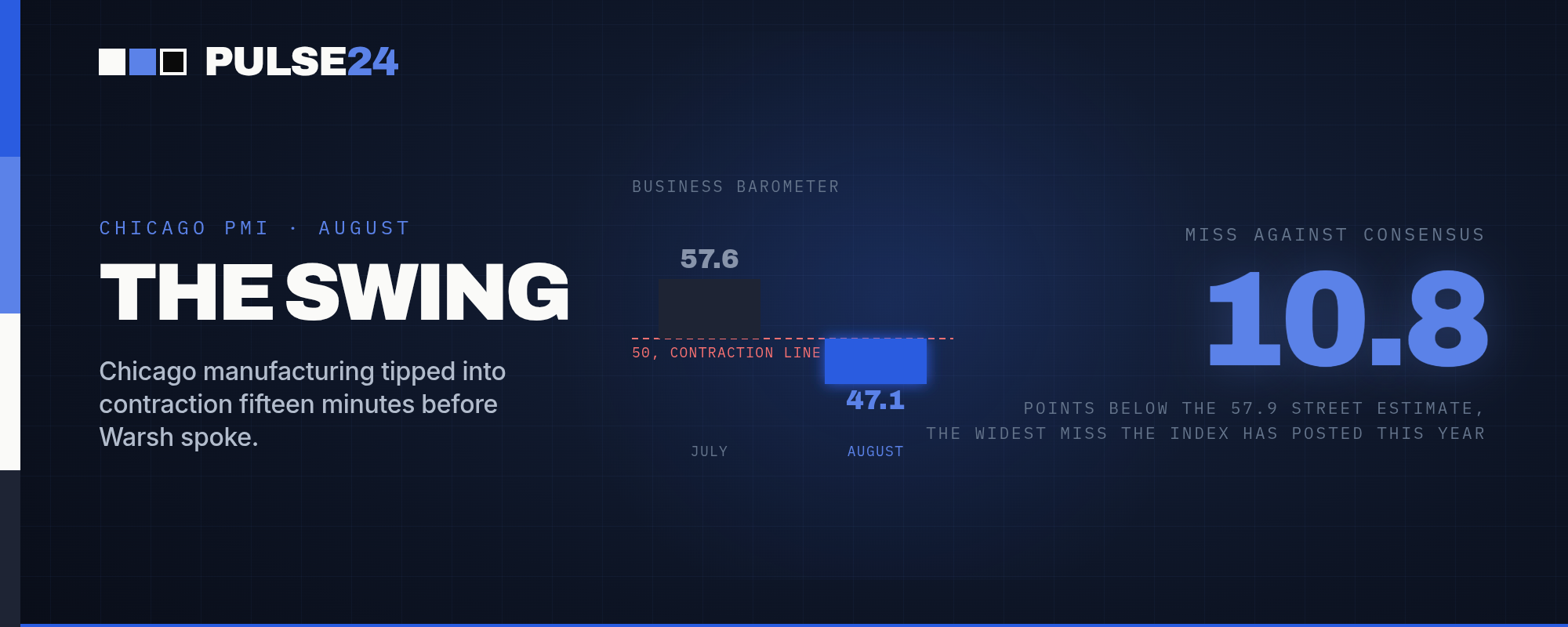
Chicago's Business Barometer swung from expansion to contraction in a single month, missing forecasts by nearly eleven points. The report landed minutes before the Fed's new chair doubled down on inflation at Jackson Hole, leaving traders to reconcile two very different signals about where the economy is headed.
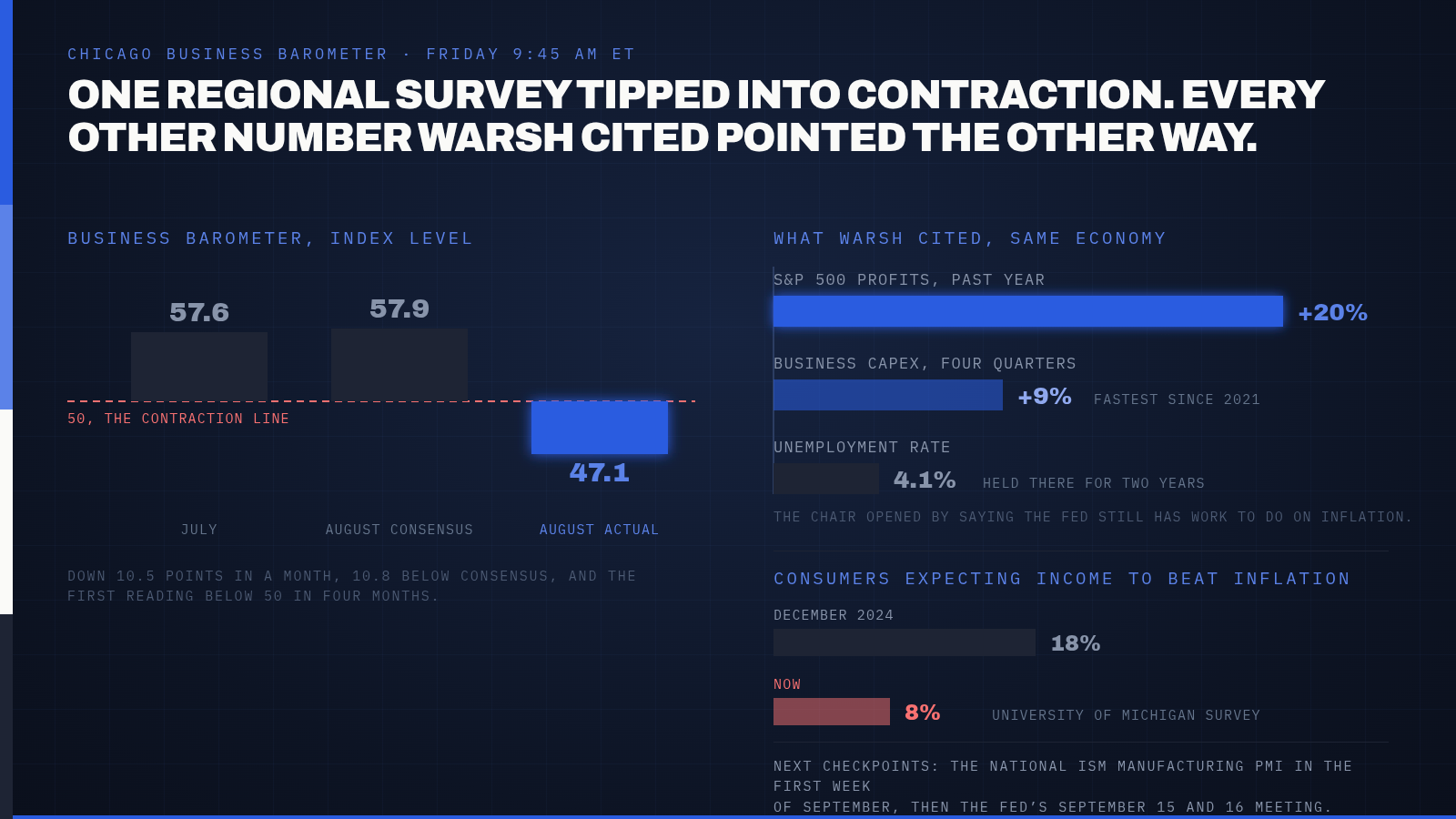
Chicago's Business Barometer, the regional survey better known as the Chicago PMI, fell from 57.6 in July to 47.1 in August. That's a 10.5-point decline that also left the index about 10.8 points below Wall Street's consensus estimate of 57.9, the widest miss it has posted all year, and it pushed the gauge back below the 50 line separating expansion from contraction for the first time in four months.
The timing is what made Friday interesting. The report crossed the wire at 9:45 a.m. Eastern, just fifteen minutes before Fed Chair Kevin Warsh stepped to the podium at the Jackson Hole Economic Policy Symposium at 10 a.m. and delivered his first keynote as chair. His message was unambiguous: inflation is running above the Fed's 2% target, and "we have work to do" if officials aren't confident it's returning there at a sufficient pace. Pulse24 covered that speech and the market's reaction to it in detail; this piece is about the data point that landed just ahead of it and complicates the picture Warsh was painting.
What Changed
A one-month, 10.5-point swing in a regional business survey doesn't usually make headlines on its own. What set this one apart is the size of the miss and what it broke from. July's reading of 57.6 had been comfortably in expansion territory, bolstered by stronger new orders, and it fit an economy Warsh himself described as running hot: business capital expenditures up 9% on a four-quarter basis, the fastest pace since 2021, and profits at S&P 500 companies up more than 20% over the past year, a gain that echoes the sharp profit jump Pulse24 tracked in the government's second read on second-quarter GDP. Unemployment, meanwhile, has held at 4.1% for two years running.
None of that squares easily with a manufacturing gauge that just swung from comfortably above the contraction line to well below it in a single month. Chicago's index is a regional read, not a national one, and volatile enough that one soft print doesn't confirm a trend by itself. It's also watched as an early signal for the national ISM Manufacturing PMI, due in the first days of September, which makes a swing this size harder to dismiss as noise.
Why It Matters
The Fed's dilemma just got harder to describe in a single sentence. Warsh's speech leaned entirely on the inflation side of the mandate: headline PCE running at 3.7% annually, core PCE holding at 3.3% in July, both well above target, with more than half the goods and services in the PCE basket still posting price gains above 3%. That's the case for a September rate hike, and traders responded within hours by pushing the implied odds of one above 50%.
Chicago's PMI argues the other side without saying a word about prices. A manufacturing sector swinging into contraction is a sector pulling back on hiring, output, and orders, the kind of slowdown that has historically made central banks more cautious about tightening, not less. Add in consumer sentiment data from the same week, where only 8% of households now expect their income to outpace inflation this year, down sharply from 18% in December 2024, and the picture looks less like an economy that needs cooling and more like one where the cooling may already be underway in places the Fed's preferred inflation gauge doesn't capture.
This is close to the textbook version of a central bank's hardest problem. Inflation data argues for tightening. Growth data argues against it. Raise rates into a manufacturing contraction and the Fed risks accelerating a slowdown that hasn't shown up in the jobs numbers yet. Hold off and risk validating Warsh's own warning that price pressure isn't cooling fast enough. Friday's data doesn't offer a way to avoid choosing between those two risks.
What to Watch Next
Two dates matter more than usual now. The national ISM Manufacturing PMI, due the first business day of September, will show whether Chicago's contraction was a one-off or the leading edge of something broader; a second weak print would be far harder to dismiss than a single regional survey. Then comes the Fed's September 15-16 meeting, where policymakers will have a full month of additional inflation data and, potentially, a clearer national manufacturing read to weigh against Warsh's Jackson Hole message.
Watch how other Fed officials respond, too. A hawkish chair speaking largely alone still moves markets, but a hawkish chair backed by colleagues citing weaker growth data as a reason for restraint would be a meaningfully different signal than the one markets priced in on Friday.
The Pulse24 Take
Markets spent Friday trading Warsh's words, not Friday's data. Gold, the dollar, and Treasury yields all moved on the Jackson Hole speech, understandably so, since a new Fed chair's first extended remarks on policy carry more weight than a single regional survey. But the Chicago PMI report deserves more attention than it got, because it's the kind of number that tends to matter more in hindsight than it does on the day it's released.
Stagflation gets thrown around any time inflation and weak growth show up in the same week, and it's usually an overstatement. This case has more going for it than most: an inflation basket still running hot enough that the Fed chair felt compelled to warn about it, sitting next to a manufacturing survey that just posted its worst reading of the year. Neither data point settles the question on its own. Together, they suggest the easier stretch of this cycle, when inflation and growth data mostly pointed the same direction, may be ending.
How we read the data
Curious how we get from raw data to a take like this? Our Trader's Toolkit walks through the tools we lean on.
Explore the Toolkit