Pulse24 Original
American Consumers Turned Sharply Gloomier in August. Sentiment Fell to 51.7 From a Five-Month High of 55.2, Even as Inflation Expectations Eased to 4%.
August 29, 2026
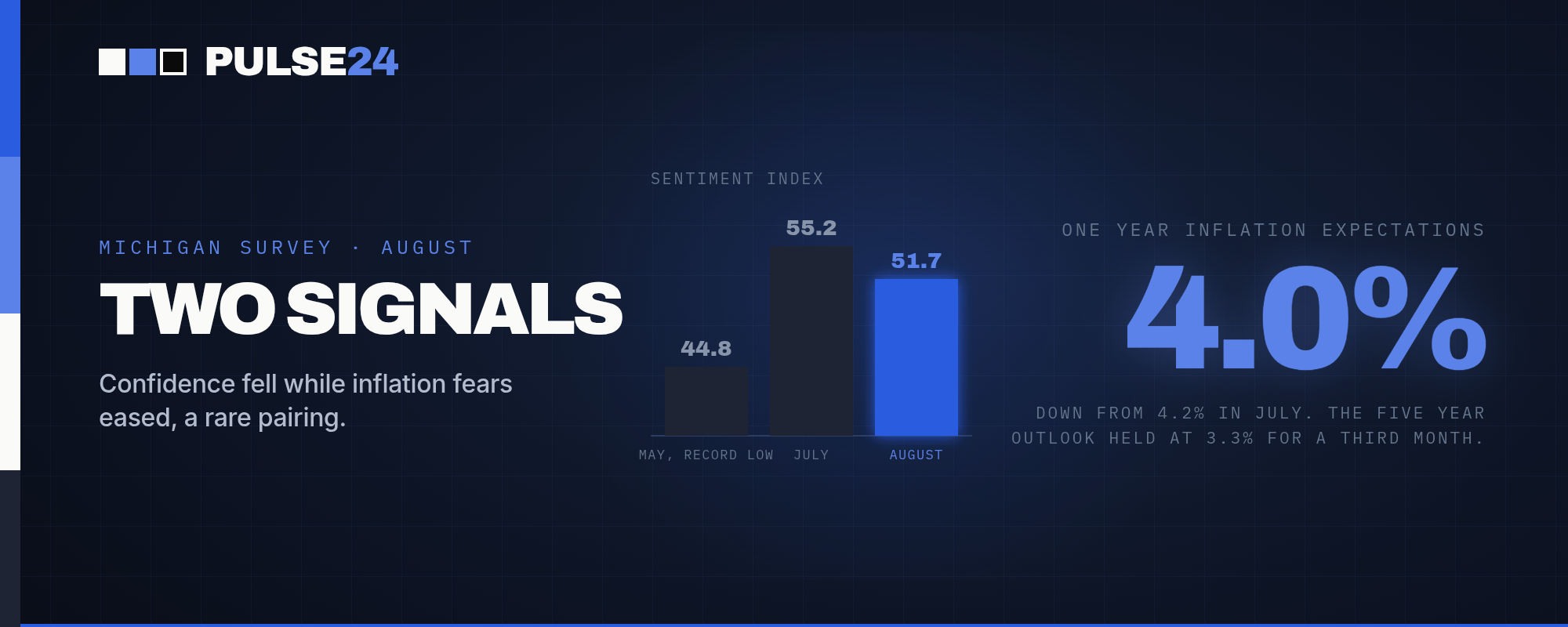
Consumer sentiment fell to 51.7 in August, giving back most of a two-month rebound. The stranger part: inflation expectations eased instead of climbing, a combination the Fed rarely sees together.
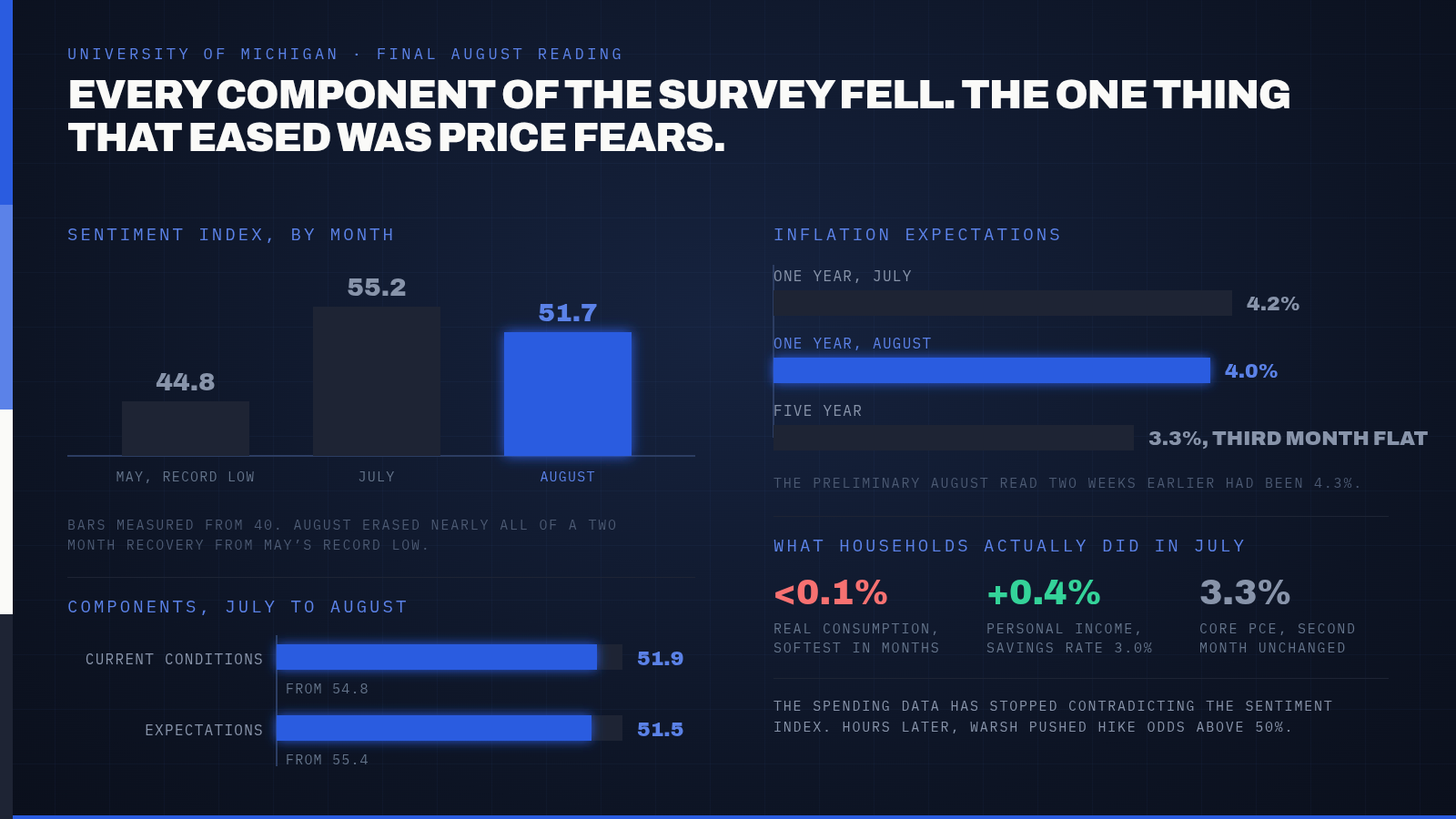
The University of Michigan's consumer sentiment index fell to 51.7 in its final August reading, released Friday, down from 55.2 in July. That decline erased almost all of a two-month recovery that began after the index touched a record low of 44.8 in May, the weakest reading since the survey started tracking sentiment in 1952. Every major component of the report moved lower. The Current Economic Conditions gauge slipped to 51.9 from 54.8, and the Index of Consumer Expectations, which asks households how they see the next year unfolding, dropped to 51.5 from 55.4.
Inflation expectations told a different story. Consumers now expect prices to rise 4.0% over the next year, down from 4.2% in July and well below the 4.3% preliminary reading from two weeks earlier. The five-year outlook held at 3.3%, unchanged for a third straight month. Falling confidence paired with easing price fears is not the combination that usually shows up together in this survey.
What Changed
For much of this year, a standard rebuttal has followed every weak Michigan reading: strategists point out that what households tell pollsters and what they actually do with their money often diverge, and that spending kept climbing even as sentiment sat near historic lows. July's spending data narrows that gap. Real personal consumption expenditures grew less than 0.1% for the month, according to the Commerce Department, the softest pace in months. Personal income rose 0.4%, and the savings rate held at 3.0%, while core PCE inflation stayed at 3.3% annually for a second straight month. None of those figures point to a recession on their own. They do mean the spending data has stopped contradicting what the sentiment index has been signaling since spring.
Timing sharpened the contrast further. Fed Chair Kevin Warsh used his first Jackson Hole keynote on Friday to sharpen his inflation warning, and traders responded by pushing September rate-hike odds above 50% for the first time this cycle. Warsh's speech and the Michigan report landed hours apart, describing two different economies. One version has a Fed chair worried enough about prices to open the door to a hike. The other has a household survey where inflation fear is easing even as confidence in jobs and income keeps falling.
Why It Matters
Sentiment and inflation expectations usually move together, not apart. Anxiety about the economy tends to feed anxiety about prices, since both fears reinforce each other during a downturn scare. August's report looks more like a labor-market and income scare specifically. Joanne Hsu, the survey's director, pointed to the sharpest declines coming from older consumers, lower-income households, and those without a college degree, the groups with the thinnest cushion against a softening job market. That's a narrower kind of warning than the one markets have been pricing since Warsh spoke.
Retail earnings have been flashing something similar. Walmart posted its first US same-store sales miss in at least five years last quarter, and its own CFO pointed to gas prices above $4 a gallon rather than anything on the shelves. Target's profit forecast increase leaned almost entirely on a one-time tariff refund rather than underlying demand. Each of those looks like a company-specific story in isolation. Alongside Friday's sentiment data, they start to look like a pattern.
What to Watch Next
September's Michigan survey will show whether August was a one-month air pocket or the start of a trend, and its final reading lands three days before the Fed's September 16-17 meeting. A repeat of this month's pairing, sentiment falling while inflation expectations ease, would build the case for a Fed that leans toward cutting, regardless of the tone Warsh struck at Jackson Hole. Retail earnings from consumer-facing companies still reporting this quarter will offer another read on whether the pullback described in the survey is showing up in receipts, not just in answers to pollsters.
Watch the gap between the Current Conditions and Expectations components too. Consumers currently rate today's conditions and their outlook for the future almost identically, both in the low 50s. Historically, a wide gap between the two, expectations far below current conditions, has been a better recession signal than either index alone. Right now that gap barely exists, which argues against reading August's drop as a recession call just yet.
The Pulse24 Take
A single weak sentiment reading rarely moves markets anymore. Traders have grown used to confidence surveys sitting near historic lows while spending kept chugging along, and that disconnect made it easy to treat soft data as noise. What made Friday's report worth a second look wasn't the headline number. It was the pairing: sentiment falling at the same time inflation fear eased, in the same week real spending growth nearly stalled and the Fed's newest chair leaned hawkish.
None of this demands a dramatic reaction yet. One soft month of real PCE growth is not a trend, and the Michigan index has produced false alarms before. But the gap between what households tell pollsters and what they do with their wallets has been the main argument all year for shrugging off weak sentiment. That gap just got a little smaller, in the same week the Fed's own chair made the opposite argument about where rates are headed. Anyone leaning hard into either the hawkish read or the recession read might want to sit with that contradiction before picking a side.
How we read the data
Curious how we get from raw data to a take like this? Our Trader's Toolkit walks through the tools we lean on.
Explore the Toolkit