Pulse24 Original
Walmart Just Posted Its First US Same-Store Sales Miss in at Least Five Years. Its Own CFO Blamed Gas Prices Above $4, Not Anything on Its Shelves.
August 20, 2026
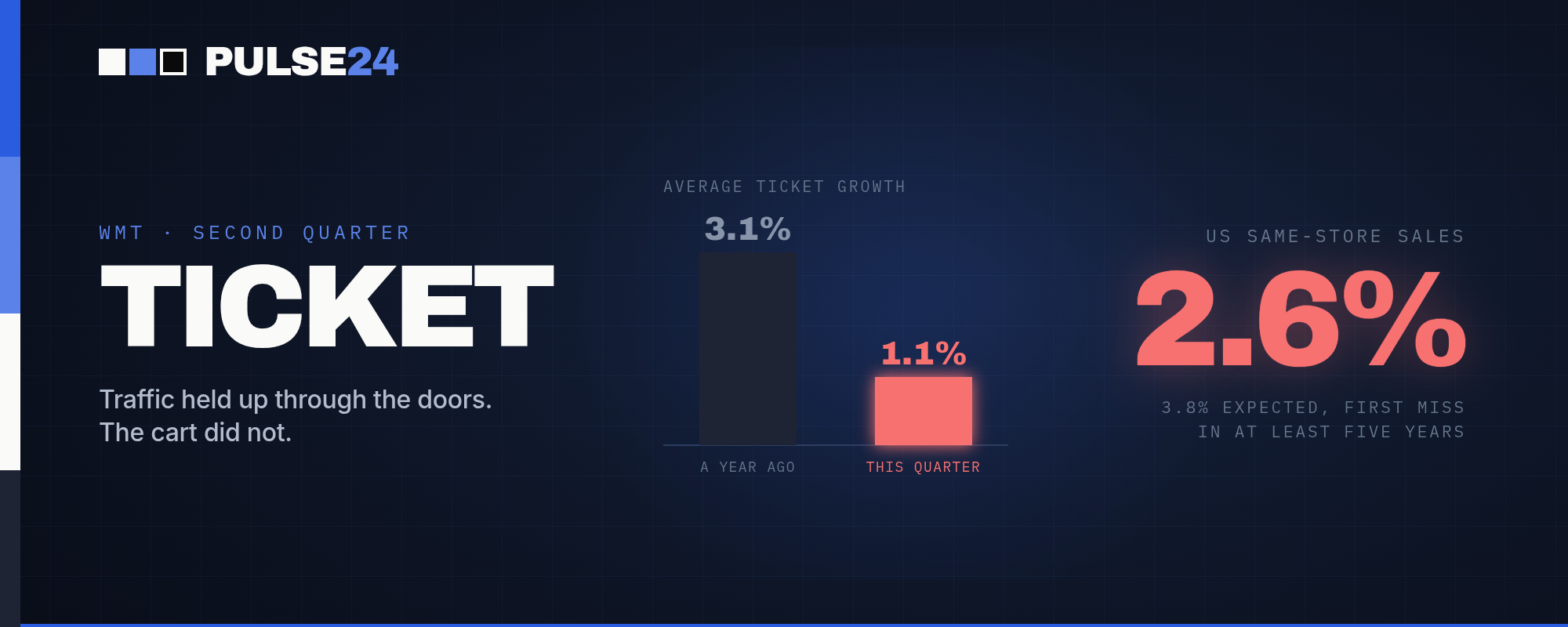
Walmart grew US same-store sales 2.6% last quarter, short of the 3.8% Wall Street wanted and its first miss on that number in at least five years. The company that usually wins when shoppers trade down is now the one flashing a warning about the American consumer.
Walmart is supposed to be the winner when money gets tight. When households cut back, they usually cut back into Walmart, swapping the pricier grocery run or the department-store trip for the everyday-low-price aisle. That pattern held through the 2022 inflation shock, through this year's tariff scares, through every recent stretch of consumer anxiety. On Thursday it cracked. Walmart reported US same-store sales growth of 2.6% for its second quarter, below the 3.8% Wall Street expected, and the first time in at least five years the retailer has missed on the one metric investors watch most closely. Shares fell about 9% to close at $103.84.
What Actually Changed
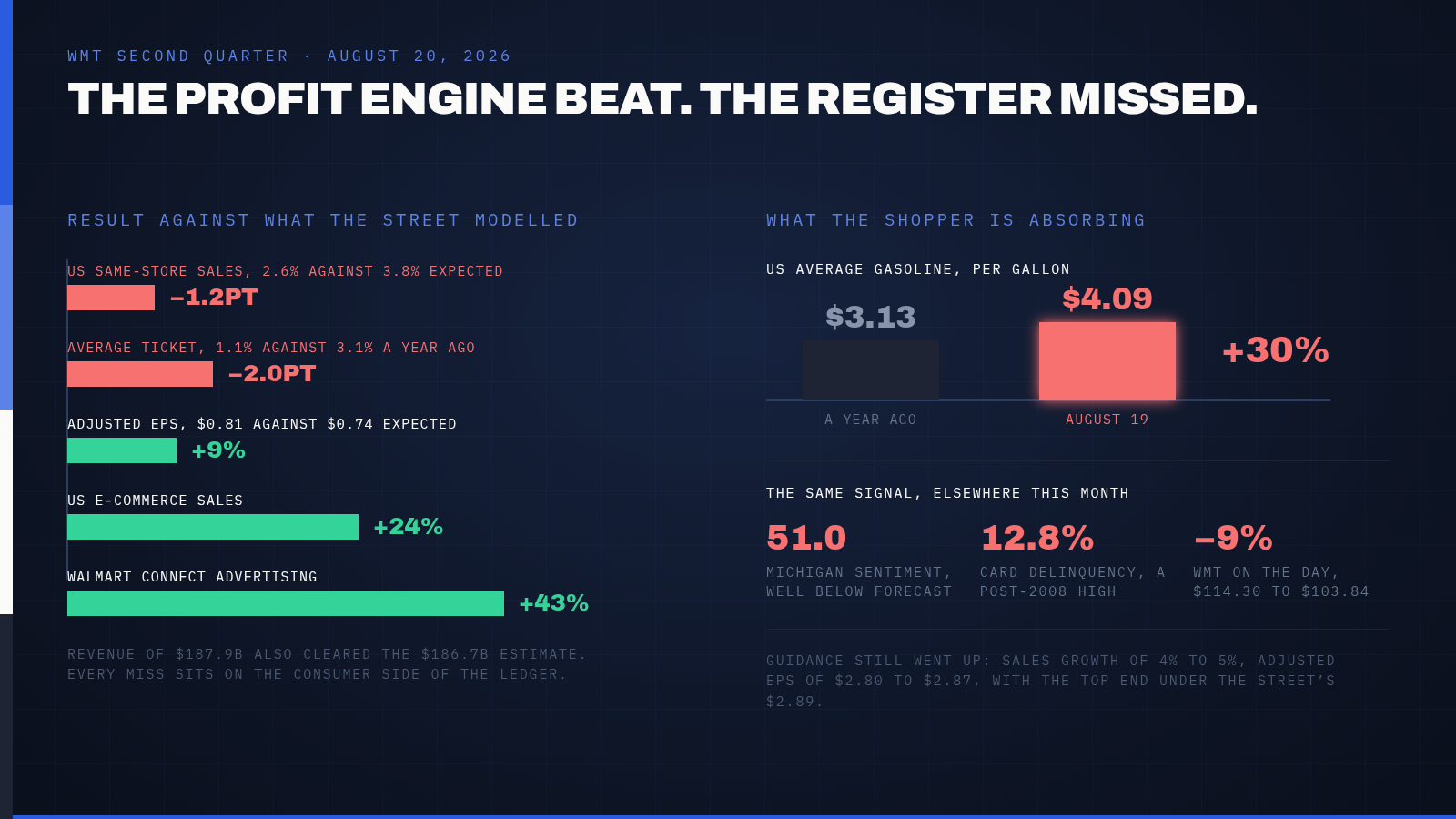
The headline was the same-store sales miss, but the detail underneath it mattered more. Average ticket, the amount a shopper spends per visit, grew only 1.1%, a sharp slowdown from 3.1% a year earlier. Traffic held up better than spending, which tells you something specific. People are still coming through the doors. They are just putting less in the cart. That is the signature of a consumer managing a budget, not one that has stopped shopping.
Not everything was soft. Total revenue came in at $187.9 billion, ahead of the $186.7 billion analysts modeled. Adjusted earnings of $0.81 a share beat the $0.74 estimate. E-commerce in the US grew 24%, and Walmart Connect, the company's advertising arm, jumped 43%. The profit engine is running fine. The problem sat squarely with the American shopper's willingness to spend.
Why It Matters
Walmart is the closest thing retail has to a live read on the whole US consumer. Its stores reach nearly every corner of the country, and its customer base spans income brackets in a way few retailers can claim. When Walmart's own traffic and ticket data soften at the same moment, it is hard to write the result off as a company-specific stumble. Brian Jacobsen of Annex Wealth Management put it bluntly: for the consumer economy, a Walmart slowdown is like Nvidia posting a slowdown for the AI trade. Walmart has spent two years winning the trade-down, and that tailwind may finally be fading.
The market read it the same way. A 9% single-day drop in a stock priced for relentless consistency is not a reaction to one soft quarter in isolation. It is investors repricing how much slack the US consumer has left.
The Fuel Price Problem
CFO John David Rainey did not point at competition or weather. He pointed at the gas pump. When fuel prices get above $4, he said, there is perhaps a psychological impact to that, and consumers are making trade-offs. The national average sat at $4.086 on August 19, up roughly 30% from about $3.13 a year earlier. Crude has pushed higher on tighter supply conditions, and that has fed straight into pump prices.
For a household running a tight monthly budget, an extra dollar a gallon is a direct tax on discretionary spending. Fill the tank, and there is less left over for the extra items that lift the average ticket. That mechanism connects a commodity price most people watch every week to the same-store sales line of the largest retailer on earth.
The Read on the Consumer
Walmart's warning does not arrive in a vacuum. Target reported this same week and leaned on a one-time tariff refund to lift its own forecast, a reminder that headline retail beats this season have often been built on accounting one-offs rather than underlying demand. The University of Michigan's sentiment index recently sank to 51.0, badly missing expectations. Retail sales came in weak enough to reshape rate-hike odds. And credit-card delinquencies have climbed to their highest level since the Great Recession.
String those together and a picture forms. The consumer is not collapsing, but the cushion is thinning. Walmart's ticket data is the latest and arguably clearest data point in that sequence, because it comes from the register rather than a survey.
What to Watch Next
Two things. First, whether the gas-price pressure eases. If crude and pump prices roll over into the fall, some of Walmart's lost ticket growth could return quickly, and this quarter starts to look like a blip. If fuel stays above $4, the pressure compounds into the holiday season.
Second, watch the Fed. A softening consumer complicates the case for the rate hike some officials have been leaning toward, since weaker demand does part of the central bank's inflation-fighting work on its own. Walmart's register just became a small input into that debate. If other retailers echo the same ticket softness over the next two weeks, the read-through to policy gets louder.
The Pulse24 Take
The instinct is to treat a Walmart miss as a Walmart problem. It rarely is. This is a company whose entire model is built to absorb consumer stress, not transmit it, which is exactly why a miss here carries more signal than a miss almost anywhere else in retail. The profit numbers were fine. The trade-down engine still works. What changed is that the shopper doing the trading down now has less to spend once the tank is full. That is not a story about Walmart's execution. It is a story about how much room the US consumer has left, and the honest answer this quarter is: less than the market assumed a week ago. Keep watching the ticket, not just the traffic. It is telling you where the squeeze actually lives.
How we read the data
Curious how we get from raw data to a take like this? Our Trader's Toolkit walks through the tools we lean on.
Explore the Toolkit