Pulse24 Original
Real GDP Slowed to 1.5% in the Second Quarter, Down From 2.1% in the First. Corporate Profits Still Jumped $400.9 Billion, More Than Five Times What They Rose Three Months Earlier.
August 27, 2026
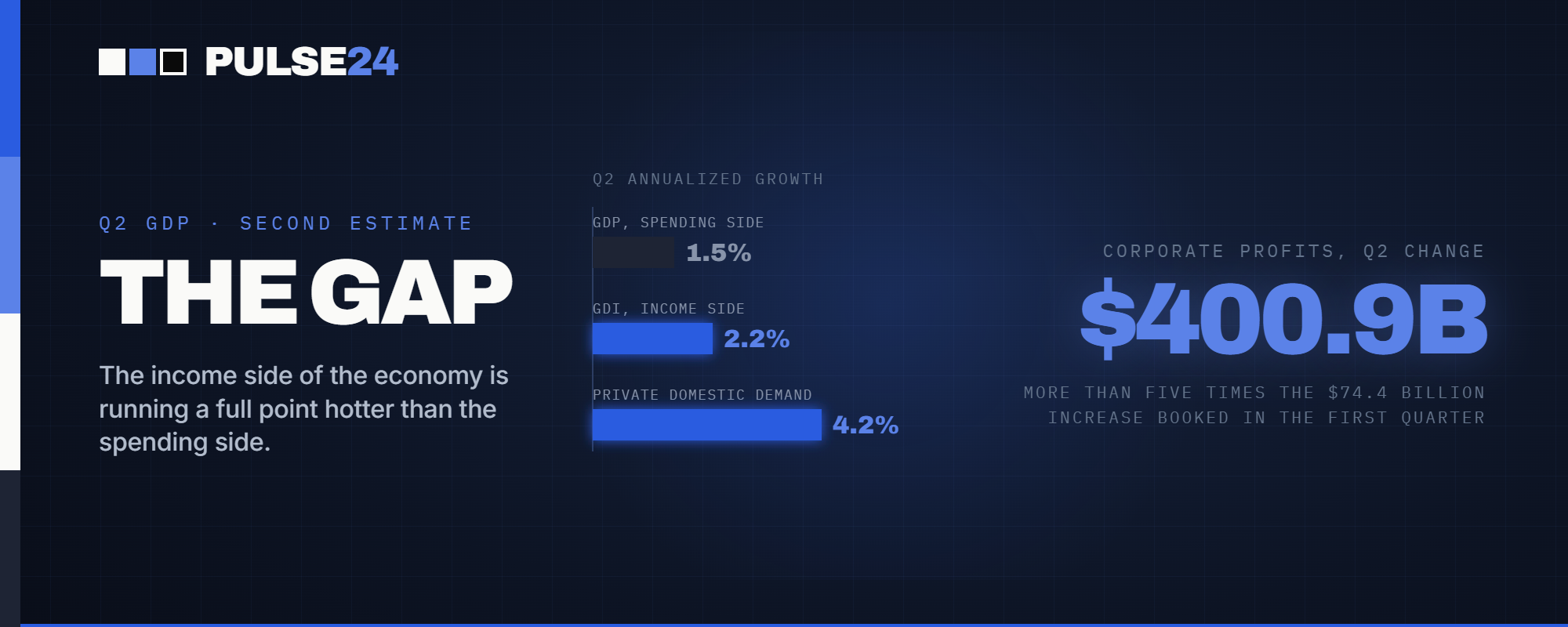
The government's second read on second-quarter GDP confirmed growth slowed to 1.5%, but corporate profits jumped more than five times faster than they did in the first quarter. The split between a soft headline number and a much stronger underlying economy lands right before Fed Chair Kevin Warsh's first Jackson Hole speech.
The Commerce Department's second look at second-quarter GDP, released Wednesday, confirmed the headline number nobody particularly loved the first time around. Real GDP grew at a 1.5% annualized rate between April and June, exactly what the advance estimate showed in July, and a step down from the first quarter's 2.1% pace. Economists had penciled in something closer to 2%, and a deceleration of that size would ordinarily be the whole story. Not this time. Buried in the same release are figures suggesting the economy underneath that headline number is running considerably hotter than 1.5% would imply.
What Changed
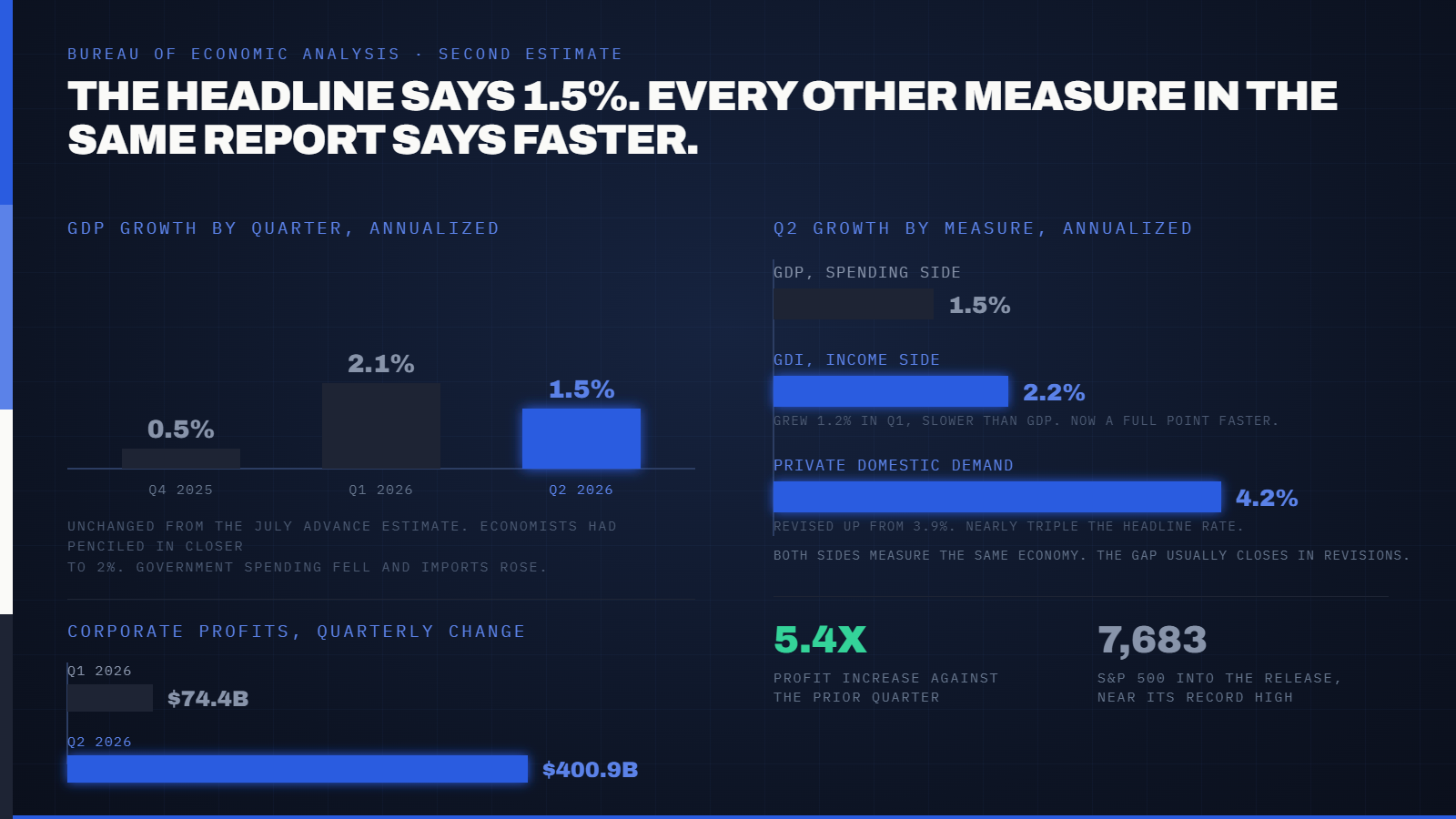
Growth in the world's largest economy has been anything but smooth over the past three quarters. GDP expanded just 0.5% in the fourth quarter of last year, jumped to 2.1% in the first quarter of 2026, and has now settled back to 1.5% in the second. The deceleration traces mostly to two culprits: government spending fell, and imports rose enough to subtract from the growth calculation even as businesses kept adding to inventory and consumers kept spending. None of that is unusual by itself. What stands out is how the report's other components moved in the opposite direction.
Consumer spending was revised higher in this second look, driven almost entirely by services, particularly hospital and physician spending captured in new Census data the BEA didn't have in July. Goods spending moved the other way, with recreational items, vehicles, and energy products all revised down. Corporate profits from current production, meanwhile, rose $400.9 billion in the quarter, more than five times the $74.4 billion increase in the first quarter. Real gross domestic income, which measures the same economy from the earnings side rather than the spending side, grew 2.2%, actually accelerating from 1.2% in the first quarter even as GDP decelerated from 2.1%.
Real final sales to private domestic purchasers, which strips out the more volatile categories like inventories, trade, and government spending, was revised up to 4.2% from 3.9%, nearly triple the headline growth figure. Wall Street didn't treat any of this as bad news. The S&P 500 sat around 7,683 heading into Wednesday's report, within striking distance of its record high, and the index barely moved on the release.
Why It Matters
The gap between GDP and GDI matters more than it sounds like it should. Both measures are supposed to describe the identical economy, one by adding up spending and the other by adding up income, and in theory they should match. In practice they never do exactly, and economists have long treated a widening gap as a signal that one side needs to catch up to the other in future revisions. A GDI reading running a full point above GDP, as it did this quarter, has historically tilted toward GDP eventually getting revised higher rather than GDI getting revised lower. If that pattern holds again, the 1.5% headline could look understated in hindsight.
The profit surge helps explain something that's been puzzling some investors this earnings season: how corporate America keeps beating estimates even as GDP growth cools. Nvidia's revenue doubled to $96.2 billion this week and Salesforce's adjusted profit nearly doubled, and Wednesday's data suggests those weren't isolated wins. A $400.9 billion jump in economy-wide profits in a single quarter is the kind of number that supports stretched valuations even when the growth headline looks soft.
None of this settles the argument at the Fed, and if anything it complicates it further. A softer headline growth number is normally the kind of data a rate-setting committee treats as an argument for patience or even cuts. But Wednesday's inflation report showed core prices holding at 3.3% year over year, with the headline measure running hotter, and this GDP report carries its own less commonly cited price gauge: a quarterly annualized PCE price index that accelerated to 5.3%, a different calculation than the year-over-year figure but one pointing in the same broad direction of inflation that hasn't fully cooled. Add in three regional Fed presidents who dissented in favor of a hike at July's meeting, the most hawkish split since 2016, and a resilient private-demand number gives that camp more to point to, not less. The strength shows up unevenly at the household level too. Credit card delinquencies have been climbing toward multi-year highs even as aggregate profits and income accelerate, a reminder that an economy-wide number can look strong while a meaningful share of households are falling further behind.
What to Watch Next
Kevin Warsh delivers his first Jackson Hole keynote as Fed chair on Friday, and Wednesday's GDP data gives him more room to lean hawkish than he had a week ago if he chooses to. Whether he actually does is the open question. The Fed's own dissenters now have a resilient private-demand number and an elevated price gauge to point to, while the deceleration in the headline growth rate gives the other side of the committee something to argue with just as easily.
The September 15-16 FOMC meeting is the next real test, and futures markets have been pricing roughly one-in-three odds of a hike rather than a hold heading into it. Watch whether that probability moves after Friday's speech, and watch the August jobs report due out in the first week of September. July's payrolls fell by 23,000, the number that did the most to talk down hike odds in the first place. A repeat would argue for patience regardless of how strong Wednesday's GDP internals looked.
The Pulse24 Take
A single GDP report rarely settles anything, and this one settles less than most. Read the headline alone and the economy looks like it's cooling, decelerating from 2.1% to 1.5% with a Fed chair about to take the stage amid an already-hawkish policy debate. Read the internals and a different economy shows up: corporate profits accelerating, private demand running near 4%, and an income-side measure that grew faster than GDP itself. Both readings are true at the same time, which is exactly the kind of split that makes a single data print hard to trade on.
What happens next probably depends less on this report and more on which of its two stories policymakers choose to emphasize. A Fed chair looking to justify caution about cutting has a resilient private economy and hot profit growth to cite. A Fed chair looking to justify patience about hiking has a headline number that missed expectations and slowed from the first quarter's pace. Friday's speech won't resolve that tension on its own, but it should say a lot about which story Kevin Warsh finds more convincing.
How we read the data
Curious how we get from raw data to a take like this? Our Trader's Toolkit walks through the tools we lean on.
Explore the Toolkit