Pulse24 Original
Salesforce's Adjusted Profit Nearly Doubled to $5.90 a Share, Beating the $3.27 Estimate by Roughly 80%. The Stock's 13% Jump Came With an Expanded AI Deal That Puts Claude Inside the CRM.
August 27, 2026
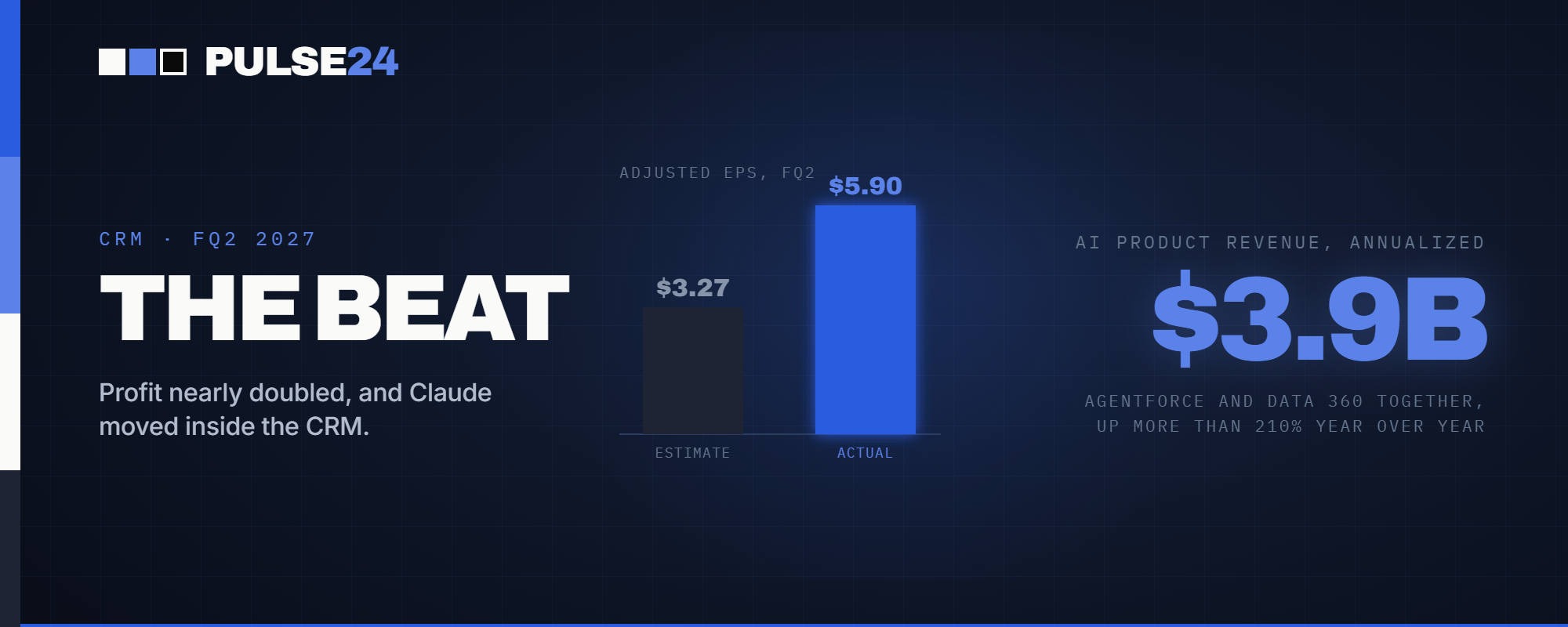
Salesforce's profit beat estimates by roughly 80% and the stock jumped 13% in after-hours trading, but the more interesting move was the expanded partnership with Anthropic that puts Claude directly inside the CRM. It's Salesforce's clearest answer yet to a year of worry that AI agents would make software like its own obsolete.
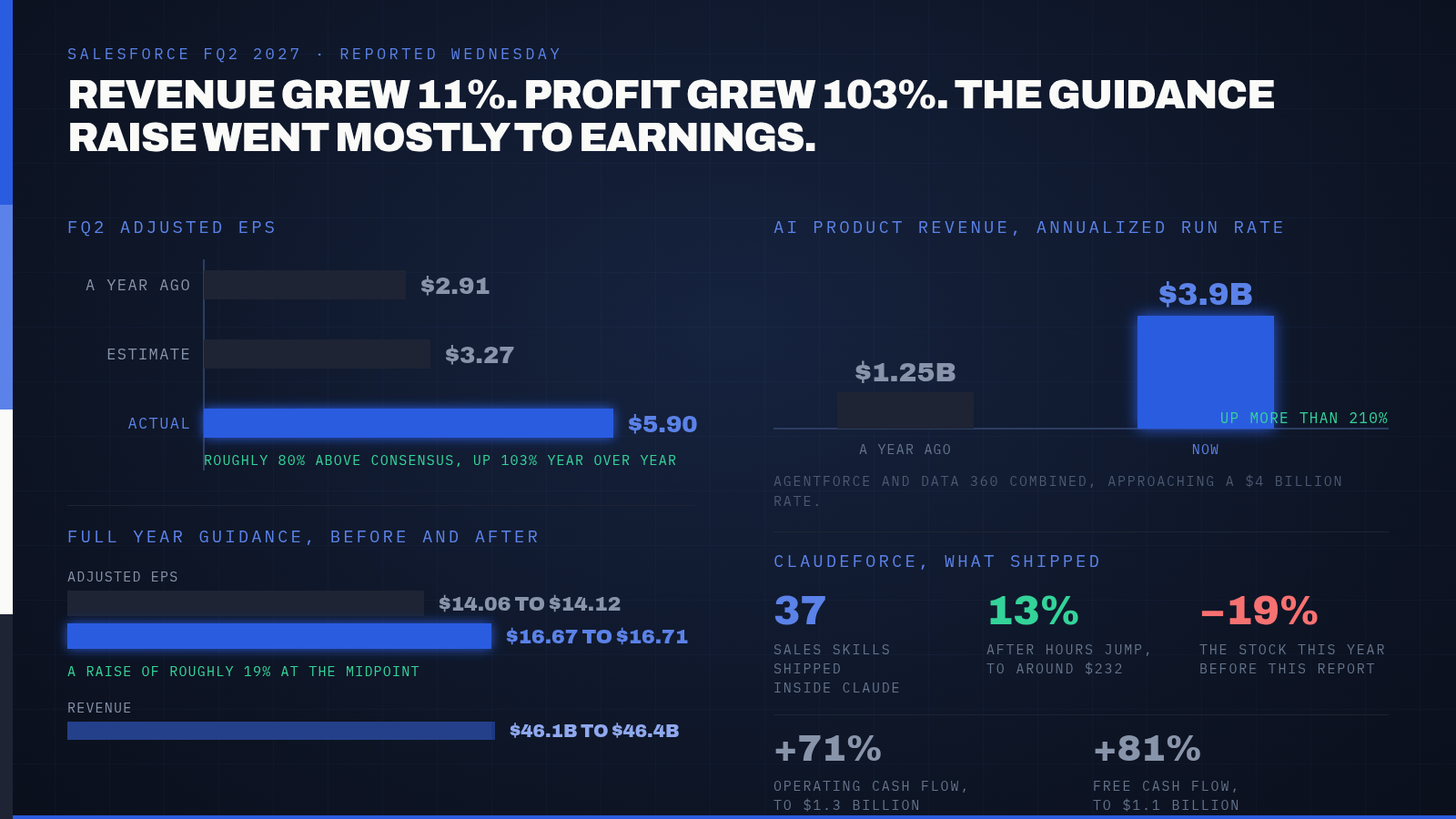
Salesforce's adjusted profit came in at $5.90 a share for its fiscal second quarter, up 103% from a year earlier and about 80% above the $3.27 analysts had penciled in. Shares did what a beat that size is supposed to do: they jumped as much as 13% in after-hours trading Wednesday, clawing back a chunk of what had been a rough year for the stock.
The size of the beat matters as much as the beat itself. Revenue of $11.3 billion was only modestly ahead of the roughly $11.32 billion consensus, up 11% year over year, a normal quarter by Salesforce's recent standards. The profit line is where the surprise lived, and it arrived the same day the company deepened the AI partnership that has investors debating whether Salesforce is a beneficiary of the AI shift or a target of it.
What Changed
Salesforce raised full-year guidance across the board. Revenue guidance moved to $46.1 billion to $46.4 billion, up from $45.9 billion to $46.2 billion at the start of the quarter. Adjusted earnings per share guidance jumped further, to $16.67 to $16.71 a share from $14.06 to $14.12, a raise of roughly 19% at the midpoint. Operating cash flow rose 71% year over year to $1.3 billion, and free cash flow climbed 81% to $1.1 billion, both growing faster than revenue.
The AI numbers were the other headline. Agentforce and Data 360, the company's newer AI and data products, reached a combined $3.9 billion in annualized recurring revenue, up more than 210% year over year, pushing total AI product revenue toward the $4 billion mark. CEO Marc Benioff called it one of the company's best quarters ever, and the growth rate backs that framing up more than most earnings-call superlatives do.
Alongside the results, Salesforce and Anthropic announced Claudeforce, an expansion of a partnership the two companies first struck in June. The plugin, called Salesforce in Claude, lets sales reps query and update live CRM records, review deal health, and prepare for meetings from inside Claude rather than Salesforce's own interface. It ships with 37 pre-built sales skills, with more planned for other business functions later this year. Salesforce is also an investor in Anthropic, whose revenue grew fourteenfold this year to $11.5 billion, so the two companies have more than one financial thread running through this deal.
Why It Matters
Putting a rival AI lab's chatbot in charge of your own software is an unusual move for a company that has spent three decades selling access to that software directly. Salesforce's stock was down about 19% for the year heading into Wednesday's report, a decline that tracks a broader worry investors have been pricing into software stocks all year: if an AI agent can do the work a CRM seat used to require a human to click through, why keep paying for as many seats?
That worry has a nickname now. Some on Wall Street have taken to calling it the SaaSpocalypse, shorthand for the idea that AI agents will hollow out the subscription software model the way cloud computing hollowed out on-premise software a decade earlier. Benioff has pushed back on the term directly, arguing that AI expands how much customers use Salesforce rather than replacing it. Wednesday's numbers are the clearest evidence he's offered so far. AI product revenue growing more than 200% a year is not what a company being disintermediated by AI usually looks like.
The skepticism hasn't disappeared, and it shouldn't. Handing Anthropic a more central role in how customers interact with Salesforce data raises a real question about where pricing power ends up over time, and whether Salesforce's seat-based revenue eventually cedes ground to whatever Anthropic captures instead. Salesforce's own first-quarter report this spring is a reminder that beats don't automatically settle these questions: EPS grew 50% that quarter and the stock still fell, because investors focused on guidance rather than the headline number. Wednesday's reaction suggests that, for now, the market is willing to take the AI revenue growth at face value.
What to Watch Next
The next data point worth watching isn't Salesforce's, it's how enterprise customers actually behave once Claudeforce is live. A 210% growth rate off a small base is easier to produce than to sustain, and the real test is whether Agentforce and Data 360 keep compounding anywhere near this pace as the comparisons get tougher. Seat count trends matter too. If traditional per-seat subscription revenue starts decelerating while AI product revenue accelerates, that looks more like the cannibalization scenario bears have been describing than the coexistence story Benioff is telling.
Other AI labs and hyperscalers are running similar plays elsewhere in enterprise software, so how Anthropic and Salesforce split the economics of Claudeforce over time, and whether rival software vendors strike comparable deals with OpenAI or Google's Gemini team, will say something about which side of the AI buildout, the model makers or the software incumbents, ends up holding more pricing power.
The Pulse24 Take
Wednesday's report answers the question investors have been asking about Salesforce all year, just not permanently. A profit beat this size, paired with AI revenue growing at triple-digit rates, is real evidence that Salesforce has found a way to make the AI shift work in its favor rather than against it. That's worth taking seriously. It's also worth remembering that Salesforce is the one telling this story, and the company has every incentive to frame Claudeforce as expansion rather than as a first step toward ceding ground to Anthropic.
The more interesting test won't show up in a single earnings report. It will show up over several quarters, in whether seat-based revenue holds steady while AI revenue keeps growing, or whether one starts coming at the expense of the other. Software companies have survived platform shifts before by staying indispensable through them. Salesforce just spent a quarter, and a stock price, arguing that this shift is no different. The market believed it for one after-hours session. Whether that belief holds through the next few quarters of data is the actual story here, not Wednesday's number by itself.
How we read the data
Curious how we get from raw data to a take like this? Our Trader's Toolkit walks through the tools we lean on.
Explore the Toolkit