Pulse24 Original
Nvidia's Revenue Doubled to $96.2 Billion, Beating Every Wall Street Estimate. The Stock Still Dropped Before Clawing Back to a Gain in After-Hours Trading.
August 27, 2026
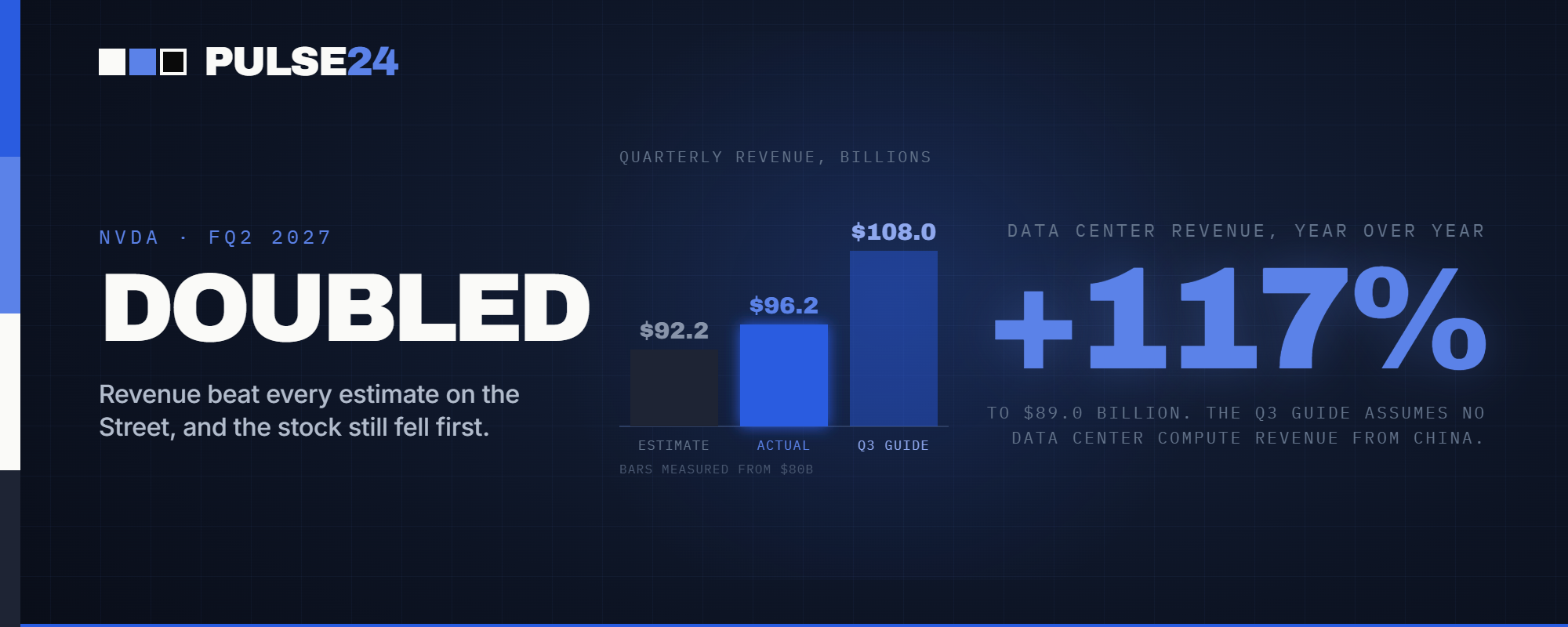
Nvidia's fiscal second-quarter revenue came in at $96.2 billion, up 106% from a year ago and ahead of every analyst estimate on the Street. The stock still spent its first few minutes of after-hours trading in the red before Jensen Huang's commentary on AI demand turned the session positive.
Nvidia's fiscal second-quarter revenue came in at $96.2 billion on Wednesday, more than double what the company reported a year earlier and above the roughly $92.2 billion Wall Street had modeled. Data center revenue, the number that matters most to anyone trying to gauge whether AI infrastructure spending is still accelerating, rose 117% year over year to $89.0 billion. The stock's reaction told a more complicated story than the headline number did.
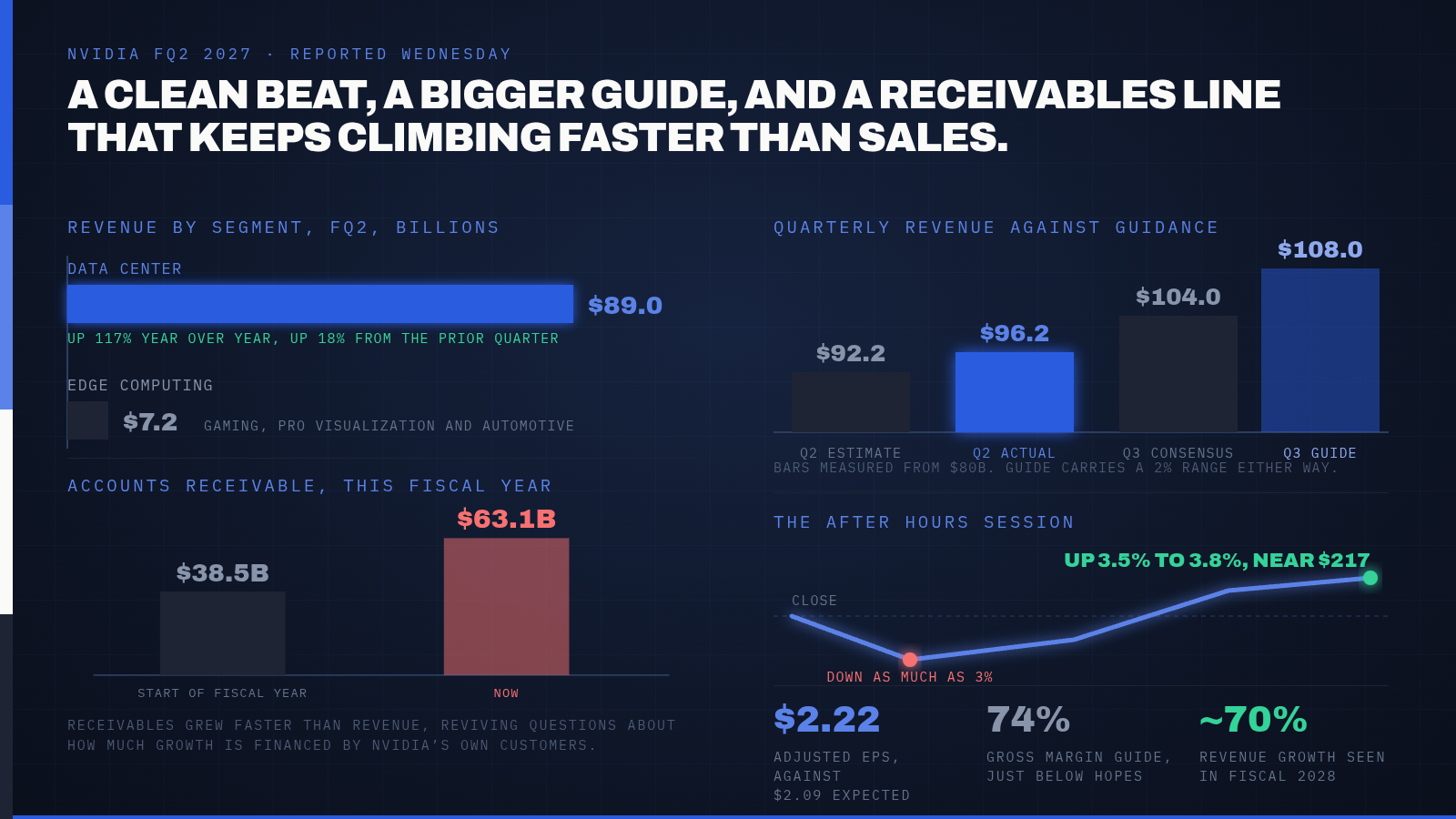
Shares fell as much as 3% within the first few minutes of after-hours trading once the numbers hit the wire, before reversing once Jensen Huang and the rest of Nvidia's management team worked through their prepared remarks on the earnings call. By the close of after-hours trading, the stock was up roughly 3.5% to 3.8%, near $217. That the shares dropped at all on a clean beat isn't unusual for Nvidia this year: the stock had fallen on the day of earnings after four of the company's last five reports, even though each of those quarters also beat EPS estimates by mid-single-digit margins. What separated Wednesday from those four is that Nvidia clawed the loss back the same session instead of closing lower.
What Changed
Wall Street had priced in a lot going into this print. Options markets were implying a swing of roughly $282 billion in either direction, and that setup was itself the story two days earlier. The actual numbers cleared that bar: revenue reached $96.2 billion against a roughly $92.2 billion estimate, and adjusted earnings per share of $2.22 beat the $2.09 to $2.10 analysts had modeled.
Guidance is where the reassurance came from. Nvidia forecast third-quarter revenue of $108.0 billion, plus or minus 2%, comfortably above the roughly $104 billion consensus, while telling investors directly that it is assuming zero data center compute revenue from China in that number. Gross margin guidance of 74%, plus or minus half a point, came in a touch below where some analysts wanted to see it, a detail that explains part of the stock's initial dip even as the rest of the report looked strong.
Huang's framing on the call leaned into the idea that AI spending has moved past its experimental phase. "AI has reached its inflection point," he said. "It's doing useful work. Its tokens are productive and profitable. Now, compute is revenue." The company also told investors to expect fiscal 2028 revenue growth of roughly 70%, a number well above what most sell-side models had built in.
Why It Matters
The bigger question sitting underneath the print is how much of Nvidia's growth is still funded by Nvidia itself. Accounts receivable climbed to $63.1 billion as of late July, up from $38.5 billion at the start of the fiscal year in January, a jump that outpaced revenue growth over the same stretch. Some of that reflects the ordinary mechanics of a company whose customers are placing bigger orders. It also feeds a debate that's been building all year: Nvidia's $105 billion financing guarantee for OpenAI's Ohio data center was one example of a pattern where Nvidia's biggest customers are financed, directly or indirectly, by Nvidia and its Wall Street partners.
That pattern got a formal name earlier this month, when Nvidia lined up more than $500 billion in third-party capital commitments from firms including Apollo, BlackRock, Blackstone, Brookfield, Goldman Sachs and KKR to help fund AI compute infrastructure. The arrangement shifts more of the financing risk for data center buildout onto Wall Street's balance sheets rather than Nvidia's own, which is part of why credit markets have started pricing AI-linked debt with more caution even as equity investors keep bidding up the stocks tied to the buildout.
None of this makes Nvidia's numbers less real. Data center revenue growing 117% in a single year is an actual demand signal, not an accounting artifact. But a business this large, growing this fast, financed this heavily by arrangements that route back to its own balance sheet in some form, is also a business where a slowdown anywhere in the chain (a hyperscaler trimming a capex budget, a data center project delayed by a power constraint) would show up in Nvidia's results faster than it would for a more conventionally financed company.
What to Watch Next
China remains the biggest wildcard Nvidia has chosen not to guide around. The company's forecast assumes no data center compute revenue from the country at all, which means any policy shift from Washington's export rules, in either direction, would move the number from here rather than already being baked in. Competition is the other thread worth following: hyperscalers building their own custom AI chips, and rivals pushing on the inference side of the market specifically, are chipping away at the argument that Nvidia's dominance is permanent rather than merely current.
Margins are worth watching too. A gross margin guide of 74%, even if it lands exactly where forecast, sits below the 75% Nvidia posted this quarter, a reminder that the newest generation of chips tends to cost more to build before yields improve. If margin guidance keeps drifting lower even as revenue keeps beating estimates, that combination is worth more attention than either number in isolation.
The Pulse24 Take
The most useful part of Wednesday's reaction isn't the number, it's the shape of it. A stock that falls on a beat and then recovers once management explains the beat is a market trying to separate two different questions: is the business still growing, and is the growth still worth the price being paid for it. Nvidia answered the first question about as clearly as a company can. The second question is the one that actually determines what happens to the stock from here, and it has less to do with data center revenue than with how comfortable investors remain with the financing structure underneath the entire AI buildout.
That's the tension to hold onto. A 117% jump in data center revenue is a real number, not a story someone is telling to keep a valuation intact. Whether it keeps growing at anything close to this pace now depends on something that has little to do with chip demand: whether hyperscalers can convert years of committed spending into running, power-connected data centers on schedule, and whether Wall Street's newest role as AI's lender of record holds up under whatever comes next. Nvidia's earnings were the easy part. What happens to the debt and equity now sitting behind them is the part still being written.
How we read the data
Curious how we get from raw data to a take like this? Our Trader's Toolkit walks through the tools we lean on.
Explore the Toolkit