Pulse24 Original
Nvidia Now Carries an 8% Weight in the S&P 500, the Heaviest Any Stock Has Held Since 1974. Wednesday's Earnings Are Priced for a $282 Billion Swing Either Way.
August 24, 2026
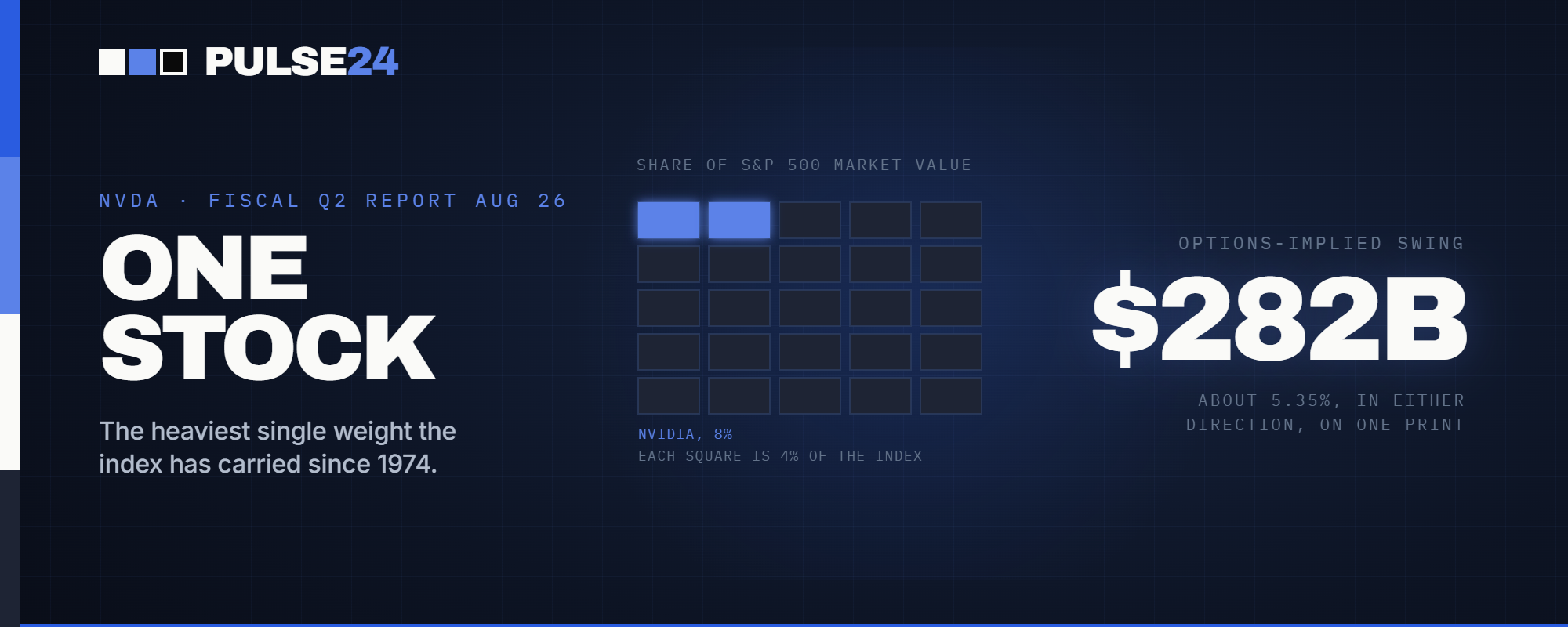
Nvidia reports fiscal second-quarter earnings Wednesday, and options traders are pricing an $282 billion swing in either direction. The stock has gained only 21% this year while the rest of the chip sector rallied 63%, and this week's number will go a long way toward explaining why.
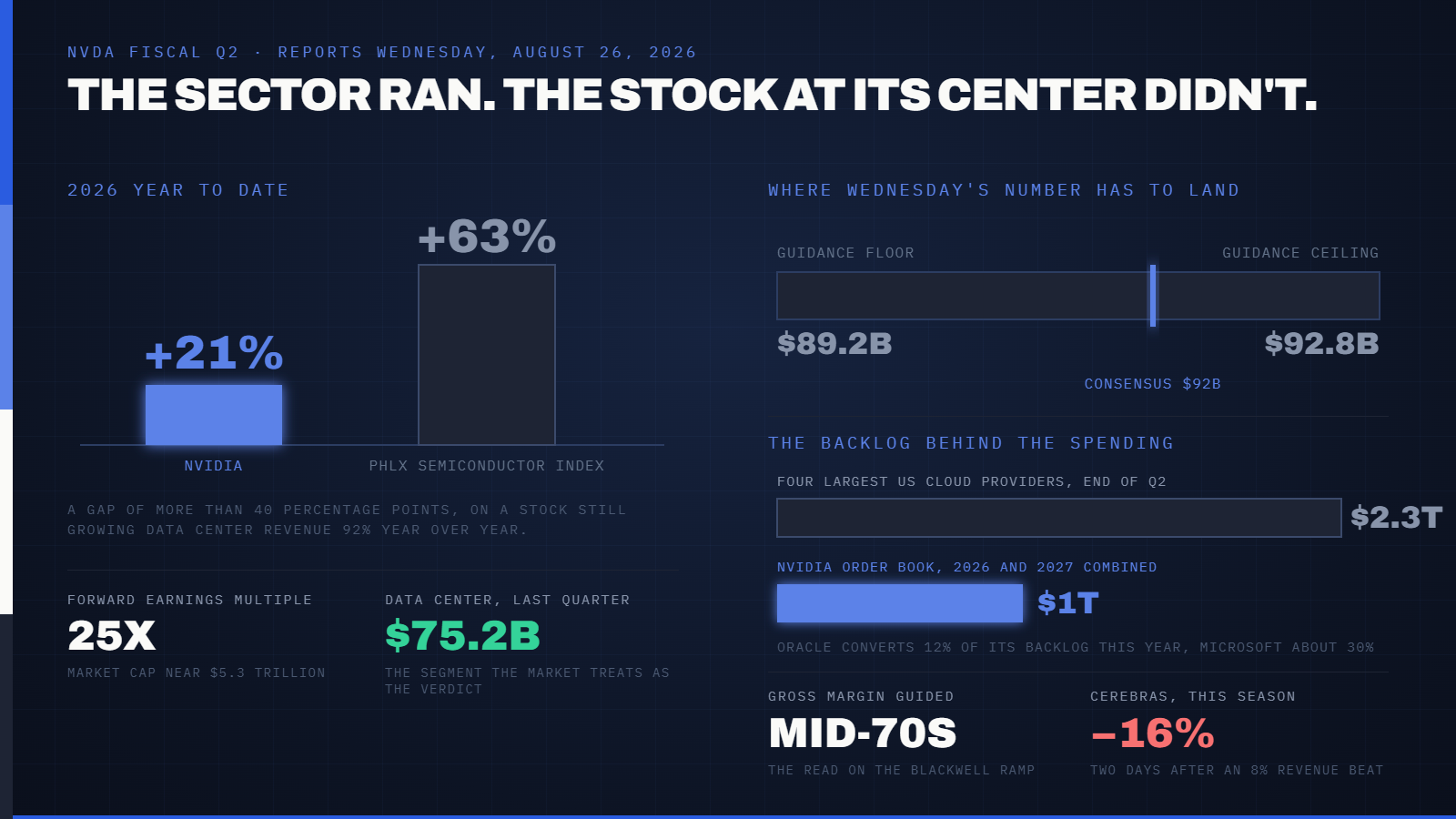
Ninety-two billion dollars. That's roughly where Wall Street has landed on Nvidia's fiscal second-quarter revenue, due after the market closes Wednesday, and it sits almost exactly at the midpoint of the $89.2 billion to $92.8 billion range the company guided to back in May. Options traders aren't treating that number as a formality. They're pricing an implied move of about 5.35% in either direction, which on a company Nvidia's size works out to roughly $282 billion in market value moving in a single session.
Few single earnings reports carry that kind of weight anymore. Nvidia's market capitalization sits near $5.3 trillion, and the stock alone now accounts for roughly 8% of the S&P 500, the largest weighting any company has held in the index since at least 1974. A print that surprises in either direction doesn't just move Nvidia. It moves index funds, retirement accounts, and every other AI-linked stock that trades on Nvidia's coattails.
What Changed
The setup into this earnings report looks different than it did three months ago. Long-term Treasury yields spent the back half of August grinding toward their highest levels since 2007, and high-multiple AI stocks took the brunt of it. Memory and chip names sold off on sessions with no company-specific news attached at all, just a discount-rate math problem: when a bond that carries no default risk pays more than 5%, a stock priced on earnings that arrive years from now gets less attractive by comparison.
Nvidia itself has mostly sat out that repricing. The stock is up only 21% in 2026, a fraction of the 63% gain in the broader PHLX Semiconductor Index over the same stretch. That gap is unusual for the company supposedly leading the AI trade, and it shows up again in the valuation: Nvidia trades near 25 times forward earnings, a multiple that looks almost conservative next to names like AMD, which investors have bid up on the same story with far less revenue to show for it so far.
Investor positioning has split along similar lines. Dan Loeb's Third Point exited its entire Nvidia stake in the second quarter, while David Tepper's Appaloosa added to its position over the same three months. Both trades were made without knowing what Wednesday's numbers would say, which is really the point: this is a stock where sophisticated investors disagree, and an earnings report is one of the few events that can resolve that disagreement quickly.
Why It Matters
The number to watch inside the headline revenue figure is data center. That segment came in at $75.2 billion last quarter, up 92% from a year earlier, and it's the piece of Nvidia's business the market treats as a referendum on whether AI infrastructure spending is still accelerating or starting to plateau. Any guidance suggesting hyperscalers are pulling back, even slightly, would land harder than a straightforward revenue miss.
That's because the backlog behind that spending has become its own source of anxiety. Bank of America estimated the four largest US cloud providers were sitting on a combined $2.3 trillion in backlog by the end of the second quarter, deferred revenue that still has to be converted into actual data centers, chips, and power contracts. Oracle expects to convert only about 12% of its backlog into revenue over the next year, versus roughly 30% for Microsoft over the same stretch. Nvidia's own order book, near $1 trillion across 2026 and 2027, is a fraction of that combined hyperscaler commitment.
This is the same tension running through Nvidia's $105 billion financing guarantee for OpenAI's Ohio data center earlier this month: a circular arrangement where Nvidia's largest customers are increasingly financed, directly or indirectly, by Nvidia itself. None of that is illegal or even unusual for a capital-intensive industry. It does mean a slowdown anywhere in the chain, a hyperscaler trimming capex guidance, a data center delayed by a power constraint, shows up in Nvidia's numbers faster than it would for a company with a more diversified customer base.
What to Watch Next
Wednesday's print isn't only about the top-line beat. Gross margin guidance, expected in the mid-70s percentage range, will show whether the Blackwell ramp is proceeding as smoothly as Nvidia has claimed, or whether the newer architecture is still working through the yield and supply issues that dogged its launch. Any commentary on China will also matter more than usual: Washington's export policy toward advanced AI chips has shifted direction more than once this year, and Nvidia's guidance has generally assumed close to zero contribution from that market, leaving room for either a pleasant surprise or a fresh complication depending on where policy moves next.
There's also a lesson sitting nearby from Cerebras, which beat Wall Street's revenue estimate by 8% this earnings season and still saw its stock fall 16% over the following two days. A clean beat is no longer a guarantee of a positive reaction when expectations are already this elevated. For Nvidia, the bar isn't just beating the number Wall Street published. It's convincing a market that just spent two weeks repricing every high-multiple AI stock on the planet that the growth still justifies the multiple.
The Pulse24 Take
Nvidia's own stock chart is arguably the most useful data point in this entire setup. If the AI trade were as overextended as the recent chip selloff suggests, the company at the center of it should be the most obviously overvalued name on the board. Instead it's lagging its own sector by more than 40 percentage points this year, trading at a multiple that would look ordinary for a mature industrial company, let alone one still growing revenue at close to 100% a year.
That doesn't mean Wednesday is risk-free. Pricing a $282 billion swing either way isn't the mark of a confident market, and an 8% weighting in the S&P 500 means Nvidia's own volatility has become something closer to systemic risk than single-stock risk. What it does suggest is that the simple story of AI stocks as an obvious bubble doesn't fully hold up against how skeptically the market has already priced its biggest name. The more interesting question for investors isn't whether Nvidia beats or misses. It's whether Wednesday's reaction, in either direction, finally tells the market something it didn't already believe.
How we read the data
Curious how we get from raw data to a take like this? Our Trader's Toolkit walks through the tools we lean on.
Explore the Toolkit