Pulse24 Original
Credit Card Delinquencies Appear to Have Nearly Doubled Since 2022, Rising From 7.6% to 12.8% of Balances. The New York Fed Says the Actual Delinquency Rate Hasn't Budged in Two Years.
August 23, 2026
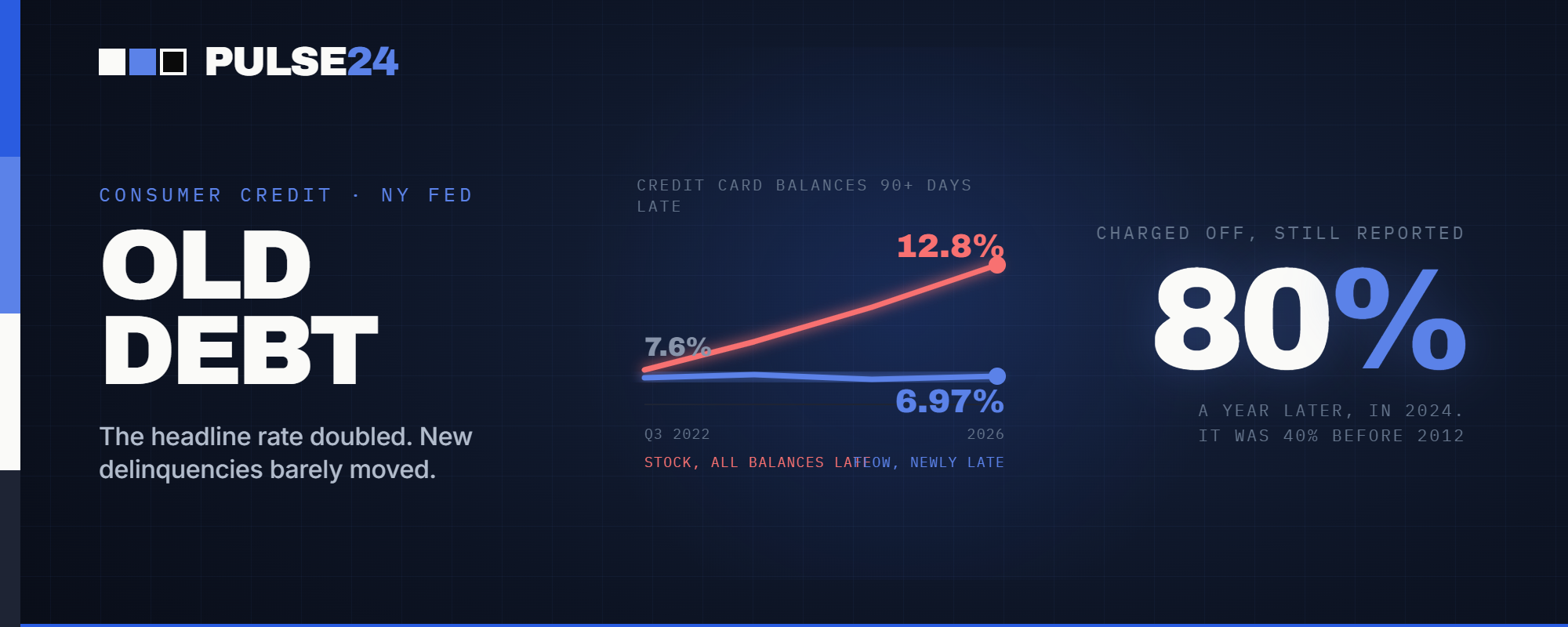
Credit card delinquencies look like they nearly doubled since 2022, but the New York Fed says that's mostly an illusion created by how long lenders now report charged-off debt. The actual rate of new delinquencies has barely moved in two years.
Credit card balances 90 or more days past due climbed from 7.6% of the total in the third quarter of 2022 to 12.8% by the first quarter of 2026, according to New York Fed data. Read quickly, that looks like consumers are falling apart. Read carefully, according to a Liberty Street Economics research note published this month, it looks like something else entirely: an accounting quirk dressed up as a crisis.
What the Data Actually Shows
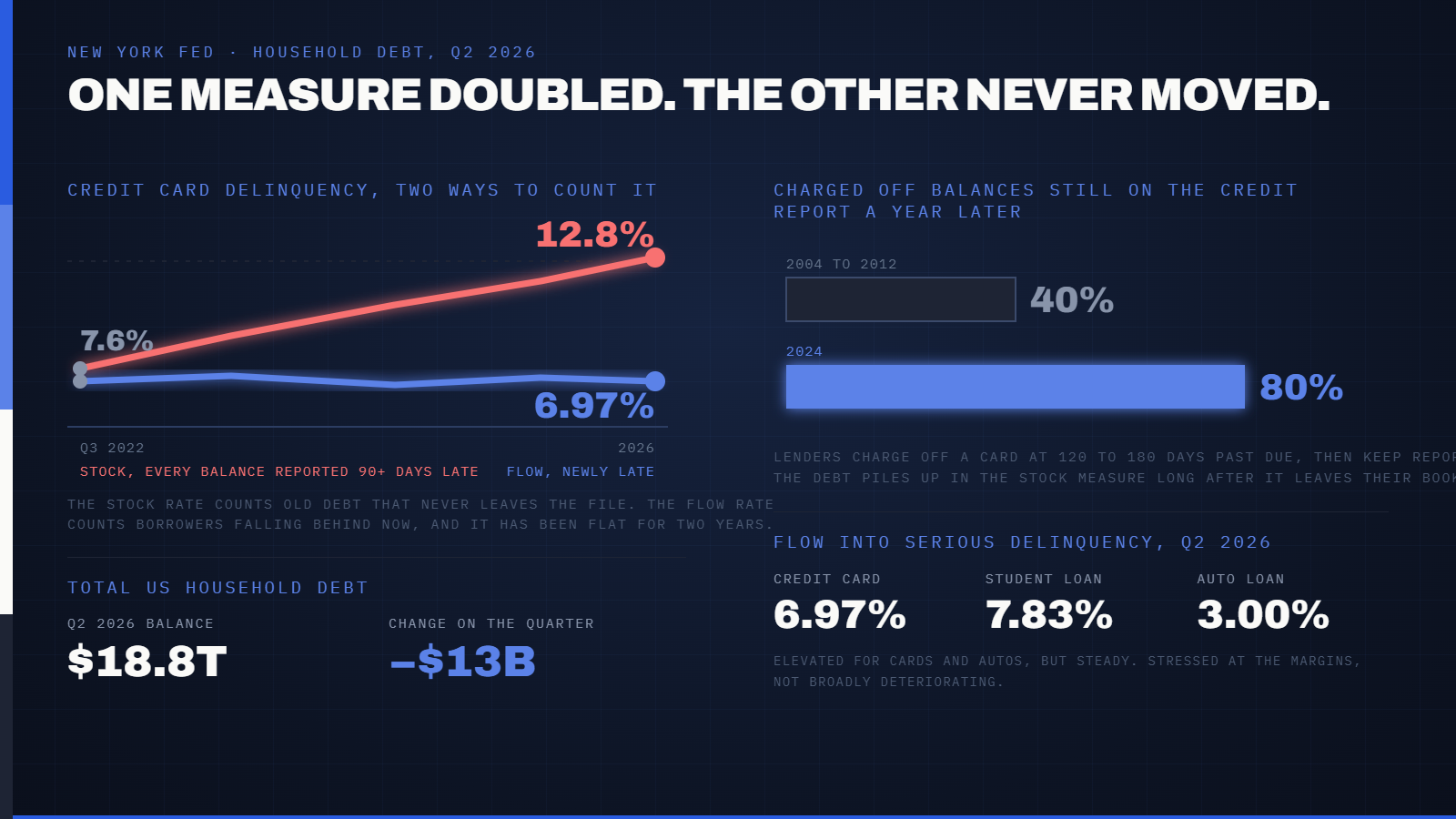
New York Fed researchers split delinquency into two separate measures. The stock rate counts every balance currently reported 90-plus days past due on a credit file, no matter how old the debt is. The flow rate counts only balances that newly crossed into serious delinquency during a given quarter, a cleaner read on how borrowers are behaving right now. Between 2022 and 2026, those two lines diverged sharply. The stock rate nearly doubled. The flow rate, the researchers write, has stayed close to flat.
The explanation comes down to timing, not repayment. Lenders typically charge off a credit card account once it's 120 to 180 days past due, removing it from their own books. The debt does not disappear from the borrower's credit report, though, and lenders have stretched out how long they keep reporting it. Between 2004 and 2012, about 40% of charged-off balances were still showing up on credit reports a year later. By 2024, that share had climbed to roughly 80%. Old, already-written-off debt is piling up in the stock measure, making the headline delinquency rate look far worse than what's happening to borrowers making payments today.
The New York Fed's broader Q2 2026 household debt report puts numbers on that stability. Credit card balances stood at $1.26 trillion, with 6.97% of that balance newly flowing into serious delinquency during the quarter. Auto loans saw a 3.00% flow rate into serious delinquency, and student loans came in at 7.83%. Total household debt was essentially unchanged at $18.8 trillion, down $13 billion from the first quarter even as it grew $383 billion from a year earlier. "Delinquency rates across most products have held steady over the past two years," said Joelle Scally, an economic policy advisor at the New York Fed. "Still, new delinquencies for auto loans and credit cards remain at elevated levels, a trend we'll continue to monitor."
Why It Matters
Bank loan-loss provisions get set against expectations for future defaults, and a headline stock delinquency rate that looks like it's spiraling can push analysts toward overly cautious forecasts for consumer lenders heading into third-quarter earnings. The same confusion feeds into the broader debate over consumer health that's been running through markets all summer. Walmart's own CFO pointed to gas prices, not credit stress, when the retailer posted its first US comp-sales miss in five years, and the New York Fed data backs that framing up: flow delinquencies aren't accelerating, even if survey-based measures of how consumers feel about their finances keep sliding.
That gap between sentiment and hard data has shown up elsewhere this month too. University of Michigan sentiment sank to 51.0 in August, well below estimates, even as actual delinquency flows held steady. Consumers report feeling worse about their finances than the underlying repayment data suggests they should, a pattern that shows up more often near turning points in the economic cycle than most people expect.
For the Fed, a household sector where new delinquencies are elevated but not accelerating is a different picture than one in genuine distress. Auto loan and credit card flow rates sitting above their pre-pandemic norms give policymakers a reason for caution. Flat, rather than rising, trends give them room to avoid overreacting to a single scary-looking chart when they weigh the case for a September rate move.
What to Watch Next
Third-quarter bank earnings, starting in mid-October, will be the next real test of this distinction. If loan-loss provisions at major card issuers come in below what the stock delinquency rate alone would suggest, that's the market pricing in the New York Fed's read rather than the headline number. Watch the flow rate specifically in the Fed's next quarterly household debt report too, due in November, for whether the modest elevation in auto and card delinquencies is stabilizing or building. A shift higher there, not in the stock rate, would be the real signal that consumer credit is deteriorating rather than just aging on paper.
The Pulse24 Take
The lesson here goes beyond credit cards. Plenty of economic indicators get built by stacking things up over time, and any measure like that can look alarming purely because old data keeps accumulating faster than it gets cleared out. The New York Fed did the work of separating stock from flow and found a household sector that's stressed at the margins, elevated delinquencies among borrowers already struggling, but not one that's broadly deteriorating. Investors who reacted to the 12.8% headline without digging into what's driving it would have drawn the wrong conclusion about consumer credit. The safer habit, with delinquency data or almost any cumulative statistic, is to ask whether a rising number reflects more new distress or just more old distress that hasn't cleared the books yet.
How we read the data
Curious how we get from raw data to a take like this? Our Trader's Toolkit walks through the tools we lean on.
Explore the Toolkit