Pulse24 Original
US Employers Added 79,000 Fewer Jobs Than First Reported for the Year Through March. The Revision Landed Hours Before Warsh's Hawkish Fed Debut at Jackson Hole.
August 31, 2026
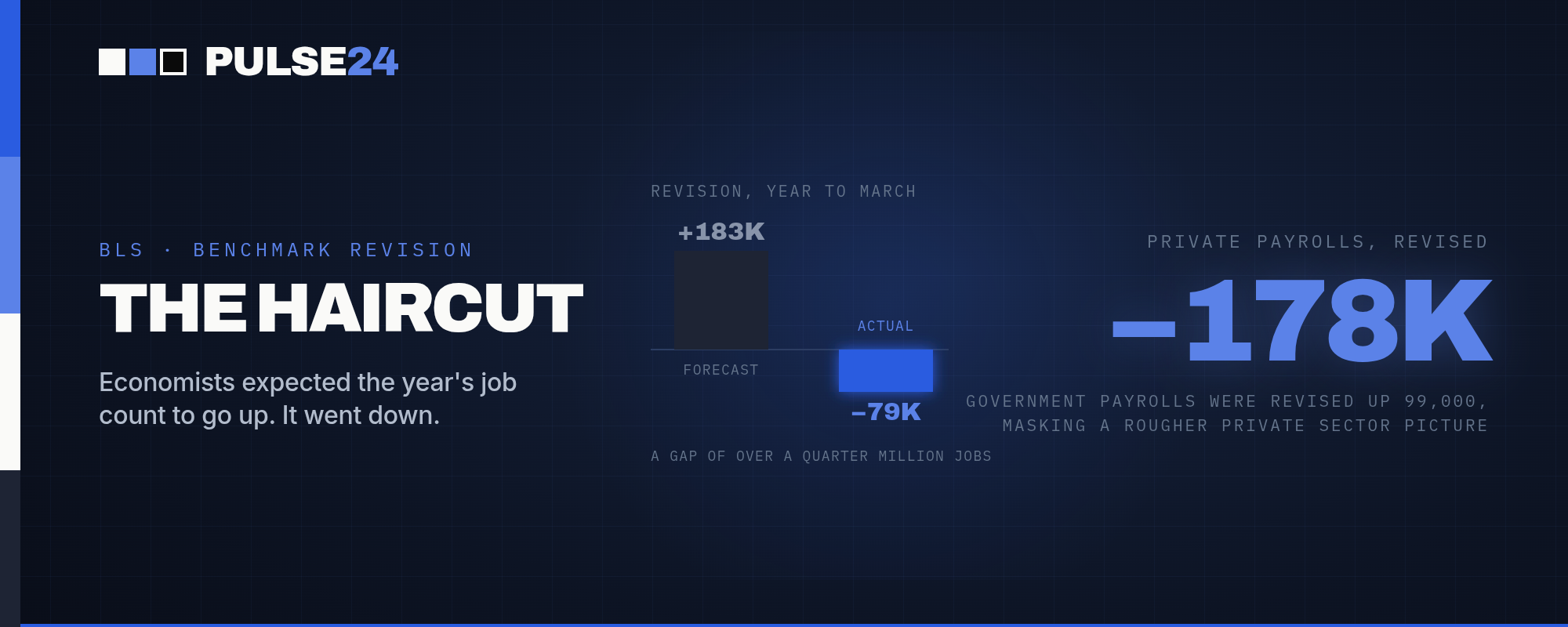
A routine data revision knocked 79,000 jobs off the past year's employment count on the same afternoon Kevin Warsh made his hawkish case for more rate hikes. The two data points don't quite agree, and figuring out which one the Fed weighs more heavily is the real story heading into September.
Seventy-nine thousand jobs disappeared from the government's ledger on Friday afternoon. Not because anyone lost work that day, but because the Bureau of Labor Statistics concluded they were never really added in the first place.
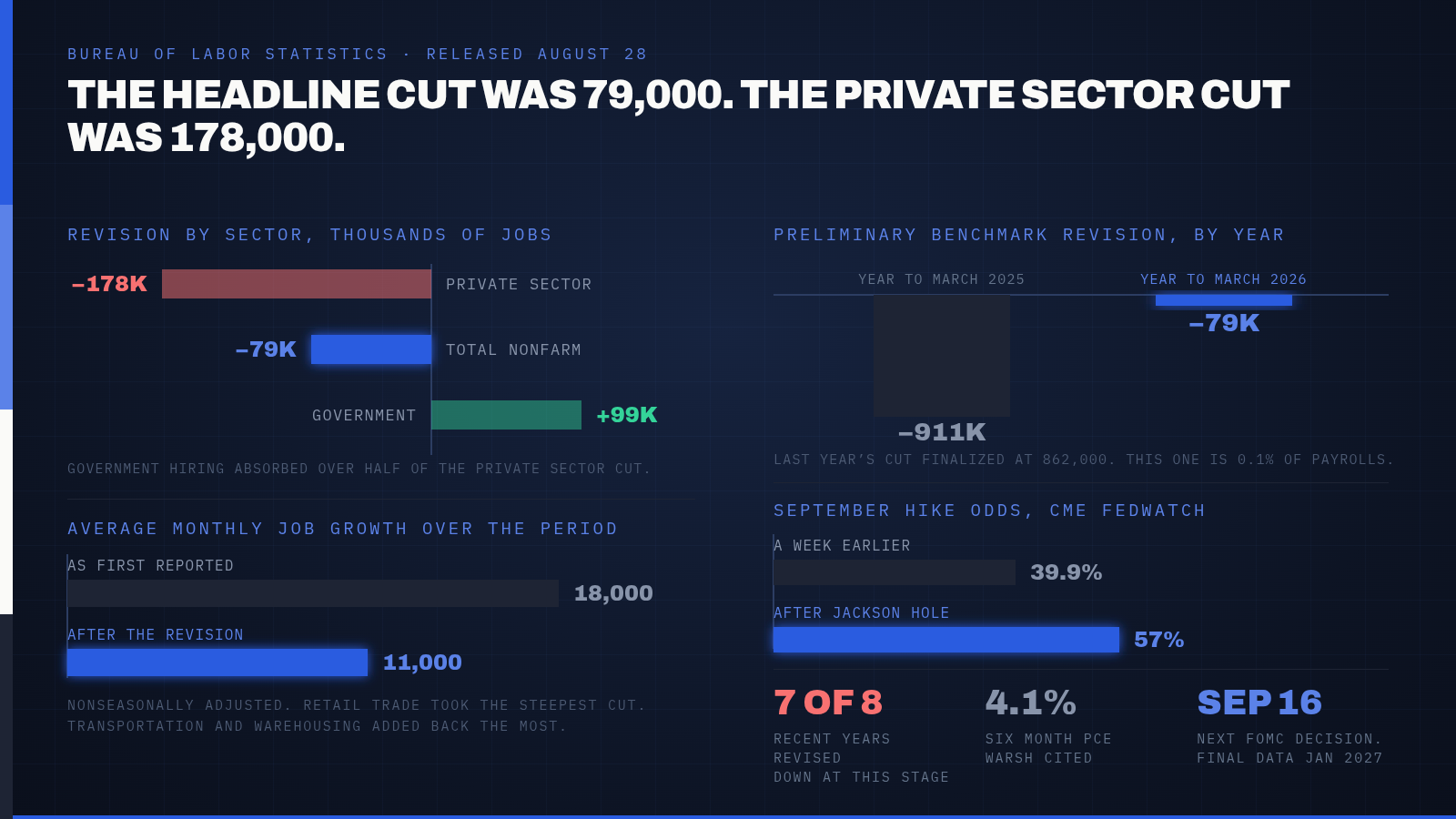
The agency's preliminary benchmark revision, released August 28, cut the twelve-month employment count through March 2026 by 79,000. Economists surveyed by Bloomberg had penciled in the opposite: a gain of roughly 183,000. The miss, more than a quarter million jobs relative to consensus, arrived on the exact afternoon Fed Chair Kevin Warsh delivered his first Jackson Hole speech and argued the central bank still has inflation work to do.
What Changed
Benchmark revisions exist because the monthly payroll survey samples a fraction of employers, then gets checked against a far larger dataset built from state unemployment insurance tax records. Every year, the BLS reconciles the two counts. Preliminary benchmark revisions have now pushed employment estimates lower in seven of the past eight years, so a downward correction on its own tells you little.
This one is worth reading anyway. Private employment took the brunt of it, revised down 178,000, while government payrolls were revised up 99,000. Retail trade posted the steepest cut of any sector. Transportation and warehousing moved the other way, adding back the most jobs. Average nonseasonally adjusted job growth over the period now looks closer to 11,000 a month rather than the 18,000 first reported, a meaningful haircut even if the headline figure sounds modest.
Scale matters too. Last September, the same exercise erased 911,000 jobs from the year through March 2025, later finalized at a loss of 862,000. Measured against that, a 79,000 cut looks almost tame. The BLS's own release notes that annual benchmark revisions over the last ten years have averaged 0.2% of total nonfarm employment in absolute terms, so this year's 0.1% miss actually comes in below the typical swing. The direction is still negative. It is the seventh negative preliminary revision in eight years, and it landed at a moment when the Fed's newest chair is making the opposite argument about the economy's strength.
Why It Matters
Kevin Warsh's Jackson Hole speech leaned hard on inflation that hasn't cooled as promised. Twelve-month PCE sits at 3.7%, and the six-month annualized reading runs hotter still at 4.1%, both comfortably above the Fed's 2% target. Warsh pointed to that gap, plus unemployment holding at 4.1% and business investment in AI infrastructure running strong, as reasons the Fed has room to tighten without breaking the labor market. CME FedWatch odds of a September hike jumped to 57% on that argument, up from 39.9% just a week before.
The payroll revision complicates that story without demolishing it. A labor market solid enough to absorb a rate hike and a labor market whose own bookkeeping just got trimmed for the seventh time in eight years are not necessarily in conflict, but they are in tension. Consumer sentiment fell to 51.7 in August even as households expect inflation to ease, and Chicago's regional PMI cratered to 47.1 the same week Warsh spoke. None of these numbers alone forces the Fed's hand. Together, they describe an economy where the inflation case for hiking and the growth case against it are both getting louder at once.
What to Watch Next
The September FOMC meeting on September 15 and 16 is the next real test of which argument wins. A hike would be the Fed's first since 2023 and would validate Warsh's inflation-first framing over the labor-market caution this revision hints at. A hold would suggest the softer jobs data, the weak Chicago PMI, and sinking consumer sentiment carried more weight behind closed doors than the Jackson Hole rhetoric implied.
Between now and then, watch the incoming jobs and inflation prints for confirmation in either direction, and watch how the dollar, gold, and Treasury yields trade around them. The finalized version of this benchmark revision won't land until the January 2027 employment report ships in February, and history says the final number could move meaningfully from the preliminary one, in either direction.
The Pulse24 Take
Markets like clean narratives, and right now the clean narrative is that the Fed is turning hawkish because inflation won't quit. That's true as far as it goes. It leaves out a lot, though. The same week that story took hold, the government quietly admitted its own labor market count had been running a little hot, for the seventh time in eight years. A 79,000-job revision isn't going to reverse a rate decision on its own. It is a reminder that the data the Fed leans on is provisional, revised, and occasionally wrong in ways that only show up months later. Position for the hawkish case Warsh is building, but hold it loosely. The labor market's paper trail has a habit of getting rewritten.
How we read the data
Curious how we get from raw data to a take like this? Our Trader's Toolkit walks through the tools we lean on.
Explore the Toolkit