Pulse24 Original
Micron's Market Cap Crossed $1.1 Trillion. A Number Buried in Nvidia's Own Earnings Hints at the Rally's Shelf Life.
September 12, 2026
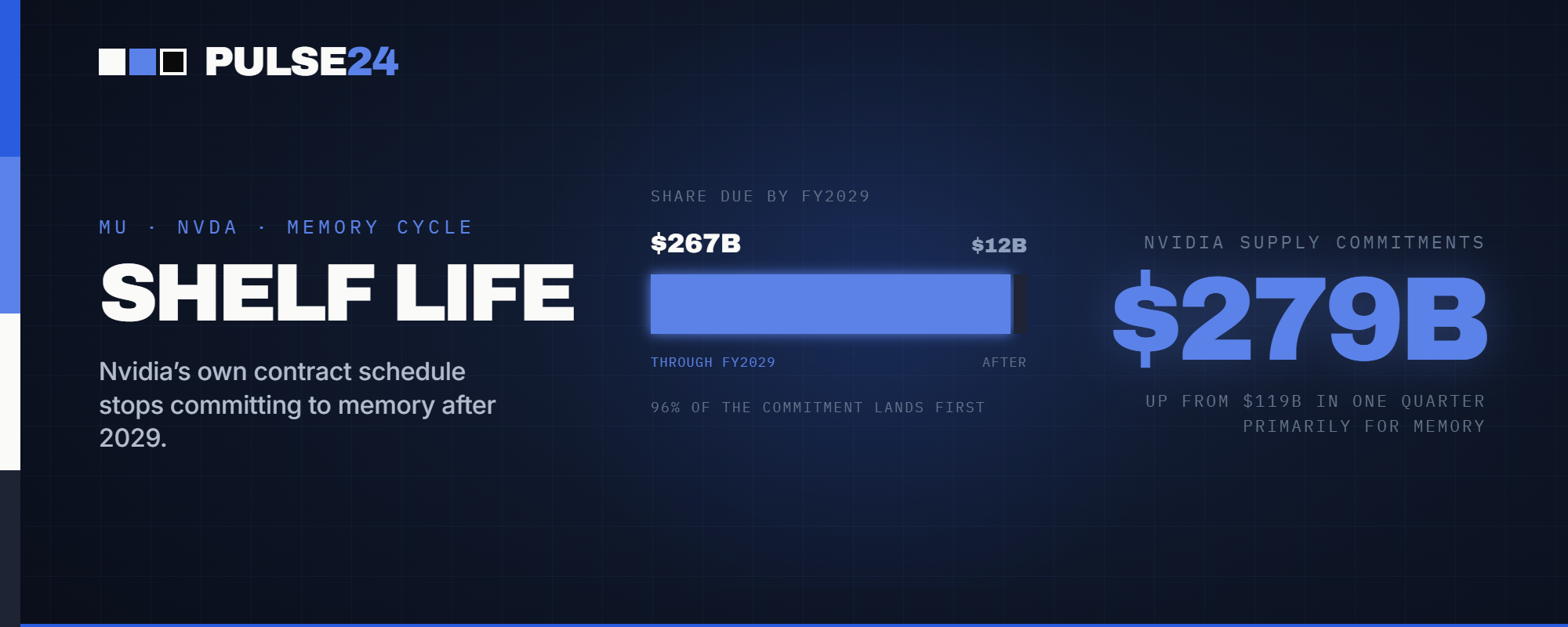
Micron closed Friday worth roughly $1.1 trillion, riding the same memory shortage that's driven revenue up 346% in a year. Nvidia's own earnings disclosure shows exactly how long its biggest customer is willing to keep paying up for that memory, and the schedule doesn't run forever.
Micron Technology closed at $975.26 on September 11, a price that puts the company's market capitalization at roughly $1.1 trillion. That number alone tells a familiar story about the AI memory boom. A more interesting number sits inside Nvidia's own earnings report from three weeks earlier, and it points to a rough end date for the trade that got Micron here.
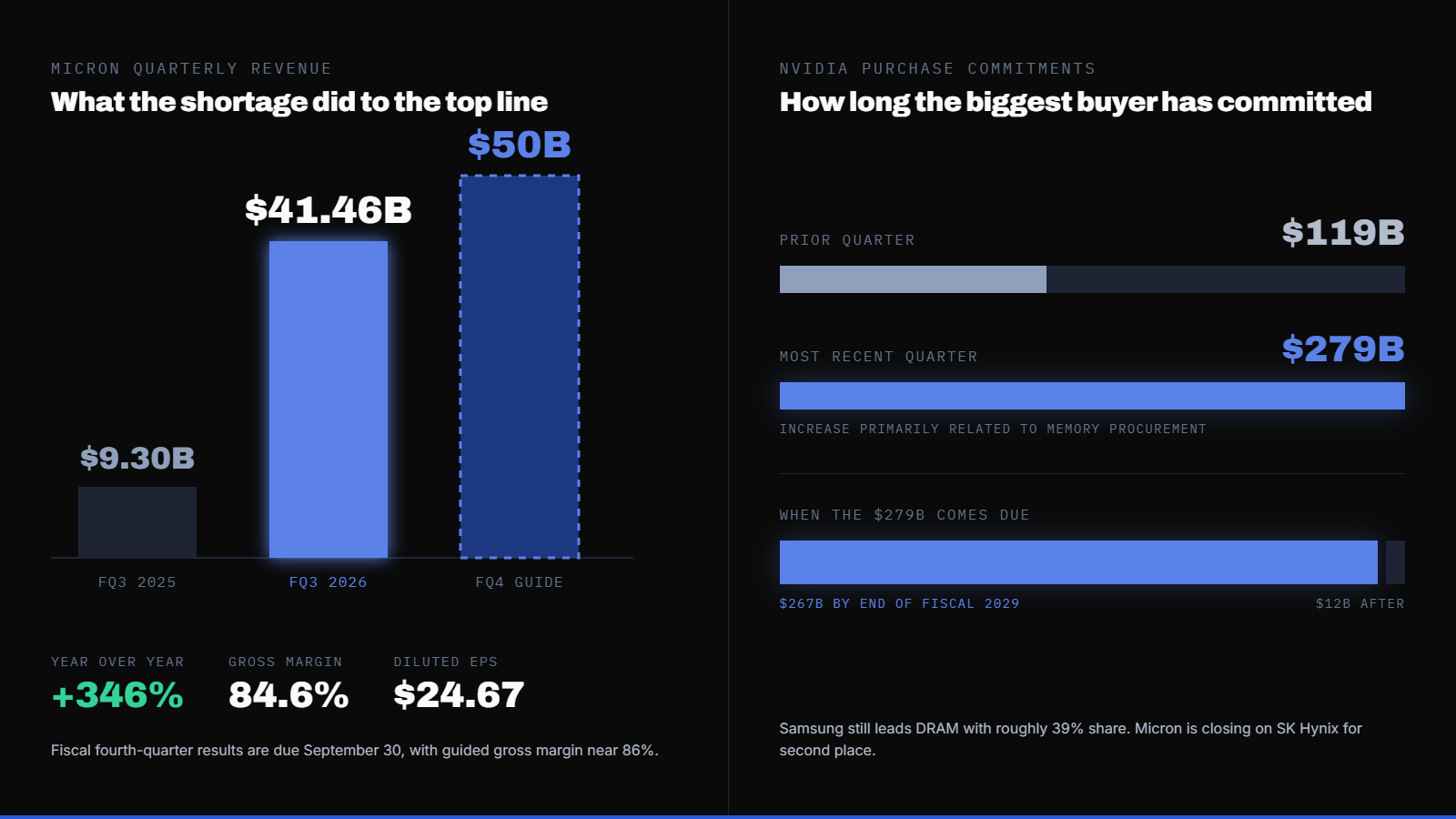
Nvidia disclosed that its supply and capacity purchase commitments, the multi-year deals it signs to lock in chips and components from its supply chain, jumped from $119 billion to $279 billion in a single quarter. The company said the increase was "primarily related to the procurement of memory." That's Nvidia, the buyer with the most leverage in the entire AI supply chain, telling investors exactly how much it's willing to pay for memory, and for how long.
What Changed
Micron's fiscal third quarter, reported in late June, showed revenue of $41.46 billion against $9.30 billion in the same quarter a year earlier, a 346% increase. Diluted earnings per share came in at $24.67. Gross margin reached 84.6% of revenue, a level that would have sounded implausible for a memory chipmaker two years ago, when DRAM and NAND were still viewed as commodity products with thin, cyclical margins. Guidance for the fiscal fourth quarter, due to be reported September 30, calls for revenue of $50 billion, plus or minus $1 billion, and gross margin near 86%.
Chief executive Sanjay Mehrotra tied the results directly to AI infrastructure spending, saying memory has become strategically important "in the AI era." The company's HBM4 product, a high-bandwidth memory chip used to feed data to AI accelerators, is now shipping in high volume to lead customers, with the next generation, HBM4E, already in development.
Nvidia's own numbers explain why Micron can charge what it's charging. When Nvidia reported its fiscal second-quarter results on August 26, revenue hit a record $96.2 billion, but gross margin came under pressure specifically from memory costs. Buried in the filing was the jump in supply and capacity commitments to $279 billion, and roughly $267 billion of that total comes due by the end of fiscal 2029, leaving only a small tail of commitment beyond that date.
Why It Matters
A buyer of Nvidia's size doesn't sign contracts by accident, and the shape of this one matters more than the headline total. Nvidia is committing real money to memory through fiscal 2029, then letting the commitment fall off a cliff. One read is that this simply reflects how far out Nvidia's own product roadmap is visible today. A different read is that Nvidia is keeping its options open for the point when memory supply catches up with demand and its leverage as a customer reasserts itself.
Micron isn't the only chipmaker riding this same shortage. Dell's Infrastructure Solutions Group expanded operating margin by 620 basis points last quarter even as memory costs climbed, because it could pass the increase through to hyperscaler customers building AI data centers. Intel has raised chip prices three times in less than a year, a decision that traces back to the same memory shortage squeezing the entire PC supply chain, even though most analysts still rate the stock a hold rather than a buy. Apple went the opposite direction, absorbing close to a 400% jump in memory costs for the iPhone 18 rather than pass it on to consumers. Every one of these companies is reacting to the same underlying scarcity in DRAM and NAND supply, just from different points in the supply chain.
Micron sits closer to the source of that scarcity than any of them, which is exactly why its margins have expanded the way Dell's and Intel's have, and why its stock has outrun the broader chip sector this year. Samsung still leads global DRAM output with roughly 39% market share, but Micron has been narrowing the gap with SK Hynix for the number two spot, and SK Hynix continues to dominate high-bandwidth memory specifically. Memory has historically been one of the more brutally cyclical corners of the chip industry, prone to years of oversupply followed by years of shortage, and nothing about the physics of building new fabs has changed. What's changed is that AI accelerators now consume memory at a scale that wasn't part of anyone's demand model three years ago.
What to Watch Next
Micron's fiscal fourth-quarter report on September 30 is the next real test. A revenue beat above the high end of guidance, or commentary suggesting HBM4E orders are already extending into 2027 and 2028, would support the idea that this cycle has more room to run than Nvidia's contract schedule implies. Signs of a guidance miss, or any hint that customers are slowing new memory commitments, would be a much earlier warning than most investors are currently pricing in.
The more useful number to track going forward isn't Micron's stock price but the pace of new capacity coming online from Samsung, SK Hynix, and Micron itself, along with China's CXMT, which has been gaining share faster than expected. Every new fab that reaches volume production chips away at the scarcity keeping prices this high. Nvidia's contract schedule already assumes that dynamic starts to shift by 2029 or 2030. Whether it arrives earlier than that is the question that will decide whether Micron's current valuation holds up or gets tested well before its bulls expect.
The Pulse24 Take
It's easy to look at a $1.1 trillion market cap and 346% revenue growth and conclude the market has simply discovered a durable new winner. Nvidia's own contract schedule suggests something more specific and more useful: even the company writing the biggest checks in this cycle isn't committing to pay these prices indefinitely. None of this argues for selling Micron today. Fiscal 2029 is still three years away, and a lot of AI infrastructure spending has to happen between now and then.
What it does mean is that the memory supercycle has a timeline attached to it now, courtesy of the customer with the most information about its own future demand. Investors treating Micron's re-rating as a permanent structural shift, rather than the sharpest phase of a cycle that has turned before, are betting against the one company in the AI trade with the clearest view of what comes after 2029.
How we read the data
Curious how we get from raw data to a take like this? Our Trader's Toolkit walks through the tools we lean on.
Explore the Toolkit