Pulse24 Original
Dell's ISG Operating Margin Jumped 620 Basis Points Last Quarter. Memory Prices Were Supposed to Wreck It.
September 4, 2026
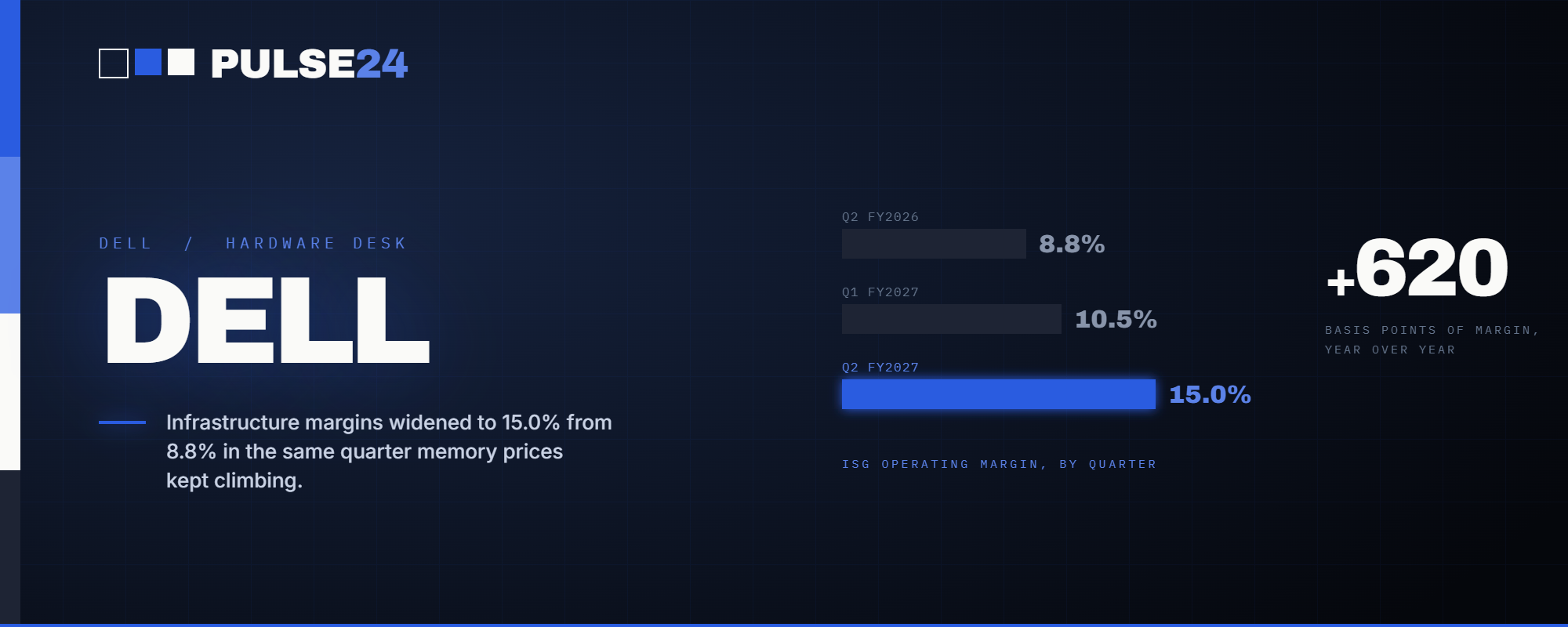
Dell's AI server orders hit $60.9 billion last quarter, but the more surprising number was margins. Infrastructure Solutions Group profitability rose 620 basis points even as memory prices climbed industry-wide, a rare bit of good news for the durability of the AI buildout.
Dell Technologies booked $60.9 billion in new AI server orders in a single quarter. Five years ago, that figure would have counted as a strong full year of total company revenue. The stock did roughly what markets now expect from a clean AI infrastructure beat: it took off. Shares gained about 15% on September 2, the session after Dell reported fiscal second-quarter results, then added another 4.9% the day after that to close at a record $516.39.
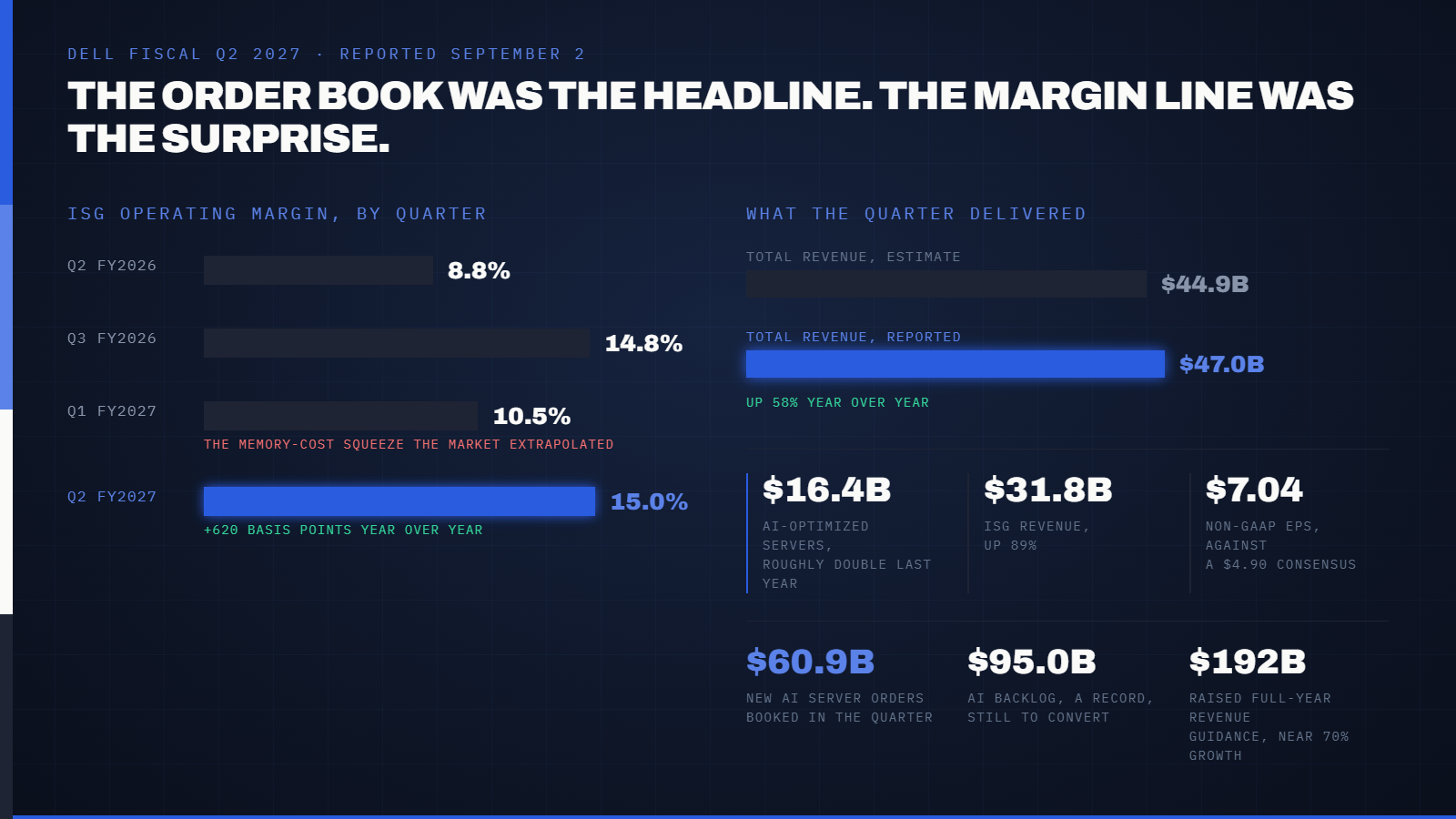
The more interesting number sat a layer beneath the headline. Dell's Infrastructure Solutions Group, the unit that builds and ships the servers going into AI data centers, posted an operating margin of 15.0%. That's up 620 basis points from 8.8% in the same quarter last year, and it moved in the opposite direction from what a good chunk of Wall Street had priced in going into the print.
What Changed
Coming into Tuesday's report, the fear was simple enough to fit on an index card. Memory prices have been climbing all year, with DRAM export values out of South Korea now worth roughly two-thirds their weight in gold and Germany's DDR5 price index sitting near five times its year-ago level. AI servers pack far more memory per unit than a standard server, so a memory-cost spike was supposed to hit the companies assembling them hardest of all. Dell's own numbers gave that fear some backing: ISG's operating margin had slipped to 10.5% in the fiscal first quarter, down from 14.8% the quarter before.
Tuesday's numbers went the other way. Total revenue reached $47.0 billion, up 58% year over year and topping the roughly $44.9 billion analysts had modeled. Non-GAAP earnings per share came in at $7.04, comfortably ahead of the roughly $4.90 consensus estimate and up more than 200% from a year earlier. ISG revenue climbed 89% to $31.8 billion, with AI-optimized servers contributing $16.4 billion, double what they generated in the same quarter last year, and traditional servers and networking adding $10.5 billion, up 122%.
Management raised full-year guidance to roughly $192 billion in revenue, about 70% growth, and $25.50 in adjusted earnings per share, near 150% growth. The company now expects AI server revenue of $74 billion for the full fiscal year. Its AI order backlog stands at $95.0 billion after the $60.9 billion booked this quarter alone, and cumulative AI orders for the year to date have reached $131.7 billion.
Why It Matters
Revenue growth this fast tends to get attention regardless of what's happening underneath it. Margin expansion this fast, in a business everyone assumed was getting squeezed, is the number that deserved more attention than it got. AI servers inherently carry thinner margins than Dell's traditional hardware, since so much of the sale price flows straight through to chip and memory suppliers. That Dell managed to expand ISG margins anyway, even as the input costs behind those servers kept climbing, suggests the company found room to pass memory inflation through to customers rather than absorb it.
That distinction matters for a market still arguing over how durable the AI capex cycle actually is. Five hyperscalers are on pace to borrow roughly $175 billion this year to fund AI buildouts, and every dollar of that debt eventually has to show up as returns on the hardware it buys. A margin story like Dell's, where a hardware integrator absorbs rising component costs without giving up profitability, is a small but genuine data point in favor of the buildout paying for itself rather than merely getting bigger.
It also isn't the universal experience this earnings season. Broadcom's AI chip revenue grew 221% last quarter, yet a guidance shortfall of roughly $230 million wiped out 5% of that stock's value within hours of the report. Strong AI infrastructure demand, on its own, no longer guarantees a clean market reaction. Investors are parsing the difference between growth and growth that holds together at the margin line, and Dell's report is one of the few recent examples where that second test was passed rather than failed.
What to Watch Next
The backlog conversion question is the one to track from here. Dell is now sitting on $95.0 billion in AI orders it hasn't yet turned into revenue, and how cleanly that backlog becomes shipped, billed hardware over the next several quarters will say more about the durability of this margin story than any single print can. A backlog that grows faster than it converts is a warning sign; one that converts on schedule while margins hold is the bullish case playing out as advertised.
Rival hardware makers reporting in the coming weeks will offer the next read on whether Dell's margin performance was company-specific or an industry-wide shift in pricing power. Should competitors report the memory-cost squeeze Dell appeared to avoid, that would suggest Dell either negotiated better supplier terms or priced its backlog more conservatively before costs rose, neither of which is guaranteed to repeat. Similar margin resilience elsewhere would raise a different question: whether AI hardware customers are simply willing to pay whatever it costs to secure capacity, an assumption with its own limits.
The Pulse24 Take
The headline number out of Dell's quarter was always going to be the size of the order book. Sixty billion dollars in new AI orders in three months is the kind of figure that speaks for itself. What required more digging was whether that growth was actually profitable growth, given everything the market already knew about memory costs climbing across the chip supply chain.
On that count, Dell's answer was more reassuring than the setup suggested it would be. A 620 basis point margin improvement, delivered in the same quarter that DRAM and NAND prices kept climbing industry-wide, is a genuinely useful data point for anyone trying to gauge whether the AI infrastructure buildout can keep paying for itself. It doesn't settle the larger argument about whether hyperscaler capex and vendor financing arrangements are sustainable at current levels. What it does is remove one specific worry, margin compression at the hardware assembly layer, from a list that still has plenty of other items on it.
How we read the data
Curious how we get from raw data to a take like this? Our Trader's Toolkit walks through the tools we lean on.
Explore the Toolkit