Pulse24 Original
Broadcom's AI Chip Sales Grew 221% Last Quarter to $16.7 Billion. A $230 Million Guidance Miss Wiped Out 5% of the Stock's Value Within Hours.
September 3, 2026
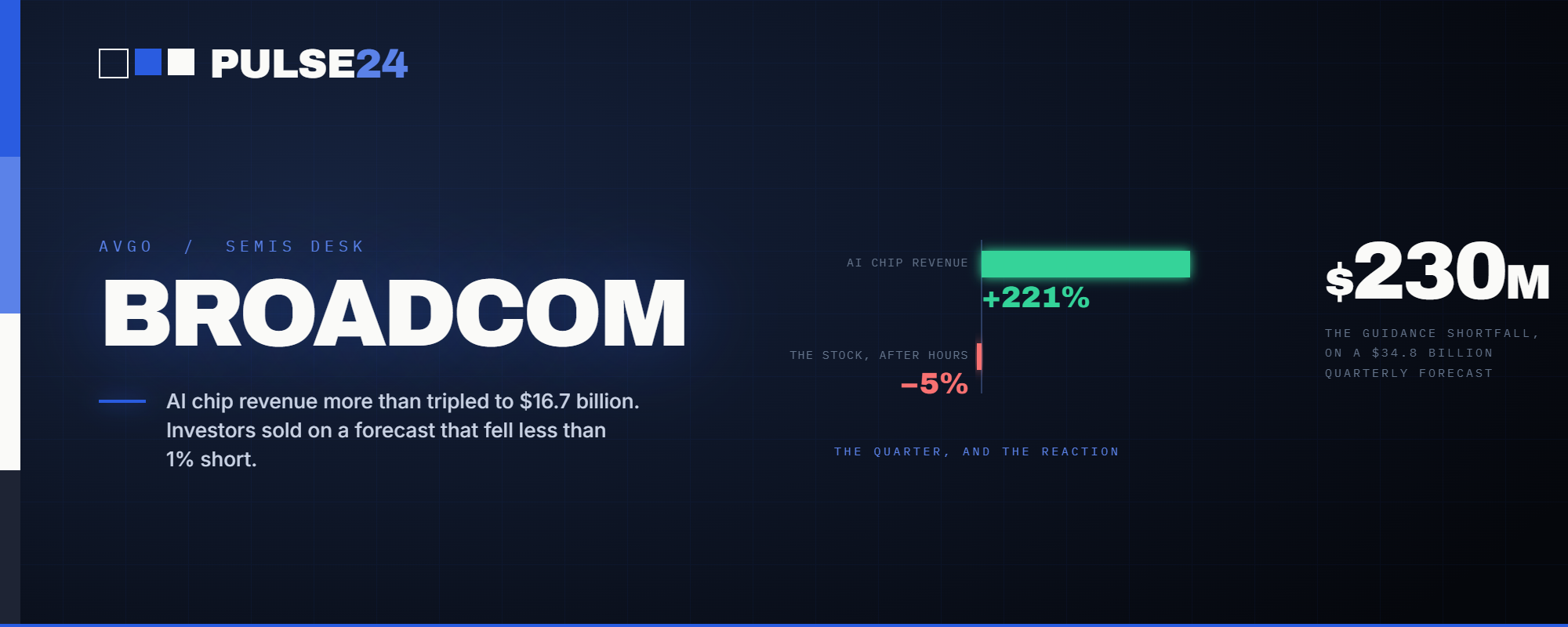
Broadcom's AI chip revenue more than tripled to $16.7 billion in its fiscal third quarter, comfortably beating Wall Street's estimate. Investors sold the stock anyway, focused on a fourth-quarter revenue forecast that came in about $230 million short of consensus.
Broadcom's AI chip revenue grew 221% year over year in its fiscal third quarter, hitting $16.7 billion and comfortably beating what Wall Street had modeled. Shares fell as much as 6% in after-hours trading Wednesday before paring the decline to roughly 5%. The problem wasn't the quarter Broadcom just reported. It was the one it's forecasting.
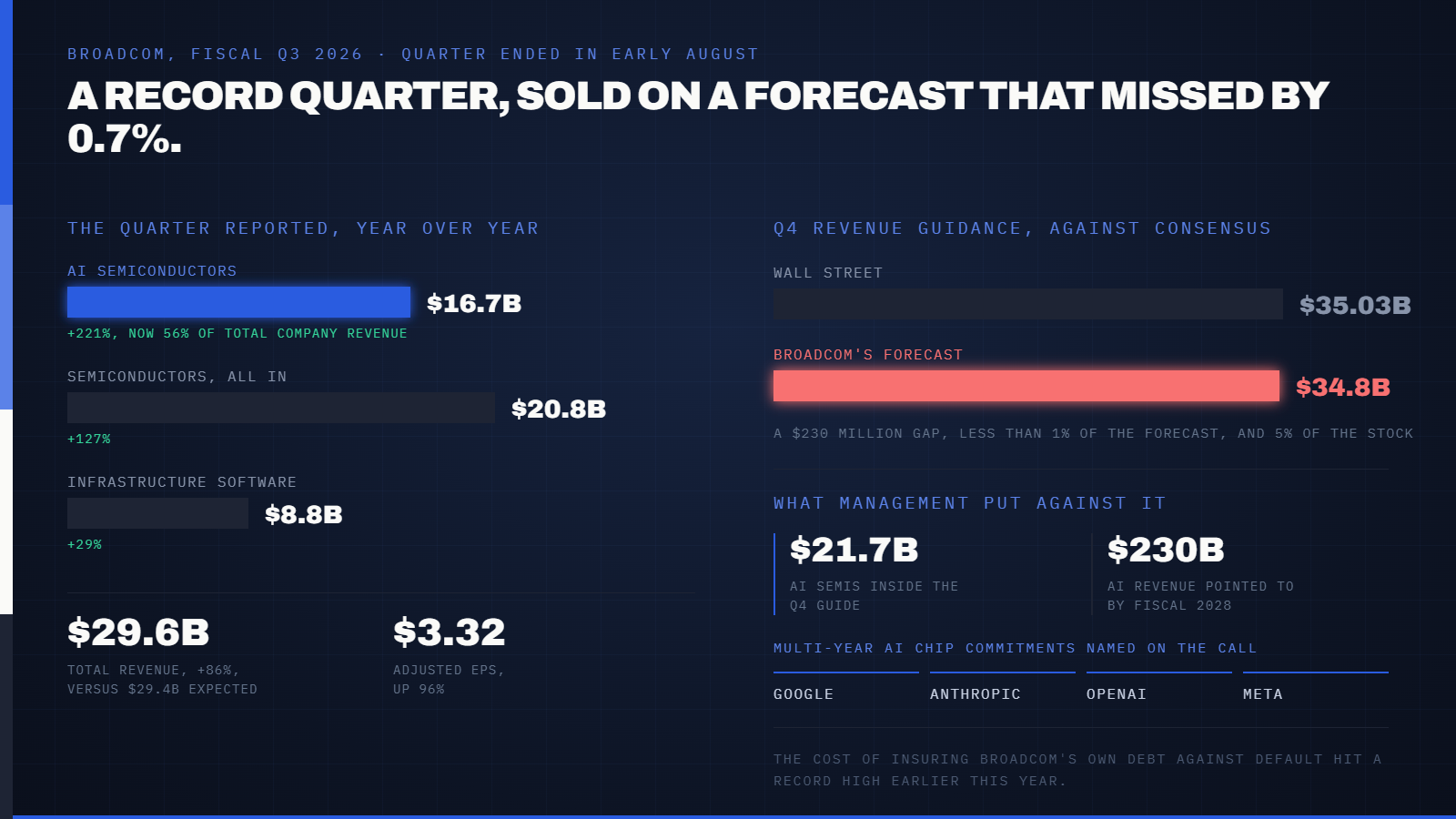
Total revenue for the quarter, which ended in early August, came in at $29.6 billion, up 86% from a year earlier and slightly ahead of the $29.4 billion analysts expected. Adjusted earnings per share rose 96% to $3.32. Semiconductor sales overall reached $20.8 billion, up 127%, and infrastructure software added another $8.8 billion, up 29%. By almost every measure besides the stock price, this was one of Broadcom's strongest quarters on record.
Why It Matters
The trouble showed up in the guidance. Broadcom told investors to expect $34.8 billion in revenue for the current quarter, including $21.7 billion from AI semiconductors. Wall Street had penciled in $35.03 billion. The gap amounts to roughly $230 million, less than 1% of the forecast, but in a stock priced for flawless execution, even a rounding error reads as a warning sign.
Broadcom isn't the only company learning that lesson this earnings season. Nvidia's revenue doubled to $96.2 billion in its most recent quarter, yet its stock dropped before clawing back to a gain, because investors had already priced in near perfect execution. AI-linked stocks increasingly trade less on whether the numbers are good and more on whether they're good enough to justify valuations built on years of uninterrupted growth.
What should reassure investors willing to look past one quarter's forecast is the customer list behind these numbers. Hock Tan described multi-year agreements with Google covering tens of billions of dollars in annual chip purchases, alongside new commitments from Anthropic, OpenAI, and Meta. The Google relationship carries extra weight for Broadcom specifically. Marvell landed its own multibillion-dollar chip warrant from Google earlier this year, a deal that raised questions about whether Broadcom would keep its position as Google's primary custom-chip partner. Wednesday's numbers suggest that exclusivity concern, at least for now, hasn't cost Broadcom any business.
There's a second thread worth watching alongside the chip numbers: how Broadcom is paying for all of this. The cost of insuring Broadcom's own debt against default hit a record 122 basis points this year, a sign credit markets are starting to price in the risk that comes with financing a buildout this size. Strong AI chip sales don't erase that risk. They just make the bet look better for now.
What to Watch Next
Two things will determine whether Wednesday's selloff was an overreaction or an early warning. First, whether Broadcom's roughly $230 billion fiscal 2028 AI revenue target holds up as more of that revenue moves from backlog into reported quarters. Second, whether the supply constraints Broadcom flagged, including data-center power availability, advanced wafer capacity, and high-bandwidth memory, actually slow deployment, or turn out to be the standard hedge language companies use to manage expectations.
The Pulse24 Take
A company that grew AI chip revenue 221% in a single quarter and still watched its stock fall says less about Broadcom's execution than about how the market is pricing the entire AI buildout. Every dollar of backlog now gets discounted against the chance that power, wafers, or memory become the bottleneck before the revenue shows up. That's a reasonable thing for investors to worry about. It's also a different worry than the one markets had eighteen months ago, when the question was whether AI demand would materialize at all. Demand showed up. What's being tested now is whether the industry can build fast enough to keep serving it, and whether investors will stay patient with the companies proving that one quarter at a time.
How we read the data
Curious how we get from raw data to a take like this? Our Trader's Toolkit walks through the tools we lean on.
Explore the Toolkit