Pulse24 Original
Micron and SanDisk Fell 7% Monday on a Report Trump May Let Apple Buy Chinese Memory Chips. The Backdrop Is a DRAM Price That's Already Up 165% This Year.
August 25, 2026
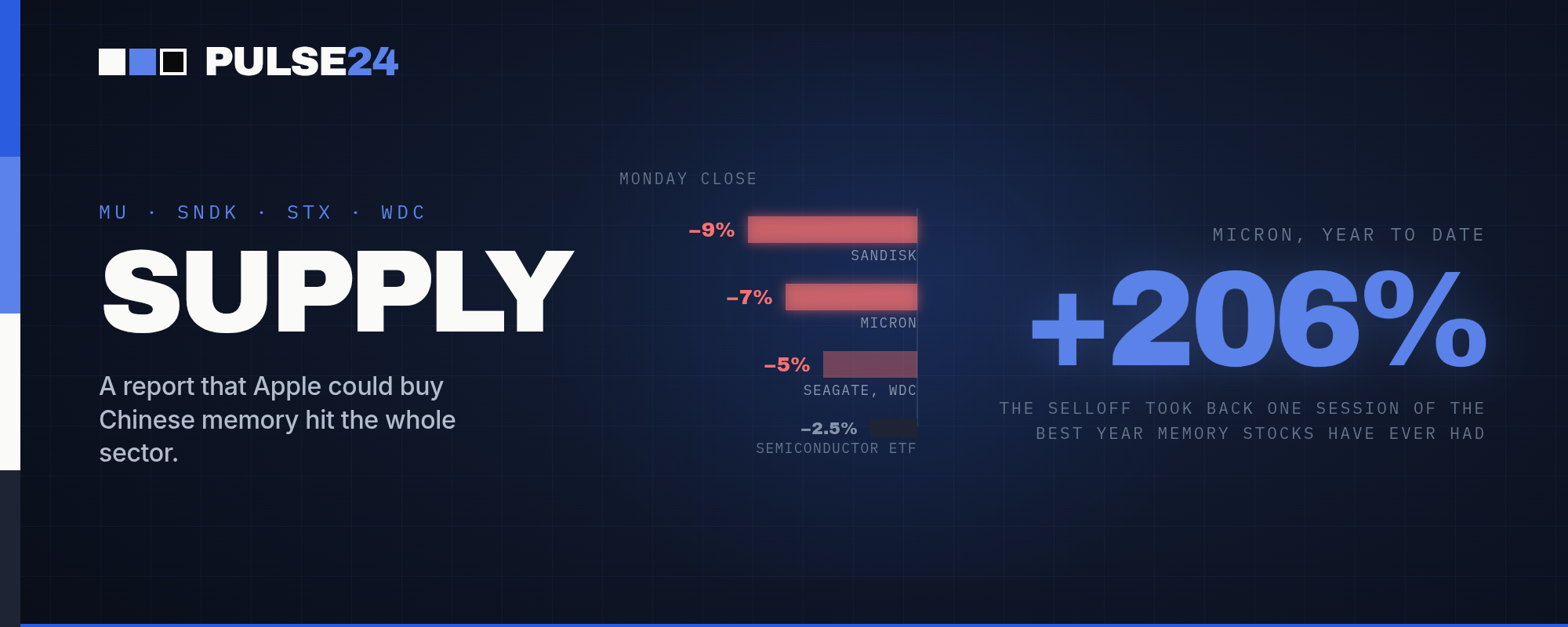
Micron and SanDisk each fell about 7 percent on Monday after a report that Washington may let Apple buy memory chips from Chinese suppliers. The threat lands squarely on the pricing power that's driven memory stocks through the best year of their history.
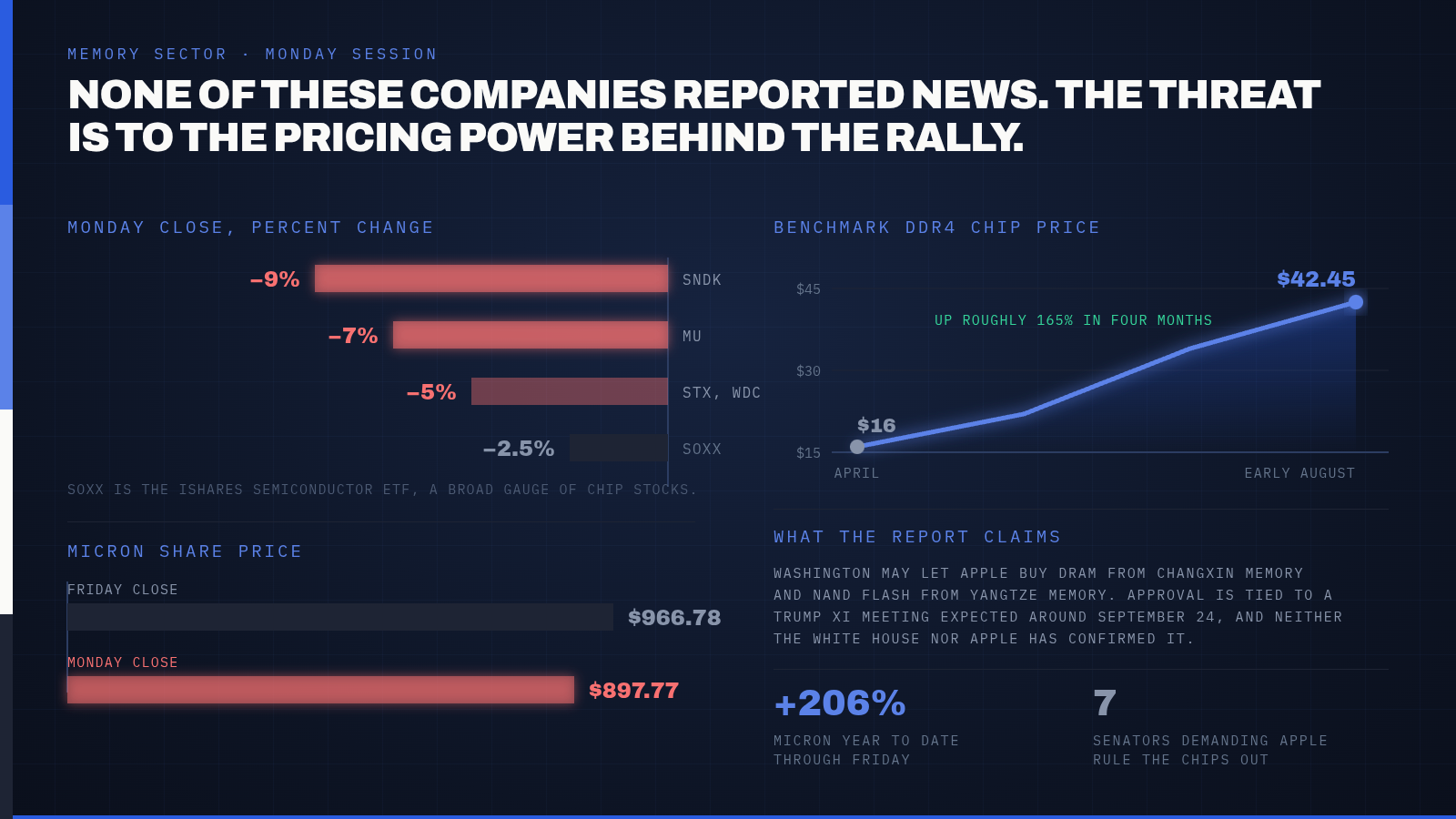
Micron Technology closed at $897.77 on Monday, down about 7% from Friday's $966.78. SanDisk fell even harder, down about 9%. Seagate and Western Digital each lost more than 5%, and the iShares Semiconductor ETF, a broad gauge of chip stocks, fell more than 2.5% for the day. None of the four companies reported news about their own businesses on Monday. The selling came from somewhere else entirely.
What Changed
A report circulating in Chinese tech media on Friday claimed the Trump administration is preparing to let Apple buy DRAM from ChangXin Memory Technologies (CXMT) and NAND flash storage from Yangtze Memory Technologies (YMTC), two Chinese chipmakers Washington has spent years trying to keep out of the US supply chain. Formal approval would reportedly wait until after a Trump-Xi meeting expected around September 24 in New York, timed to the UN General Assembly. The report traces back to an unverified social media account, and neither the White House nor Apple has confirmed it, so for now it belongs in the category of plausible rather than proven.
Apple hasn't been shy about wanting the option. On its most recent earnings call, the company said it was "continuing to evaluate" its sources of memory supply and that Chinese chips "would help us on the supply side." Apple has reportedly already been testing CXMT chips for use in iPhones and MacBooks sold in China, where the memory would stay if any deal goes through.
That testing has drawn bipartisan pushback in Washington. In late July, seven senators led by Chuck Schumer sent Tim Cook a letter demanding Apple commit to never using CXMT or YMTC chips in any product, anywhere, citing the companies' alleged ties to the People's Liberation Army. Schumer put it bluntly: American companies "should be buying chips stamped Made in America, not from companies linked to the Chinese military." The senators asked for a response by August 21. As of Monday, Apple hadn't made one publicly.
Monday's selloff had company. Samsung's own shares fell sharply the same week after a shareholder-return plan investors considered underwhelming, adding to the sense that memory stocks across the board, not just the American names, were due for a reset after months of gains.
Why It Matters
Memory has been one of the most direct beneficiaries of the AI buildout this year, and the mechanism is simple. Data centers need commodity DRAM and NAND by the truckload, supply hasn't kept pace, and scarcity has done for chipmakers what nothing else could. A benchmark DDR4 chip that traded near $16 in April hit a record $42.45 in early August, a jump of roughly 165% in about four months. Consumer prices moved even more. A 64-gigabyte DDR5 memory kit that cost $191 a year ago was selling for $1,118 by mid-August. Micron's stock is up about 206% this year on the back of that pricing power.
The Apple report threatens that pricing power at its foundation, not because of the volumes involved this year but because of what it would signal. Apple has historically sourced almost exclusively from Samsung, SK Hynix, and Micron. Even a limited deal, confined to phones and laptops sold inside China, would make CXMT and YMTC qualified suppliers to the world's most valuable electronics company. That matters more for how the market prices future capacity decisions than for how many gigabytes actually change hands in 2026. One report pegged Apple's demand at roughly 600 million gigabytes, about 6.6% of CXMT's expected year-end capacity, and noted CXMT's production is already booked through 2027 and that the Chinese firm has so far refused to offer Apple a price break. If that reporting holds up, the near-term supply threat is smaller than the headline suggests. The longer-term signal, that Washington might let a qualified new entrant into the memory chain, is the part traders appeared to be pricing on Monday.
There's also a reason this selloff looks different from the last one. A memory-stock selloff three weeks earlier was blamed on a 30-year Treasury yield sitting near its highest level since 2007, the logic being that higher-for-longer rates made expensive AI-adjacent stocks harder to justify. Monday's move happened as yields actually eased, with the 10-year down a few basis points to 4.70% and the 30-year down to 5.23%. When a stock falls alongside rising rates, that's a valuation story. When it falls as rates ease, something more specific to the business is usually in play.
What to Watch Next
The first thing to track is whether Apple ever answers the senators' August 21 deadline, and what it says if it does. A firm commitment to avoid Chinese memory chips would remove the overhang. Continued silence, or a partial answer limited to products sold outside China, would keep the uncertainty alive through the September summit. Nvidia's earnings on Wednesday are the next scheduled catalyst, and any commentary on memory costs eating into data center margins will be read closely given how much of Nvidia's own supply chain runs through the same DRAM and HBM makers. Kevin Warsh's first Jackson Hole speech as Fed chair lands Friday and could move the rate backdrop again, though Monday's price action suggests memory stocks are trading on their own news for now rather than following the broader rate trade.
Beyond this week, the number worth watching is spot DRAM and NAND pricing itself. Traders have started flagging early signs that the pace of price increases may be moderating from this summer's peak, separate from anything to do with Apple or China. If that moderation turns out to be real and durable, it will matter more to Micron's 2027 earnings than a diplomatic gesture involving a slice of the Chinese phone market ever could.
The Pulse24 Take
It's worth being honest about what actually happened here. A sector that has been one of 2026's best trades sold off hard on Monday, and the proximate cause traces back to a report sourced to a single unverified social media account, describing a policy decision that hasn't been made yet. That's a thin reed to hang a seven percent stock move on, and it says something about how stretched positioning had become in memory names that traders were willing to sell first and ask questions later.
The underlying tension is real even if this particular report turns out to be wrong or premature. Washington has spent years treating semiconductor supply chains as a national security question. Apple has spent years treating them as a cost and availability question. Those two frames have coexisted uneasily before, and they will again. What made Monday notable is that the market chose, for one session, to weight the security frame's downside for memory makers over the AI-capex story that's carried the sector all year. Whether that persists depends on facts nobody has yet: whether Apple actually answers the senators, whether Trump and Xi produce anything concrete in September, and whether the memory shortage that's driven this entire trade is showing real cracks or just catching its breath ahead of Nvidia's print. None of those questions get resolved by Friday. Investors should expect more sessions like Monday before they do.
How we read the data
Curious how we get from raw data to a take like this? Our Trader's Toolkit walks through the tools we lean on.
Explore the Toolkit