Pulse24 Original
Samsung Fell 8.7% Monday, Pulling the Kospi Down 3.1% With It. The $80 Billion Shareholder Return Promised Two Days Earlier Wasn't Enough to Hold the Stock Up.
August 24, 2026
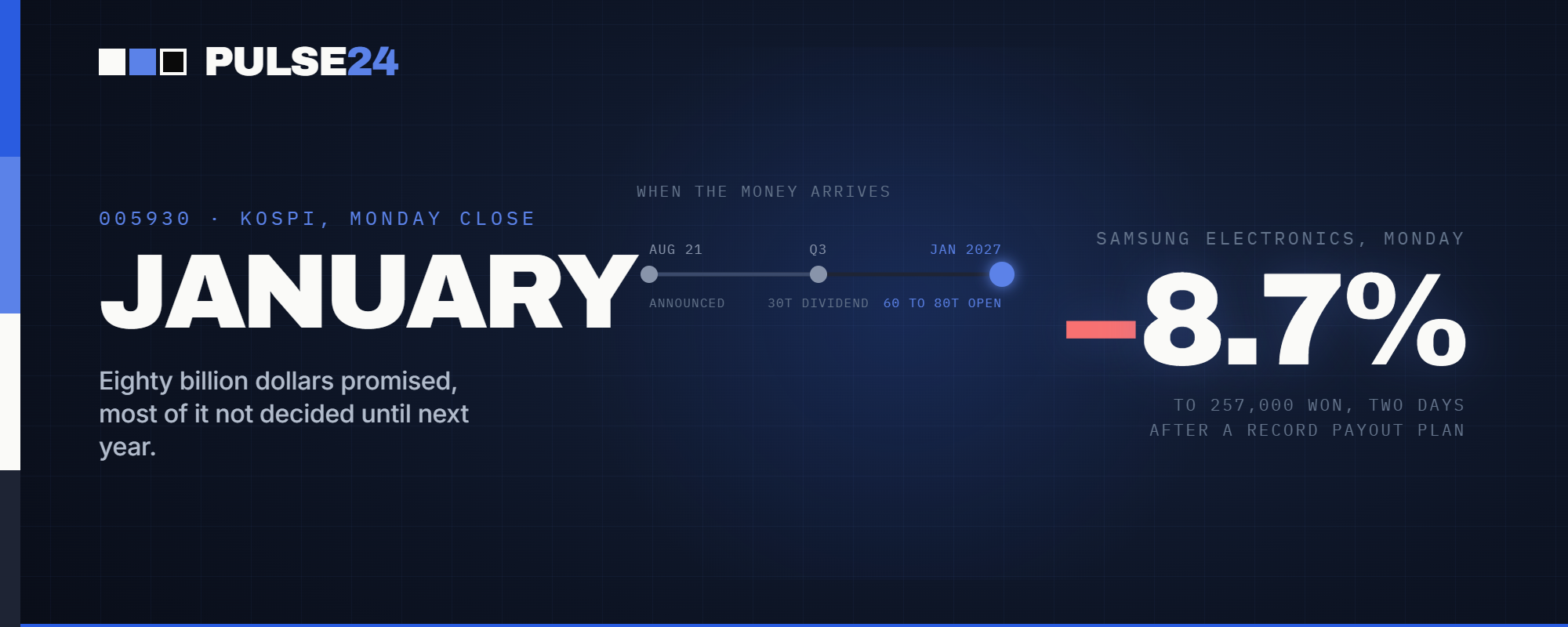
Samsung fell 8.7% and dragged the Kospi down 3.1% on Monday, two days after promising as much as $80 billion in shareholder returns. Analysts say the gap comes down to timing: SK Hynix's buyback is already running, while most of Samsung's plan won't be finalized until a board meeting in January.
Samsung Electronics fell 8.7% to 257,000 won on Monday, its steepest one-day drop since it unveiled a record shareholder return plan two days earlier. The decline dragged South Korea's Kospi index down 3.12% to 6,696.96, erasing 215.99 points in one of the index's roughest sessions of the year.
The timing is what makes it strange. On Friday, Samsung approved as much as 110 trillion won, or roughly $80 billion, in shareholder returns for 2026, a headline figure about five times larger than its previous record. Two trading days later, the stock is worth less than it was before the announcement, not more.
What Changed
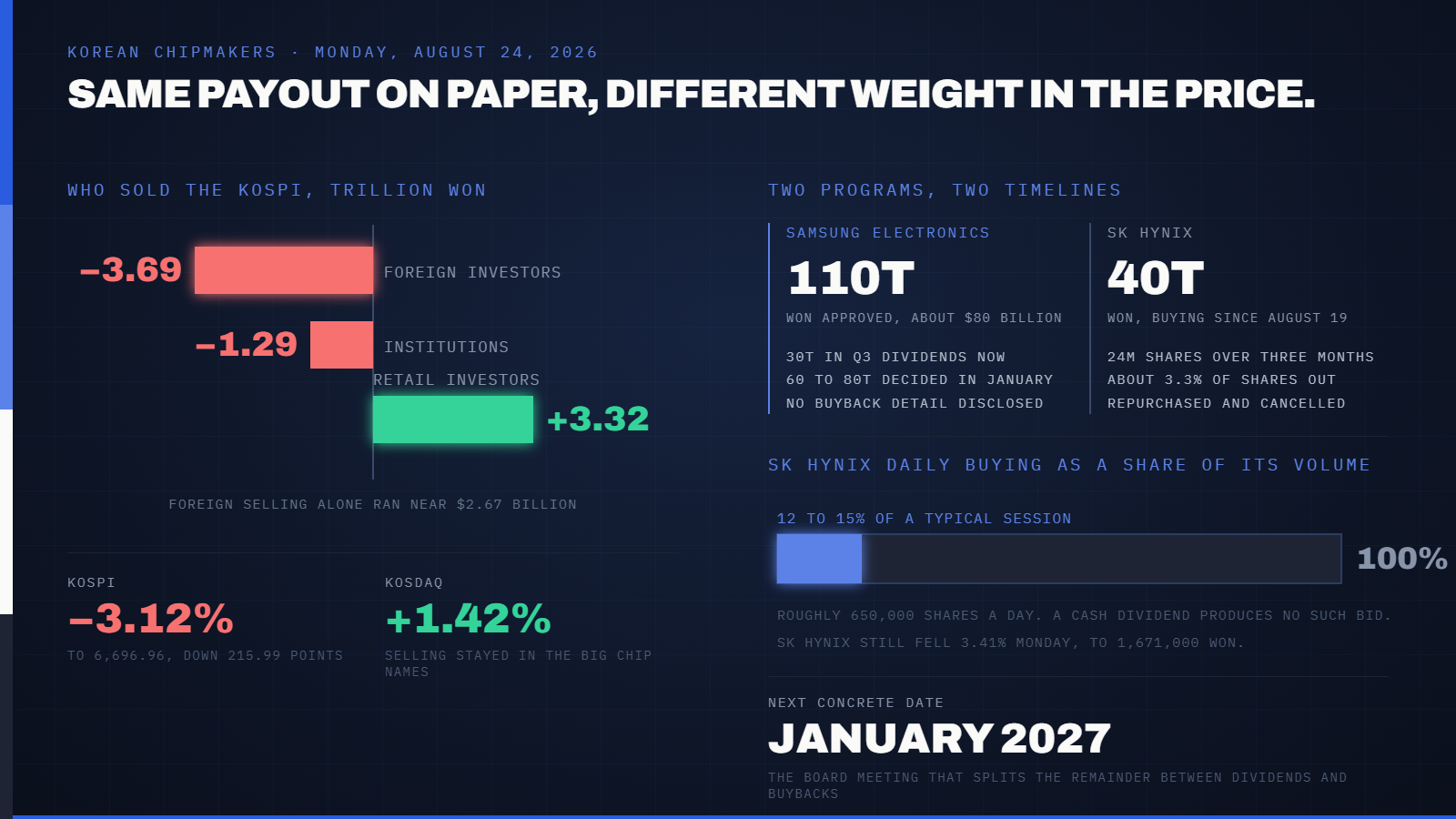
The selling wasn't confined to Samsung. SK Hynix, which announced its own 40 trillion won buyback and cancellation program back on August 19, fell 3.41% to 1,671,000 won the same session, even though its program is already underway and Samsung's largely isn't. Foreign investors sold a net 3.69 trillion won, about $2.67 billion, of Korean stocks Monday, and institutional investors added another 1.29 trillion won in sales. Retail investors were the only net buyers, adding 3.32 trillion won, nowhere near enough to offset the rest. The Kosdaq, Korea's smaller-cap index, moved the opposite direction, closing up 1.42% at 813.33, a sign the selling was concentrated in the largest chip names rather than spread across the market.
Daishin Securities analyst Lee Kyoung-min pointed to a specific gap behind the reaction. "The Kospi was weighed down by disappointment over Samsung Electronics' shareholder return plan announced last week, with other Samsung affiliates losing ground," he said, noting the company gave no details on an actual stock buyback. Toss Securities analyst Lee Young-gon made a related point about mechanics: share repurchases and cancellations, he said, tend to have more direct impact on stock prices than cash dividends, despite identical payout amounts. He pointed to SK Hynix's pace of roughly 650,000 shares repurchased a day, equal to 12% to 15% of its typical trading volume, a level of concentrated buying pressure a dividend simply doesn't produce.
Why It Matters
Samsung's plan directs about 30 trillion won toward third-quarter cash dividends, with the remaining 60 to 80 trillion won not finalized until the company locks in full-year results at a board meeting in January 2027. SK Hynix's plan, by contrast, is already buying back and cancelling roughly 24 million shares, about 3.3% of its outstanding stock, over three months. Investors appear to be pricing the two programs on different timelines: one removing shares from the market right now, and one that's mostly a promise for a later date.
That gap matters heading into an earnings season where AI infrastructure spending keeps setting records of its own. A number that looks enormous in isolation can still read as a letdown when the market already priced in something bigger, or when the mechanism behind it doesn't match what got the stock moving in the first place, a pattern Samsung's own stock had already shown once this month before Monday's drop.
What to Watch Next
Samsung's next concrete deadline is that January 2027 board meeting, when the company decides how much of the remaining 60 to 80 trillion won comes as dividends versus buybacks. Until then, expect the stock's relationship with the broader plan to stay tentative. SK Hynix's three-month buyback window runs through roughly late November, and each disclosed daily purchase gives traders a running data point on whether that support is holding.
Nvidia reports earnings Wednesday, and the Jackson Hole symposium runs Thursday through Saturday. Both are likely to reset sentiment across chip and AI-linked names regardless of what Samsung or SK Hynix do individually this week.
The Pulse24 Take
Samsung's shareholder return plan wasn't small. At up to $80 billion, it stands as the largest capital return in the company's history, and the stock fell anyway. What that gap shows is that markets aren't simply pricing the size of a promised number. They're pricing the mechanism behind it and when it actually arrives. A dividend paid next quarter carries the same dollar value on paper as a buyback running today, but a very different weight in the stock price.
Whether Samsung files in more buyback detail before January is worth watching closely, since that's the specific piece analysts flagged as missing this week. Filing it early could reverse some of Monday's selling quickly. Sticking with the current split for months tells you the market has already priced in its answer.
How we read the data
Curious how we get from raw data to a take like this? Our Trader's Toolkit walks through the tools we lean on.
Explore the Toolkit