Pulse24 Original
Samsung Approved as Much as $80 Billion in Shareholder Returns, More Than Double SK Hynix's Buyback From Two Days Earlier. The Stock Still Fell 0.7% the Day It Was Announced.
August 22, 2026
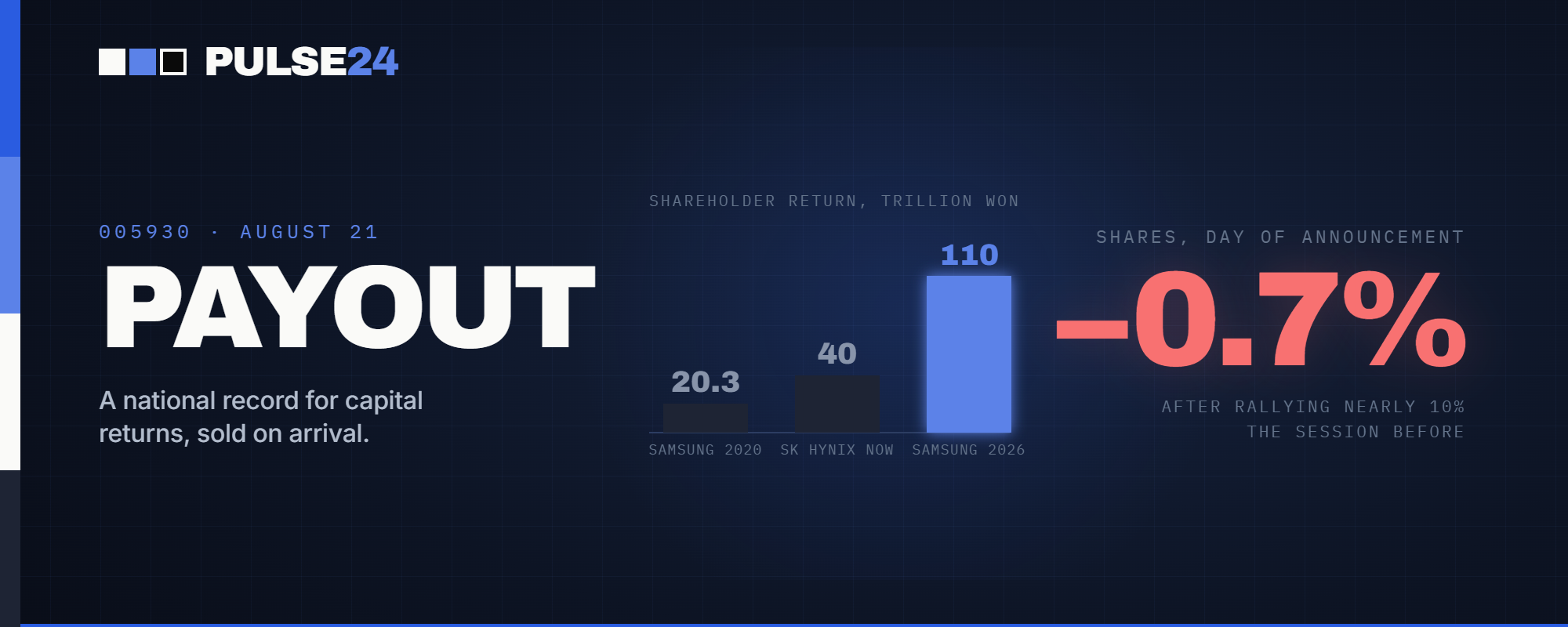
Samsung approved a record 90 to 110 trillion won shareholder return this week, more than double SK Hynix's own record buyback from two days earlier. The stock still slipped on the news, a reminder of how much good news the memory trade had already priced in during the run-up.
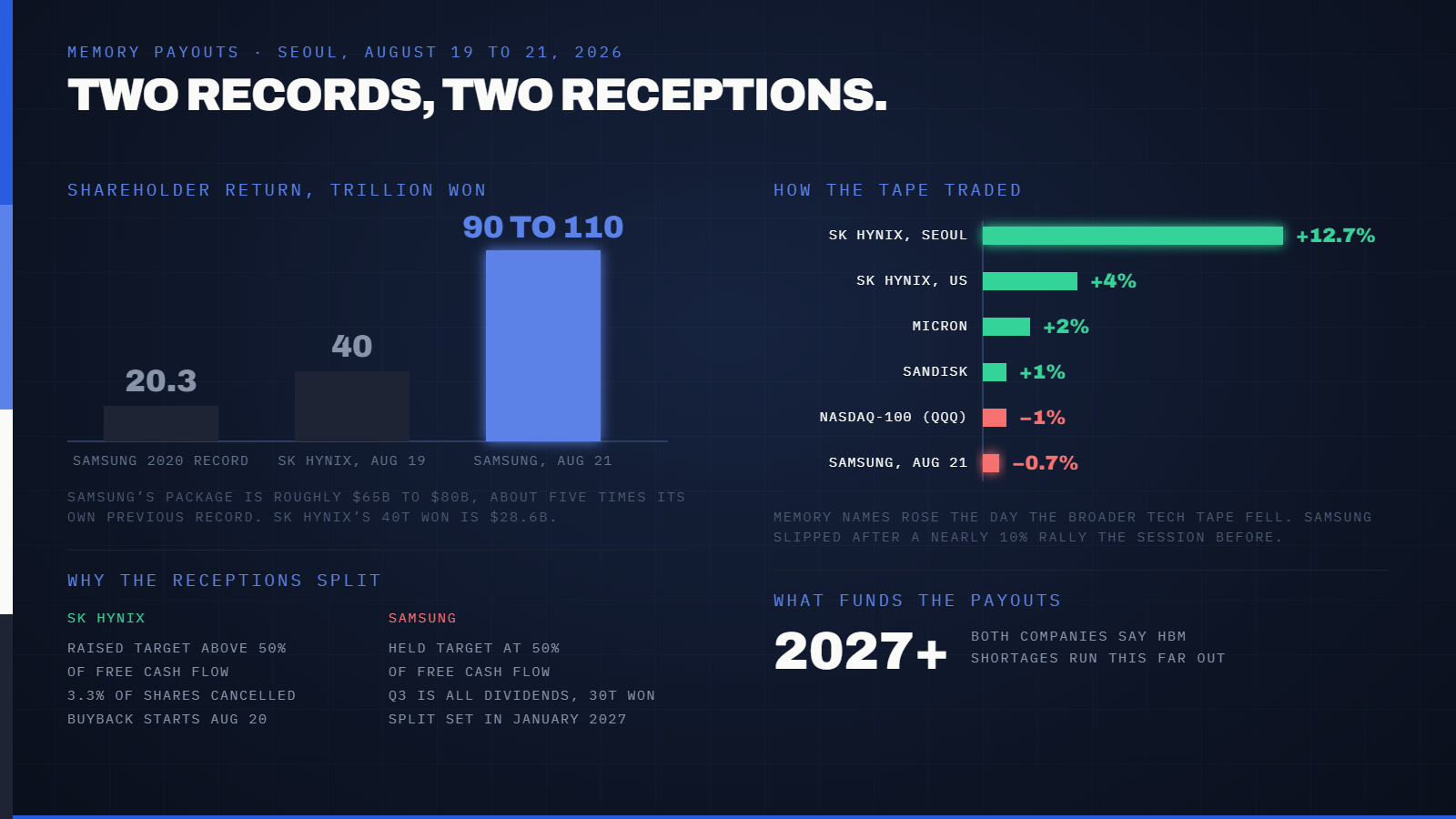
Samsung Electronics approved a shareholder return package worth as much as 110 trillion won this week, somewhere between $65 billion and $80 billion depending on the exchange rate used. That figure is roughly five times the 20.3 trillion won record the company set in 2020, and it landed just two days after SK Hynix approved a record of its own: a 40 trillion won, or $28.6 billion, buyback and share cancellation program, the largest ever carried out by a South Korean listed company.
The stock fell anyway, sort of. Samsung shares had already jumped nearly 10% in Seoul the prior session on hopes management would go big, then slipped 0.7% on the day the actual 90 to 110 trillion won figure was confirmed. The headline number set a new national record. It just wasn't the number some traders had already bid the stock up for.
What Changed
SK Hynix moved first. Its board approved the 40 trillion won buyback and cancellation on August 19, covering roughly 24.07 million shares, about 3.3% of shares outstanding, to be repurchased over three months starting August 20. Management also raised the company's shareholder return target for 2025 through 2027 from within 50% of cumulative free cash flow to over 50%, a shift tied to net cash of roughly 69 trillion won. SK Hynix shares jumped 12.7% in Seoul the next session, as much as 14% intraday. In the US, the stock (SKHY) rose 4% to close near $162, Micron added 2% to close near $952, SanDisk gained 1% to about $1,584, and Western Digital rose 1% to about $466. The Nasdaq-100, tracked by the QQQ ETF, fell 1% to $711.06 the same day, so memory names moved opposite the broader tech tape.
Then came Samsung. The company confirmed on August 21 that it would return between 90 and 110 trillion won to shareholders in 2026, including roughly 30 trillion won in cash dividends paid out in the third quarter. The stock fell 0.7% that day anyway, a mirror image of SK Hynix's reception two days earlier. A few reasons stood out: Samsung kept its payout target at 50% of cumulative free cash flow instead of raising it the way SK Hynix did, it put its entire third-quarter commitment into dividends rather than share cancellations, which do more to lift per-share value, and its free cash flow calculation deducts employee bonus compensation and advance payments tied to long-term supply deals, a narrower base behind the same headline percentage. The final split between buybacks and dividends for the rest of the package won't be locked in until a board meeting in January 2027, once full-year results are confirmed.
Why It Matters
Both companies are cashing in on the same shortage. Samsung and SK Hynix have each warned that high-bandwidth memory supply could stay tight into 2027 and beyond, with major AI customers locking in orders years ahead of delivery. That scarcity is what's funding these payouts. Memory makers are commanding prices and margins that looked unthinkable two years ago, and for the first time in this cycle, shareholders are seeing a meaningful share of that cash instead of watching all of it get plowed back into new fabs.
Worth sitting with here: Samsung's stock drop happened despite good news, not bad news. This isn't a company disappointing on earnings or cutting guidance. It's a company setting a national record for capital returns and still getting sold. The gap between a record number and a number that counts as enough has become a recurring theme this cycle. TSMC's July revenue jumped 44.7% to a record $14.5 billion and the stock barely moved, because the beat was already priced in before the report came out.
It's a different flavor of skepticism than the one shadowing the more speculative end of the AI trade. Nvidia's $105 billion commitment to OpenAI's new Ohio data center reopened questions this week about circular financing, chipmakers effectively funding the customers that buy their own chips. Memory makers don't carry that same complication. Their profits trace back to a physical shortage of chips that already exist and are already selling, not a web of vendor financing arrangements. Investors are applying a version of the same skepticism to both anyway: show a record number, and the next question is whether it's the right record number.
What to Watch Next
Micron reports fiscal fourth-quarter results in the coming weeks and will be the first US-listed pure-play memory name to face this newly raised bar. Worth remembering going in: Western Digital fell 7% and SanDisk dropped 9% in a single session just before SK Hynix's buyback news, on a day with no memory-chip-specific news at all, driven instead by a spike in Treasury yields. Memory stocks have had one of the best runs of any sector this year, and a run that large can get hit by forces that have nothing to do with the chips themselves.
Samsung's January 2027 board meeting is also worth marking down. That's when the company finalizes how much of its return comes as dividends versus buybacks and cancellations, the missing detail investors flagged this week as part of why the stock slipped despite the record headline figure.
The Pulse24 Take
Big numbers don't move markets by themselves. Context does. An $80 billion promise sounds enormous until it's measured against a rumored 150 trillion won, and then it reads as a shortfall instead of a milestone. That pattern isn't unique to Samsung. It's a defining feature of this stage of the AI cycle: companies keep posting results that would have looked unthinkable three years ago, and the market keeps finding a reason to want more.
For memory chip makers specifically, the underlying fundamentals still look real. Shortages tied to actual HBM production capacity, not speculative financing arrangements, are what's generating this cash. That distinction matters for anyone trying to separate the parts of the AI trade built on genuine scarcity from the parts built on promises about future demand. Whether the market keeps rewarding that distinction, or eventually starts treating all of it the same, may be the single most important question left in this cycle.
How we read the data
Curious how we get from raw data to a take like this? Our Trader's Toolkit walks through the tools we lean on.
Explore the Toolkit