Pulse24 Original
Bloom Energy Dropped 8% Monday and Jumped 12% Tuesday. A $165 Billion Data Center Explains the Whiplash.
September 30, 2026
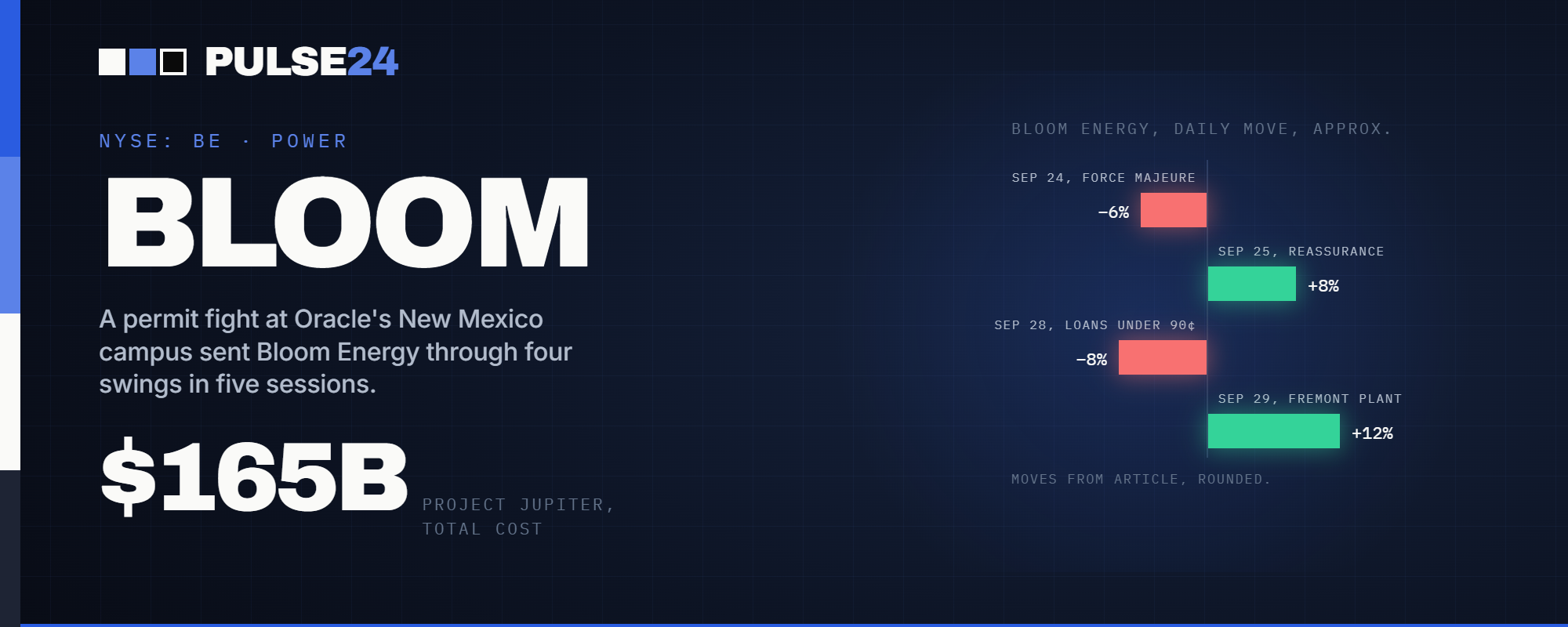
Bloom Energy swung double digits in both directions this week after Oracle filed a force majeure notice on its $165 billion Project Jupiter data center in New Mexico. The whiplash shows how much of the AI buildout's risk now sits in permits and power, not chips.
Oracle filed a force majeure notice on September 24 against Project Jupiter, a data center campus under construction in Dona Ana County, New Mexico. The filing gives Oracle contractual cover to delay payments if the site misses its 2028 target, and the reason it cited was specific: a denied permit for the energy infrastructure the site needs to run.
Project Jupiter is not a small line item. Its total cost runs to $165 billion, and its design calls for 2.45 gigawatts of capacity once complete, built as part of the Stargate initiative that OpenAI and SoftBank have backed since 2025. Bloom Energy supplies the fuel cells meant to power a large piece of it, 2.4 gigawatts under a standalone contract, and its stock dropped about 6% the day the notice became public.
What Changed
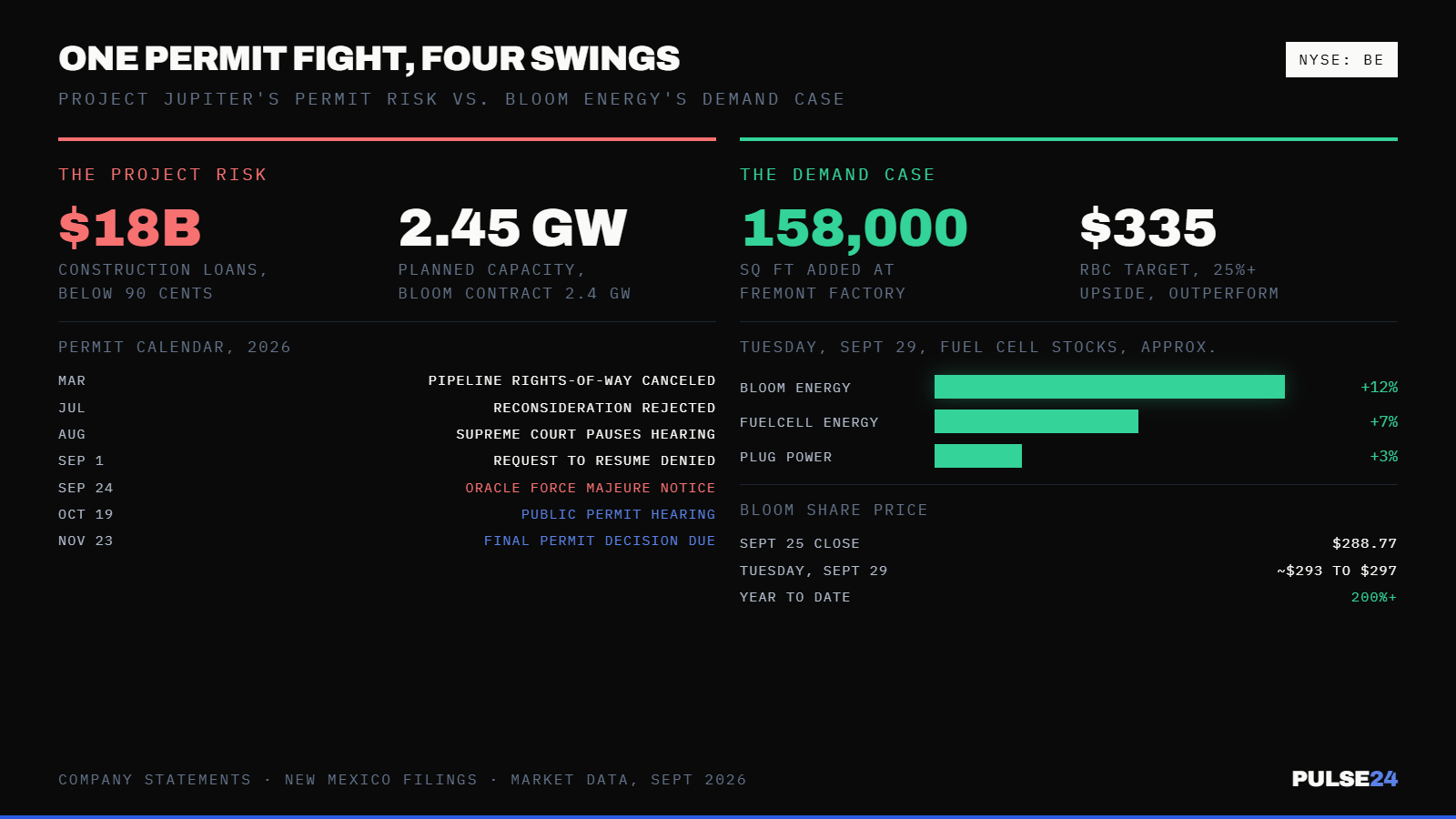
The filing did not end the story, it restarted an older one. New Mexico's land commissioner had already canceled a pipeline developer's rights-of-way across state land back in March and rejected its bid for reconsideration in July. The state Supreme Court separately paused a related air-quality permit hearing in August after an advocacy group argued it was premature, then unanimously denied the developer's request to partially resume proceedings on September 1. A public hearing on the permit is now set for October 19, and New Mexico's Environment Department has until November 23 to issue a final decision. Oracle's force majeure notice effectively acknowledged, in a legal filing, what the permitting fight had already been signaling for months: this site might not open on schedule.
Within a day, Oracle, Blue Owl Capital (the financing partner behind the site through its STACK Infrastructure unit), and Bloom Energy all issued statements reaffirming their commitment to the project and to each other's contracts. Bloom's stock recovered, closing September 25 up about 8% at $288.77. Blue Owl said the force majeure notice "doesn't change the financial obligations of the companies involved." That reassurance held for about 48 hours.
By Monday, September 28, Bloom was down again, roughly 8% to 9%, as a different detail surfaced: about $18 billion in construction loans backing the campus were trading below 90 cents on the dollar, a level that signals lenders are already discounting for delay. A securities class-action deadline tied to Bloom's own disclosures about Chinese-sourced scandium oxide added separate pressure, and the 10-year Treasury yield, hovering near its highest level since 2007, made every long-duration growth stock a harder hold that day.
Then Tuesday reversed it again. Bloom jumped roughly 12%, to around $293 to $297 a share, this time on news that had nothing to do with New Mexico: the company is adding 158,000 square feet to its Fremont, California manufacturing footprint. RBC Capital read the expansion as a demand signal strong enough to reaffirm its Outperform rating and $335 price target, implying more than 25% upside from Monday's close. Smaller fuel-cell names caught the same updraft, FuelCell Energy gained about 7% and Plug Power about 3%, even as the 10-year yield kept climbing.
Why It Matters
A stock swinging 8% one day and 12% the next over the same underlying dispute is a market pricing two different risks at once: whether Project Jupiter clears its permits on schedule, and whether Bloom Energy's fuel-cell business depends on this one campus at all.
Investors clearly decided this week that the second question matters more than the first. Texas alone has 474 gigawatts of data center capacity waiting in an interconnection queue against a grid that has never delivered more than 91 gigawatts at once, and PJM's capacity auction has hit its price cap for a third straight year as natural gas prices catch up to AI-driven power demand. Power, not chips, is increasingly the binding constraint on how fast the AI buildout can happen, and that scarcity is what gives a supplier like Bloom pricing power even when one specific deal wobbles.
The financing side of this story deserves equal attention. Project Jupiter sits inside the same Stargate initiative whose financing has already shown strain elsewhere: SoftBank is paying its highest-ever bond yields to help fund OpenAI's side of the buildout, and construction debt trading at 90 cents on the dollar is the kind of signal that shows up before a headline, not after one. When permits, pipelines, and court calendars are the actual bottleneck, the gap between an AI capex announcement and a running data center can stretch for years, and the debt backing that gap has to be serviced the entire time.
What to Watch Next
New Mexico's air-quality permit hearing is scheduled for October 19, with the state Environment Department required to issue a final decision by November 23, and that decision will say more about Project Jupiter's real timeline than anything Oracle or Bloom says in a press release. Watch whether that $18 billion in construction debt recovers toward par or keeps sliding, since bond prices tend to move before equity narratives catch up. Oracle and Bloom Energy both report quarterly results before year-end, and management commentary on Project Jupiter specifically, not just AI demand in general, will be worth more than the headline numbers. And keep an eye on whether the sympathy rally in FuelCell Energy and Plug Power holds or fades, since that will say whether the market believes this is a sector-wide power story or a Bloom Energy story that briefly borrowed some neighbors.
The Pulse24 Take
The easy read here is that Bloom Energy won the week: down 6%, up 8%, down 8%, up 12%, and still sitting well over 200% higher on the year. The harder read is what those swings represent. A single company's shares moving double digits in either direction, twice, inside five trading days, over one data center campus, says how thin the margin for error still is in the AI infrastructure trade. The capex numbers get bigger every quarter, but capex is a promise, not a power line, and this week it was New Mexico's courts, not any chipmaker's roadmap, actually setting the pace. That distinction is worth remembering the next time a headline capex figure crosses the wire without a permit attached to it.
How we read the data
Curious how we get from raw data to a take like this? Our Trader's Toolkit walks through the tools we lean on.
Explore the Toolkit