Pulse24 Original
PJM's Power Auction Hit Its Price Cap for a Third Straight Year. Natural Gas Prices Are Catching Up.
September 23, 2026
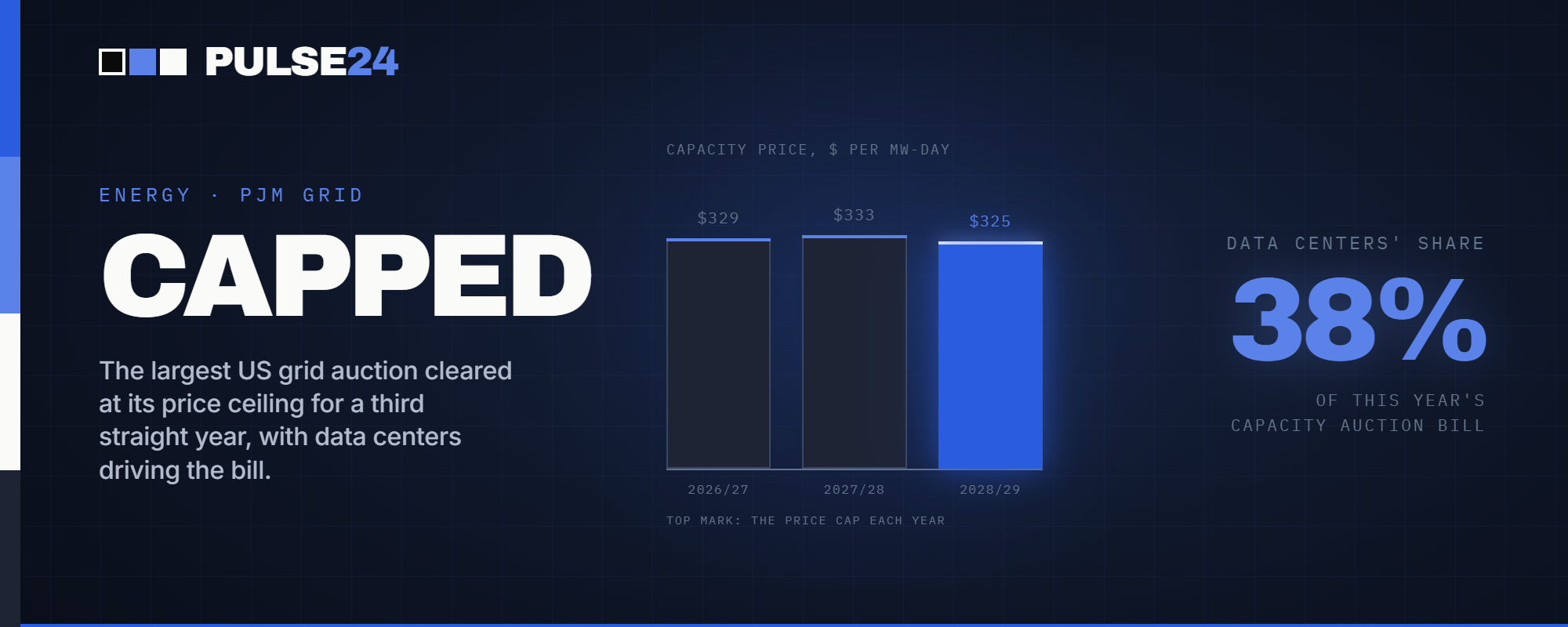
PJM's latest capacity auction cleared at its price cap for the third year running, with data centers responsible for more than a third of the bill, and natural gas prices are climbing alongside a structural shift in how the grid gets its power.
Natural gas futures rose to $3.05 on Wednesday, up about 2.8% on the day and roughly 7.5% over the past month. A late-season heat wave across the South and South-Central US kept air conditioners running well past when cooling demand usually fades, and thin storage injections relative to the five-year average added to the pressure. None of that has much to do with artificial intelligence.
But the reason a move like this barely registers as unusual anymore traces back to a much bigger story that PJM Interconnection, the largest grid operator in the country, confirmed back in July: the power market is being reshaped by a source of demand that did not really exist at this scale a few years ago.
What Changed
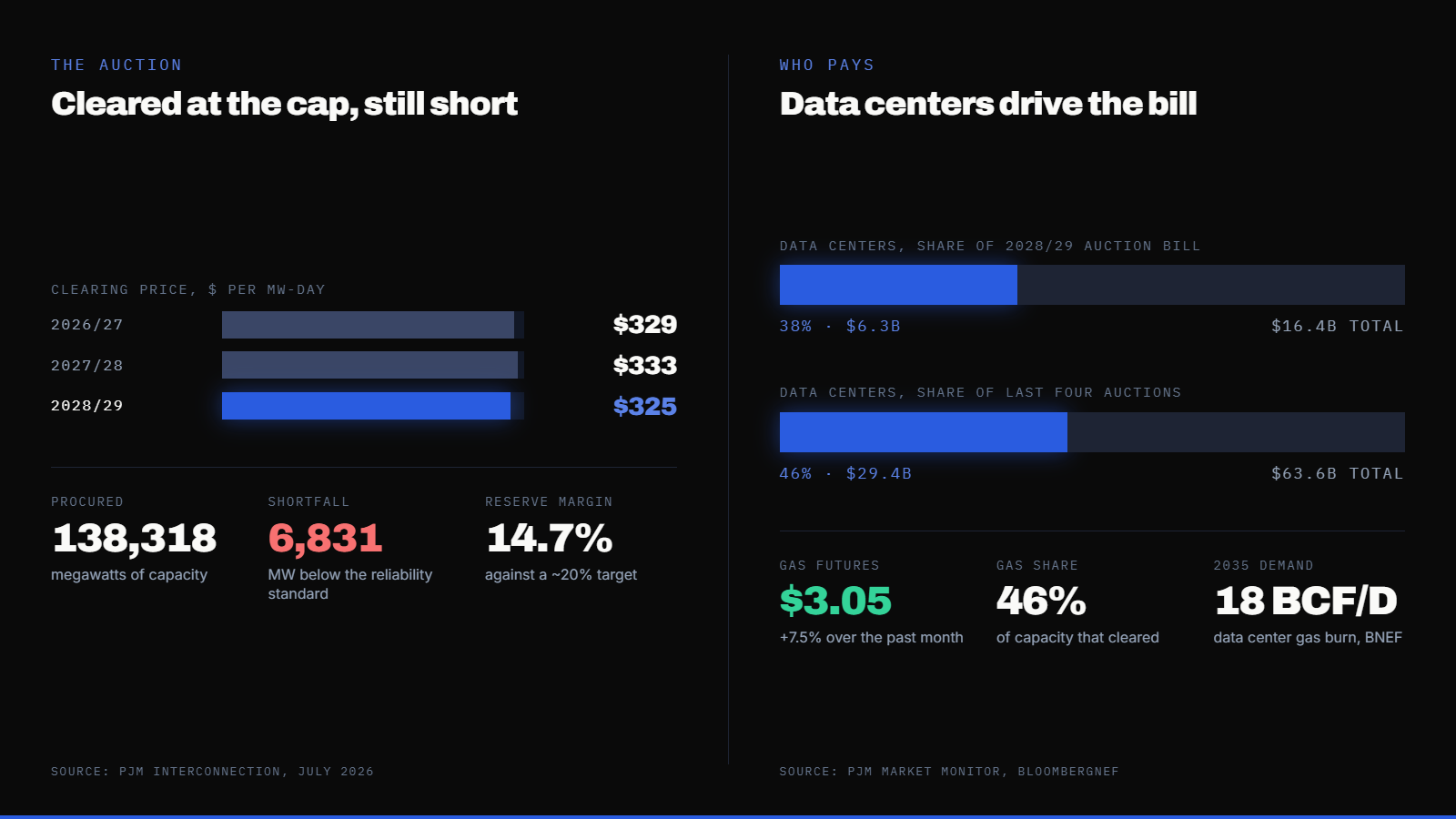
PJM runs the power grid across 13 states and Washington, D.C., and every year it holds an auction that locks in electricity capacity three years out. In July, the auction for the 2028/29 delivery year cleared at $325 per megawatt-day, the maximum price PJM's rules allow. That is actually 2.5% below the $333.44 the prior auction cleared at for 2027/28, but it is still the third year running that PJM's auction has landed at or right against its price ceiling, a run that did not happen at all in the years before 2024.
PJM procured 138,318 megawatts of capacity and still came in 6,831 megawatts short of the reliability standard the grid is supposed to meet, holding a 14.7% reserve margin against the roughly 20% target regulators consider comfortable. The shortfall was large enough that PJM's board approved a one-time backstop auction to fill the gap, an unusual step for a grid operator to take outside its normal annual process.
Why It Matters
Joseph Bowring, the president of PJM's independent market monitor, put a number on what is driving the shortfall: data centers accounted for 38%, or $6.3 billion, of this year's $16.4 billion auction bill. Across the last four auctions combined, data centers have driven 46% of $63.6 billion in total capacity costs, or $29.4 billion. Bowring has called the shift a paradigm shift and argued PJM should consider running a separate auction just for hyperscaler-driven demand rather than folding it into the same process that prices capacity for everyone else.
Gas-fired plants supplied 46% of the capacity that cleared this year's auction, more than nuclear, coal, demand response, hydro, wind, oil, and solar combined. That is the generation source grid operators keep reaching for because it can be built faster than nuclear or transmission-scale renewables, and it is also the fuel BloombergNEF expects to carry most of the incremental load from data centers going forward. The firm's latest estimate has US data centers consuming 18 billion cubic feet of natural gas a day by 2035 to keep the lights on, nearly double what it projected just nine months earlier. Roughly 15 billion cubic feet of that daily total would come from grid-connected facilities, the kind PJM prices capacity for, versus up to 3.4 billion from onsite plants that companies like Meta, Microsoft, Google, and Amazon are building to power their own data centers directly. Grid-connected data center demand alone is projected to grow five times faster than every other sector on the grid combined.
That's the same buildout Pulse24 has tracked from the capital-spending side, where a single gigawatt of AI data center capacity can cost anywhere from $38 billion to $60 billion depending on what's counted, and where hyperscalers have already had to lean on rivals' cloud capacity just to keep existing services running while new capacity gets built. Every one of those gigawatts eventually needs power, and PJM's auction results are what that need looks like once it shows up as a market-clearing price.
This remains a slow-moving force acting on a market that still trades on weather and storage day to day. Wednesday's move came from heat and thin storage builds, not from a data center flipping a switch. But every added gigawatt of committed AI capacity raises the floor under future gas demand a little further, which is part of why PJM's auction has now cleared at its ceiling three years running.
What to Watch Next
PJM's backstop auction, called specifically to close the reliability gap left by this year's results, will be the next concrete data point on how the grid operator plans to handle data center demand going forward, and whether Bowring gets the separate hyperscaler-specific mechanism he has pushed for. Winter heating season is the other test: if cold weather arrives on top of storage that is already running lean, gas prices could hold well above where they started the year, and that shows up in heating bills faster than capacity charges show up in electric bills.
Watch too for how other grid operators handle the same pressure. PJM covers the mid-Atlantic and parts of the Midwest, but data center buildouts are concentrated in a handful of other regions as well, and similar capacity auctions elsewhere will show whether this is a PJM-specific story or the leading edge of a nationwide one.
The Pulse24 Take
It is worth separating the two stories here, because conflating them leads to bad conclusions. A single-day move in natural gas is weather and storage data working through a market that reacts quickly to both. That kind of move can reverse just as fast as it happened, and reading too much AI narrative into every daily wiggle in gas prices will leave you wrong more often than right.
The auction result is a different kind of signal. It is a forward-looking price that grid operators and generators are willing to lock in three years out, and it says PJM is already budgeting for a demand curve that did not exist at this scale before 2024. A market clearing at its price ceiling three years in a row, even as the underlying number drifted slightly lower this time, describes a system adjusting to a large new customer rather than working through a temporary shock. The two stories will keep getting mixed together every time gas prices move. Telling them apart is most of the work.
How we read the data
Curious how we get from raw data to a take like this? Our Trader's Toolkit walks through the tools we lean on.
Explore the Toolkit