Pulse24 Original
Microsoft Is Promising 38 Gigawatts of AI Capacity by 2032. It's Renting Amazon's Cloud to Keep GitHub Online Today.
September 17, 2026
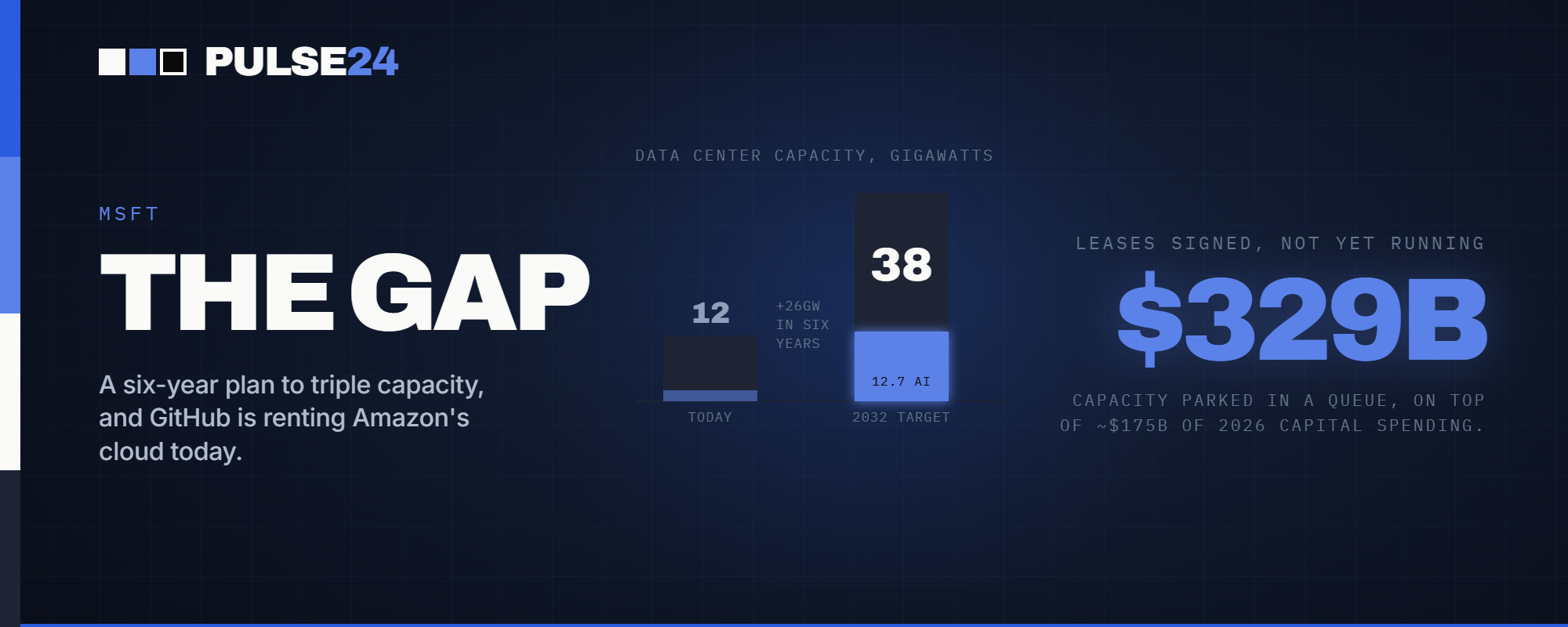
Microsoft wants to triple its data center footprint to 38 gigawatts by 2032, but right now it can't fully run GitHub on its own Azure cloud. The gap between that promise and today's capacity crunch says a lot about where the AI buildout's real bottleneck sits.
GitHub, the code-hosting platform Microsoft bought for $7.5 billion back in 2018, has spent part of this year leaning on a competitor's cloud to stay online. Amazon Web Services, not Azure, has been absorbing some of GitHub's AI coding-agent traffic, a workaround that followed a stretch this spring when the platform logged nine separate outages as demand outpaced the compute Microsoft could give it.
That detail sits awkwardly next to the plan Microsoft laid out earlier this month: grow total data center capacity from about 12 gigawatts today to 38 gigawatts by 2032, adding new capacity every year for the next six. A company that can't fully run its own flagship developer product on its own cloud is asking investors to believe it will more than triple its physical footprint inside a decade.
What Changed
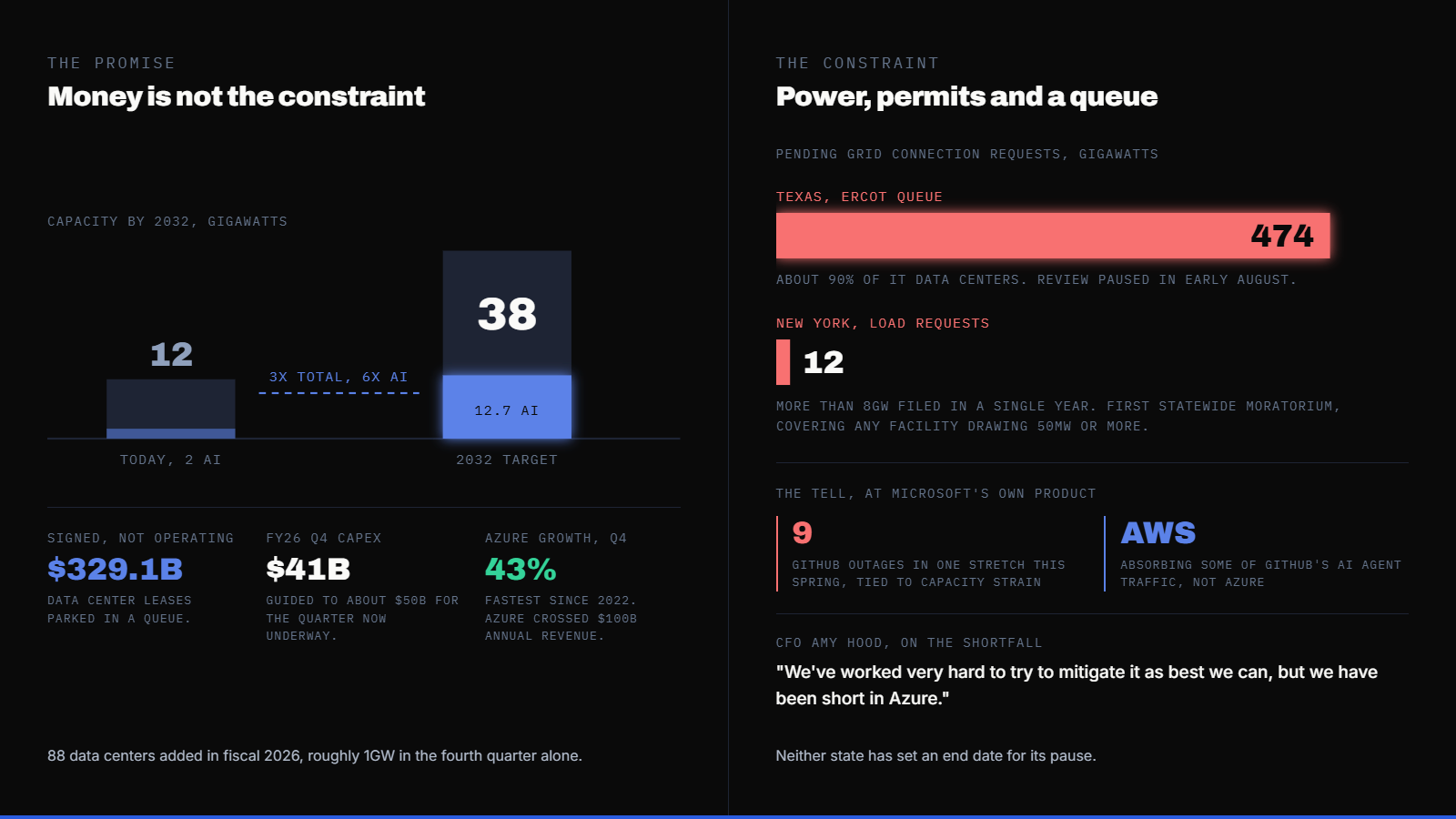
The 38-gigawatt target, first reported by Bloomberg and confirmed across Microsoft's own investor materials, splits into two pieces. Overall capacity roughly triples from today's 12 gigawatts. The AI-specific slice inside it grows faster still, from around 2 gigawatts currently to about 12.7 gigawatts by 2032, roughly a sixfold increase and close to a third of the total footprint by the end of the plan.
The company isn't starting from zero. It added 88 data centers across five continents during fiscal 2026, and roughly 1 gigawatt of capacity in the fiscal fourth quarter alone, the three months through June 30. Keeping that quarterly pace for six straight years would get Microsoft close to the 26 gigawatts of new capacity the plan calls for, which is precisely the problem: there's little room in that math for the delays already showing up in Texas and New York.
Money is not the constraint. Microsoft spent $41 billion on capital expenditures in that same fiscal fourth quarter, and calendar 2026 spending, including finance leases, is on pace for roughly $175 billion. The company has guided to about $50 billion in capital spending for the quarter now underway, an acceleration from the prior quarter's pace. Separately, it has committed to $329.1 billion in data center leases that have been signed but haven't started operating, a stack of future capacity effectively parked in a queue.
The demand side backs up the spending. Azure crossed $100 billion in annual revenue for the first time in fiscal 2026, and cloud revenue growth in the fiscal fourth quarter hit 43% year over year, the fastest pace since a 46% quarter back in 2022. Chief Financial Officer Amy Hood has been candid about the shortfall behind those numbers for a while now. Asked last fall how much revenue Microsoft was leaving on the table, she told analysts plainly: "We've worked very hard to try to mitigate it as best we can, but we have been short in Azure." She also pointed to how Microsoft weighs allocation across a portfolio of fast-growing AI products, Copilot and GitHub included, when deciding where new GPU and CPU capacity goes first. Even by the company's own account, demand for compute is outrunning what Azure can supply across its highest-priority workloads, let alone everything else.
Why It Matters
Microsoft's problem isn't unique, and it isn't really about willingness to spend. It's the same physical bottleneck Pulse24 has flagged before: AI's grid bottleneck has already become a measurable driver of retail electricity inflation, and power, not capital, is increasingly the thing standing between a hyperscaler's roadmap and its actual server count. Building a data center is fast compared with getting it connected to the grid, permitted by a state, and supplied with water and transformers that now carry multi-year lead times.
Two decisions this summer made that constraint concrete. Texas Governor Greg Abbott paused new data center interconnections in early August, citing risk to grid reliability, after the ERCOT queue swelled to roughly 474 gigawatts of pending requests, about 90% of it from data centers. Weeks earlier, New York became the first state to impose a moratorium on large new data center permits, an executive order covering any facility capable of drawing 50 megawatts or more, justified in part by a queue of its own: nearly 12 gigawatts of data center load requests sitting with the state's grid operator, more than 8 gigawatts of it filed in a single year.
Microsoft isn't the only company racing against that wall while also racing against its rivals. Oracle's cost of insuring its own debt has quintupled over the past year as Wall Street questions how the AI buildout gets financed, and hardware makers have already shown how quickly capex commitments ripple outward: Dell and HPE jumped 11% in a single session on the strength of Oracle's own spending pledge. Microsoft's balance sheet looks sturdier than Oracle's on most measures, but the underlying tension is shared across the sector: enormous, real demand meeting a buildout that physically cannot move as fast as the spending commitments suggest it can.
What to Watch Next
Microsoft's fiscal first-quarter results, expected in late October, will show whether the roughly $50 billion capex guide held and whether Azure's growth rate kept climbing or started to plateau as easier comparisons roll off.
The interconnection queues deserve attention too. Texas has not said when its review will conclude, and New York's order does not carry a fixed end date, only a requirement that the state finish an environmental review first. Either state extending its pause into next year would cut directly against the six-year buildout math.
GitHub is the clearest real-time gauge of all. If outages and AWS reliance persist into the fall even as Microsoft claims new capacity is coming online, that's a sign the gap between announced targets and delivered gigawatts hasn't closed yet.
The Pulse24 Take
The demand side of this story checks out. Azure crossing $100 billion in revenue and growing 43% in a single quarter isn't a projection, it already happened. What's less settled is whether a six-year plan to triple physical capacity can outrun constraints that sit largely outside Microsoft's control: grid interconnection timelines measured in years, state governments newly willing to hit pause, and transformer lead times that don't care how large a company's capex budget is.
GitHub running partly on a competitor's cloud is the tell here. That isn't a hypothetical risk analysts are debating, it's Microsoft's own flagship product living with the shortfall right now, months before the first meaningful slice of that 38-gigawatt target is due. The company that convinces investors it can close that gap on schedule, rather than the one with the biggest headline number, is the one worth paying attention to over the next few quarters.
How we read the data
Curious how we get from raw data to a take like this? Our Trader's Toolkit walks through the tools we lean on.
Explore the Toolkit