Pulse24 Original
Electricity Prices Climbed 4.2% in the Year Through July, Outpacing Headline Inflation. AI's Grid Bottleneck Is a Big Reason Why.
September 7, 2026
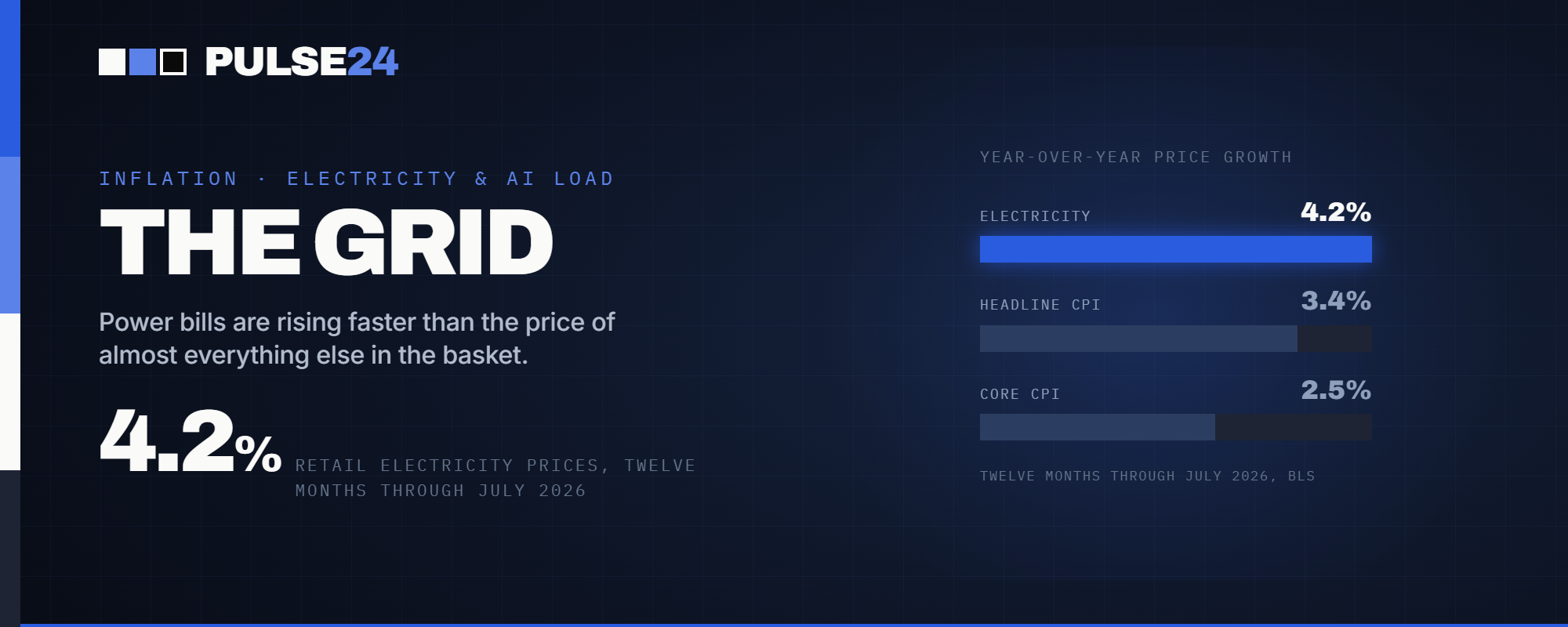
Electricity prices climbed 4.2% over the year through July, outpacing both headline and core inflation, and Goldman Sachs says AI demand is a real driver. With PJM's capacity auction stuck at its price cap for a third straight year and Marsh estimating half of planned data centers will miss their target completion window, the grid, not chip supply, may be the tightest constraint on the AI buildout.
Electricity bills climbed 4.2% over the twelve months through July, according to the Bureau of Labor Statistics, well ahead of the 3.4% rise in headline consumer prices and the 2.5% increase in the core measure over the same period. That gap has been widening for months, and economists increasingly point to the same culprit: the buildout of AI data centers.
Goldman Sachs has put a number on it in research published this year, estimating that AI-related demand could add half a percentage point to core PCE inflation by the end of the year. A Federal Reserve Bank of Dallas study reached a similar conclusion from a different angle, finding that AI-driven load has already pushed wholesale power prices up somewhere between 2% and 6% nationwide, with the increase from new data centers projected to reach 20% to 30% by 2028. Virginia, the world's densest concentration of data centers, shows what that looks like at the retail level: regulators there approved a Dominion Energy rate case last November that adds $16 a month to the typical residential bill.
What Changed
Retail electricity prices rose 42% over five years, from April 2020 through April 2025, according to federal energy data, a run-up utilities and consumer advocates increasingly tie to the same data center boom. Two forces are colliding to keep that pressure building. Demand is rising faster than anyone modeled a year ago, and the infrastructure meant to meet it is arriving on a timeline measured in years, not quarters.
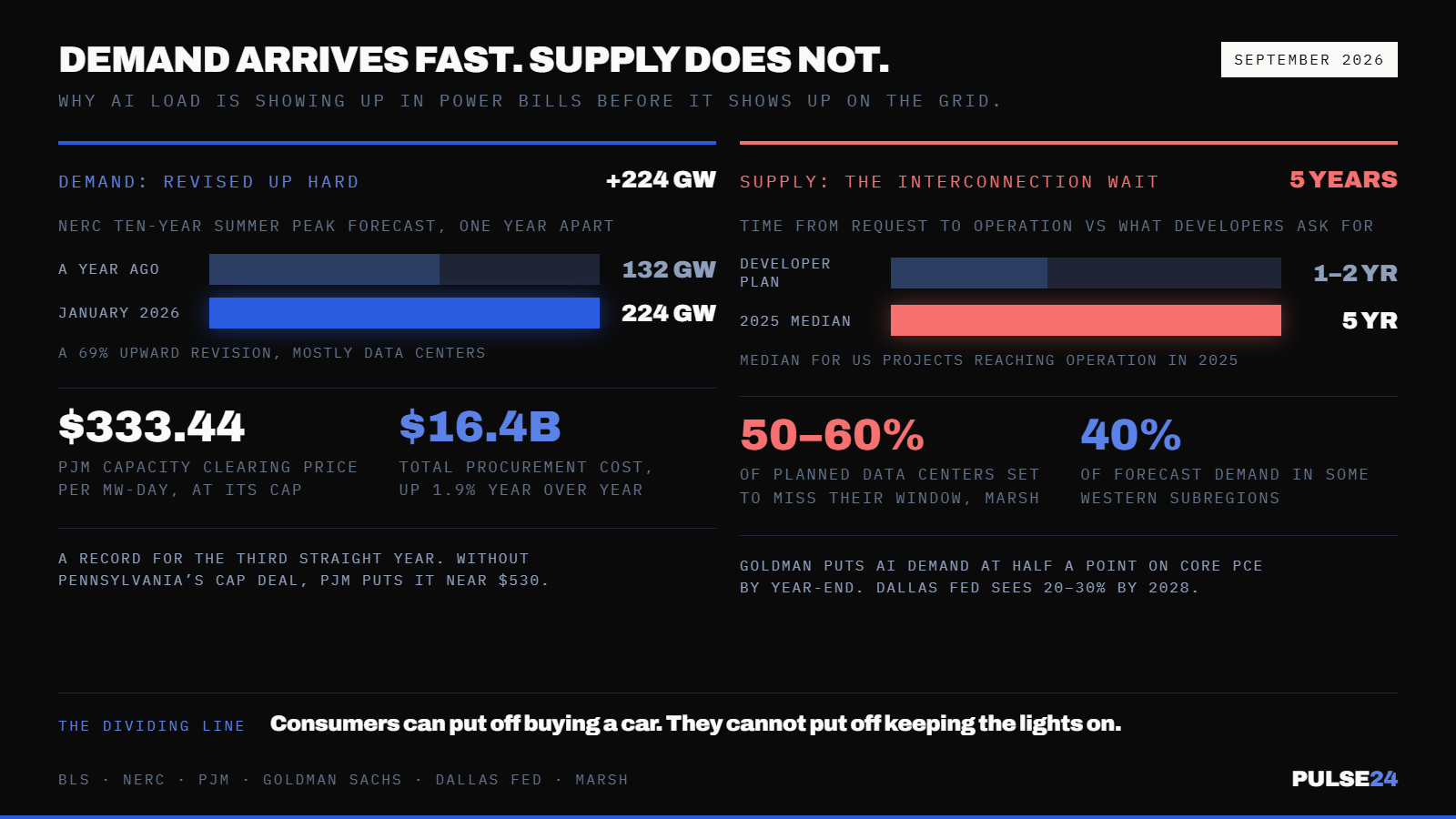
NERC's latest long-term reliability assessment, published in January, projects summer peak power demand will climb by 224 gigawatts over the next decade, a forecast that came in 69% higher than the one NERC published a year earlier. Winter peak demand is expected to rise by 246 gigawatts over the same window, with data centers accounting for most of the upward revision.
Getting new generation and transmission connected to the grid is the actual bottleneck. US power projects that reached commercial operation in 2025 took a median of five years from the initial interconnection request, far longer than the one to two years a typical data center developer asks for. In parts of the Western US grid, planned data centers already account for an average of 10% of forecast demand, and as much as 40% in some subregions.
Kathryn Burke, who leads US specialty energy and power growth at the insurance broker Marsh, puts a figure on how much of that pipeline is likely to slip: 50% to 60% of planned data center projects, by her estimate, will miss the one-to-two-year completion window their developers are counting on. Rob Gramlich, president of the consulting firm Grid Strategies, frames the mismatch simply. Tech companies want to move fast, and utilities, bound by rules requiring deliberate study and planning before committing capital, notoriously don't. Not every project chasing grid capacity right now is going to get the full service level it wants, at least until supply catches up.
Why It Matters
PJM Interconnection's most recent capacity auction, covering the 2027-28 delivery year, cleared at $333.44 per megawatt-day, the region's price cap and a record for the third consecutive year. That's only a modest increase from the $329.17 cleared the year before, largely because Pennsylvania's governor negotiated a temporary cap agreement. Without it, PJM estimates the price would have landed near $530 per megawatt-day, about 60% higher. Total procurement costs for the auction still rose to $16.4 billion, up 1.9% year over year, a bill that eventually works its way into customer rates across a market spanning 13 states and Washington, DC.
For the Fed, this matters because electricity is a stickier, less discretionary line item than most of what shows up in a monthly inflation report. Consumers can put off buying a car or a television. They can't put off keeping the lights on. If a meaningful share of the current inflation overshoot, headline CPI at 3.4% and core PCE running at 3.3% through July, traces back to power costs tied to a multi-year infrastructure buildout rather than a temporary shock, that argues for a slower path back to target than markets have been pricing, whatever the September 16 decision ends up being.
Power isn't the only physical constraint showing up in the AI buildout's cost structure. JPMorgan estimates DRAM prices will have risen more than 400% between early 2024 and the end of this year, a shortage tight enough that Dell's server unit posted a 620 basis point margin jump last quarter despite the same memory cost pressure that was supposed to squeeze it. Chips and electrons are turning out to be constrained by similar dynamics: demand from AI arrived faster than either supply chain had planned for.
The market has mostly treated all of this as a reason to buy, not a reason for caution. Utility names tied to the AI power story, Vistra, Constellation, Talen, have re-rated sharply over the past two years on the assumption that data center demand is both real and reliably monetizable. That first assumption looks solid. Where Burke's delay estimate and PJM's now-capped pricing cut the other way is the second one: if a third to a half of near-term projects slip, and regulators keep leaning on capacity prices the way Pennsylvania did, the revenue ramp built into those stock prices may arrive slower and smaller than modeled. It's the same tension Pulse24 flagged when hyperscalers' AI borrowing pushed the 30-year Treasury yield toward a 19-year high: a lot of capital is chasing a buildout whose physical constraints, power chief among them, are only now showing up in hard numbers.
What to Watch Next
The next CPI report, due in mid-September, will show whether the electricity component kept accelerating in August or leveled off, and it lands just days before the Fed's September 16 decision. A hotter reading there complicates any dovish case for a rate move.
Utility earnings this fall are worth tracking closely too. Guidance on interconnection queues, updated construction timelines, and any signs that more states follow Pennsylvania toward capping capacity costs would all signal whether the AI power trade is repricing toward reality or still running on the demand story alone.
Watch, too, for whether the Fed starts talking about electricity-driven inflation as its own category. Structural repricing tied to a multi-year infrastructure cycle calls for a different policy response than a temporary supply shock, and how officials characterize it will say a lot about how patient they're willing to be.
The Pulse24 Take
AI's electricity problem is real, and it's showing up in the data faster than inflation models built around goods and services were ever designed to capture. That much of the story checks out.
What's less settled is whether the market has priced the timeline correctly. Demand being genuine doesn't guarantee supply shows up on schedule, and Burke's estimate that half of near-term data center projects could miss their target window marks a real gap between what's been promised and what the grid can currently deliver. Investors leaning into the AI power trade, and Fed officials weighing how long this pressure lasts, are both effectively betting on an execution speed that the last year of interconnection data doesn't fully support.
How we read the data
Curious how we get from raw data to a take like this? Our Trader's Toolkit walks through the tools we lean on.
Explore the Toolkit