Pulse24 Original
Oracle's Cost to Insure Its Own Debt Has Quintupled Over the Past Year. Wall Street Can't Agree on What That Means for AI Spending.
September 13, 2026
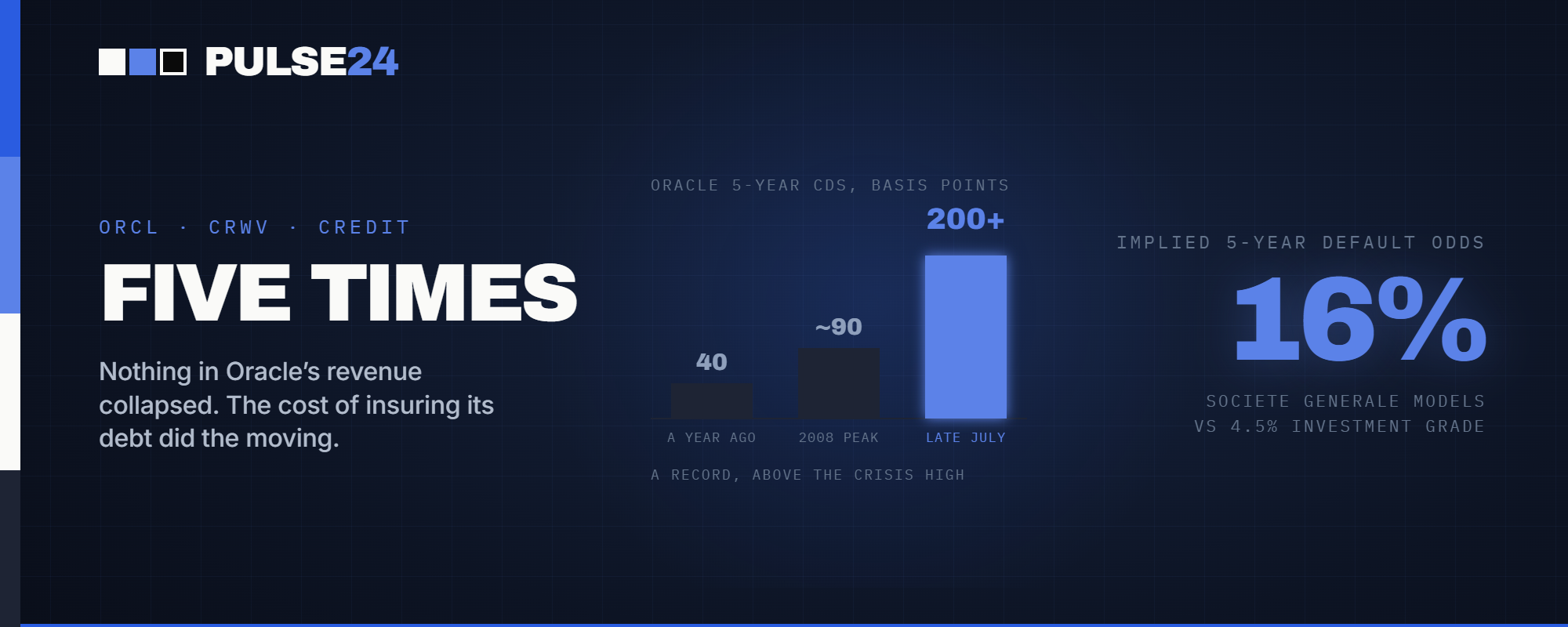
Oracle's five-year credit-default swaps have gone from about 40 basis points a year ago to a record above 200, and CoreWeave's once implied roughly even odds of default within five years. Lenders are already writing tougher covenants into new AI loans, even as JPMorgan says the bond market can easily absorb another $1.5 trillion of hyperscaler debt.
Oracle's five-year credit-default swaps, the derivatives bondholders use to insure against the company defaulting, closed near 200 basis points in late July, a record that surpassed even the peak Oracle hit during the 2008 financial crisis. A year earlier, that same insurance cost roughly 40 basis points. Nothing about Oracle's revenue collapsed in between. What moved is how bond investors price the mountain of debt Oracle and its hyperscaler peers have taken on to build AI data centers.
What Changed
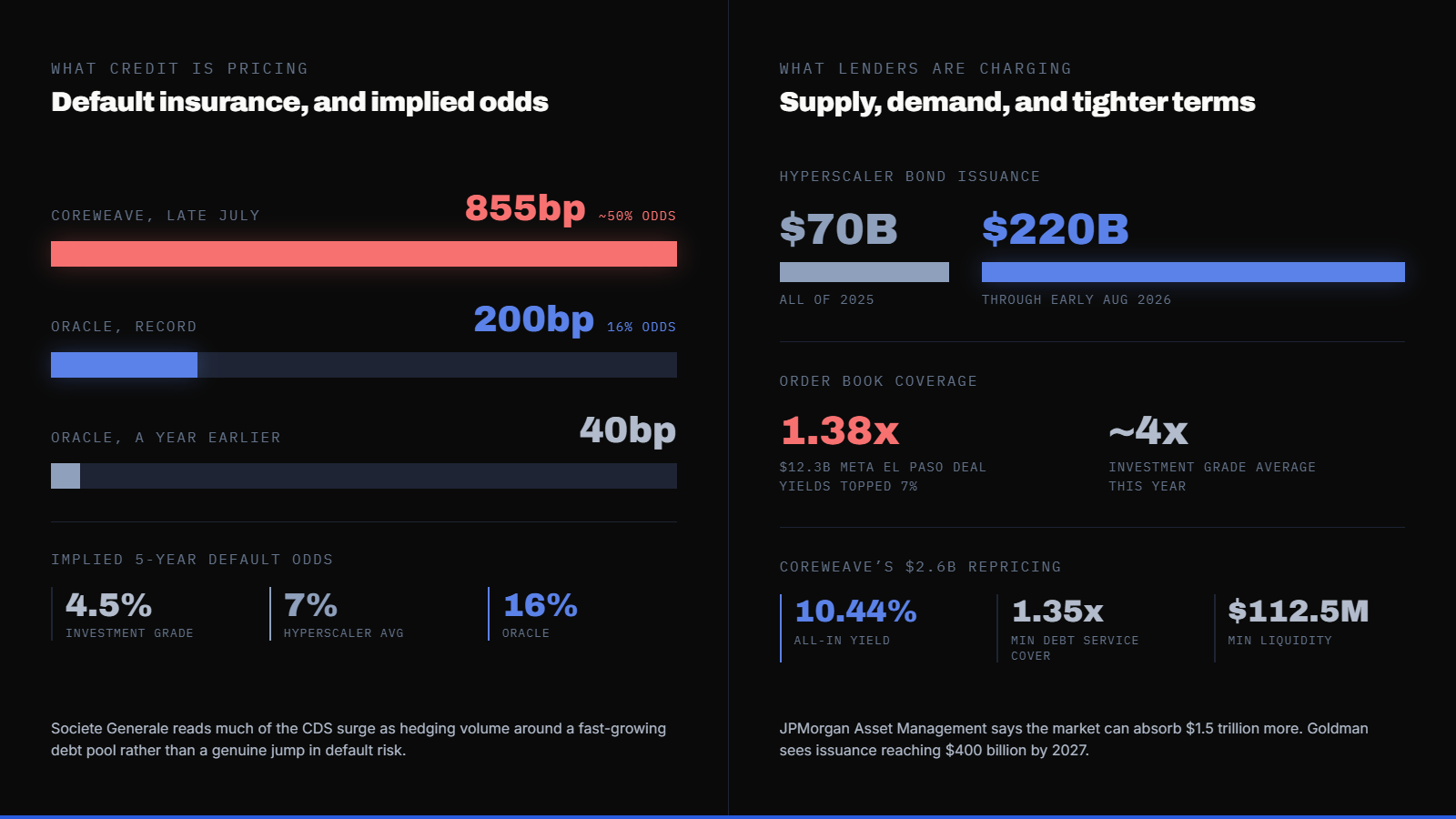
By the end of July, Oracle's CDS spread had reached a record, and Societe Generale's models implied roughly a 16% chance the company defaults within five years, more than triple the sector's already-elevated 7% average and well above the 4.5% baseline for investment-grade credit broadly. CoreWeave, the AI cloud computing company that leases GPUs to customers including Microsoft and OpenAI, saw its own default insurance jump even further, to about 855 basis points, a level implying close to a coin-flip chance of default over the same window. Nebius and CoreWeave shares fell 10% and 9% in a single session on July 29 as the CDS moves rippled into equities, extending declines that had already left both stocks down more than a third over the prior month.
Apollo's chief economist, Torsten Slok, warned around the same time that rising borrowing costs could eventually force the AI capital-spending cycle to self-throttle. The 10-year Treasury yield was sitting near 4.65% then, close to the top of its trailing 12-month range, and every basis point higher raises the price tag on the hundreds of billions of dollars in data-center debt still queued up to be sold.
The market gave a concrete example of that repricing a few days later. BlackRock priced a $12.3 billion bond in late July to fund a Meta-backed data center in El Paso, structured through a vehicle that keeps the debt off Meta's own balance sheet. The deal drew about $17 billion in orders, a coverage ratio of roughly 1.38 times, well short of the near-4-times average for investment-grade bonds this year. Yields on the new debt topped 7%, about 0.4 percentage points above what a similar Meta-backed deal known as Hyperion, sold in October 2025, had commanded nine months earlier. Those Hyperion bonds were themselves trading around 96 cents on the dollar by late July, a sign investors wanted a bigger cushion even on paper issued less than a year ago.
Lenders elsewhere started asking for more than just a higher price. CoreWeave repriced a $2.6 billion loan facility in early August, and the terms that emerged looked different from the covenant-light structures that have dominated leveraged lending for over a decade. The spread widened by 100 to 125 basis points to roughly SOFR plus 550, pushing the all-in yield to 10.44%, and the facility now carries a minimum 1.35-times debt-service coverage ratio, mandatory amortization instead of a bullet repayment, and a $112.5 million minimum liquidity requirement. Marathon Asset Management's Bruce Richards summed up the shift bluntly: "Creditors have greater rights at wider spreads, and that's a beautiful thing." Several other AI infrastructure borrowers reportedly had to sweeten terms that same week, and some deals were pushed back entirely.
Why It Matters
The dollar figures behind this are large enough to matter for markets well beyond AI. Alphabet, Amazon, Meta, Microsoft and Oracle sold about $220 billion of bonds through early August this year, more than triple the roughly $70 billion the same five companies raised in all of 2025. Oracle, whose own $95 billion spending pledge lifted server makers Dell and HPE last month, is one of the more closely watched names in the group because its debt load has grown faster than its free cash flow. Moody's flagged in late July that this pace of borrowing, which it called unprecedented, threatens the credit quality of Amazon, Meta, Alphabet and other large AI spenders, with combined hyperscaler capital spending projected to reach roughly $785 billion in 2026 and $1 trillion in 2027. A separate tally by the Wall Street Journal put nine major tech companies' off-balance-sheet AI commitments, future lease payments plus purchase obligations, at close to $3 trillion, split roughly $1.2 trillion in leases and $1.9 trillion in purchase commitments.
Structures like the Meta-BlackRock deal explain why so much of this borrowing shows up off the parent company's own books. BlackRock's vehicle owns 80% of the El Paso project and Meta the remaining 20%, and the bonds are secured by 20 years of Meta rent payments starting in 2028 rather than by the physical data center itself. Rating agencies still treat that promise almost like Meta's own credit: S&P rated the bonds A+, one notch below Meta's corporate rating, while Fitch and KBRA rated them AA-, in line with the parent. Bond buyers, in other words, are underwriting Meta's willingness to keep paying rent for two decades, not the resale value of a building full of servers that may be outdated well before the debt matures.
This skepticism isn't confined to credit markets. Independent analysts have already pushed back on AMD's $3 trillion AI market forecast, and a liquidity gauge that preceded both 2008 and 2022 turned negative in June, right around when AI stocks began trading sideways.
Not everyone reads the credit numbers the same way. JPMorgan Asset Management strategist Stephanie Aliaga argued in early September that the bond market can comfortably absorb another $1.5 trillion of hyperscaler debt, pointing to leverage ratios that remain low relative to the broader market, cash flow that AI demand keeps reinforcing, and data centers built to run for five years or more. Societe Generale's analysts have made a related point: much of the CDS surge reflects the sheer volume of new hedging activity around a fast-growing pool of debt rather than a genuine jump in the odds anyone actually defaults, and the bank expects hyperscaler free cash flow to stay negative for roughly two more years before rebounding. CoreWeave's own results support that more patient read. Even with default swaps once implying coin-flip odds, the company grew revenue 112% year over year in the second quarter to $2.575 billion, built a $129 billion backlog worth about ten times its projected full-year revenue, and kept quarterly interest expense within the range management had guided to.
What To Watch Next
The Federal Reserve's meeting on September 15 and 16 is the nearest catalyst. Markets were pricing roughly an 87% chance of a rate move heading into the decision, and any outcome that pushes the 10-year Treasury yield higher raises the baseline cost of every AI bond still to come. Goldman Sachs has projected hyperscaler issuance could climb from around $250 billion this year to as much as $400 billion in 2027, so the financing conditions set this month matter well beyond the next earnings cycle.
Watch whether CoreWeave's covenant package becomes the template rather than the exception. If more AI infrastructure borrowers start accepting debt-service coverage ratios and mandatory amortization schedules, that's a durable increase in the cost of capital for the entire buildout, not a one-time repricing. If instead the next round of hyperscaler bonds from Alphabet, Amazon or Microsoft draws demand back toward this year's roughly 4-times average, that would support the view that recent weakness was more about digesting a flood of new supply than about doubting the AI trade itself.
The Pulse24 Take
Equity investors have mostly kept faith in the AI buildout through 2026, bidding up chipmakers and cloud providers even as spending estimates climb. Bond investors, whose job is to get paid back rather than to bet on upside, are behaving with more caution. That gap between the two markets doesn't mean a crisis is coming. Oracle, Meta and their peers still carry investment-grade ratings, strong underlying demand for AI compute, and in JPMorgan's view plenty of room to keep borrowing. But credit spreads and loan covenants tend to be a more sensitive early gauge of how professional money managers actually feel about a business model than a stock chart is, and right now they're sending a more cautious signal than the equity market is. Anyone trying to judge whether the AI infrastructure boom is on solid footing would do well to watch the bond market as closely as the next round of earnings calls.
How we read the data
Curious how we get from raw data to a take like this? Our Trader's Toolkit walks through the tools we lean on.
Explore the Toolkit