Pulse24 Original
Dell and HPE Jumped 11% Friday on Oracle's $95 Billion Spending Pledge. Neither Company Said a Word of Its Own.
September 11, 2026
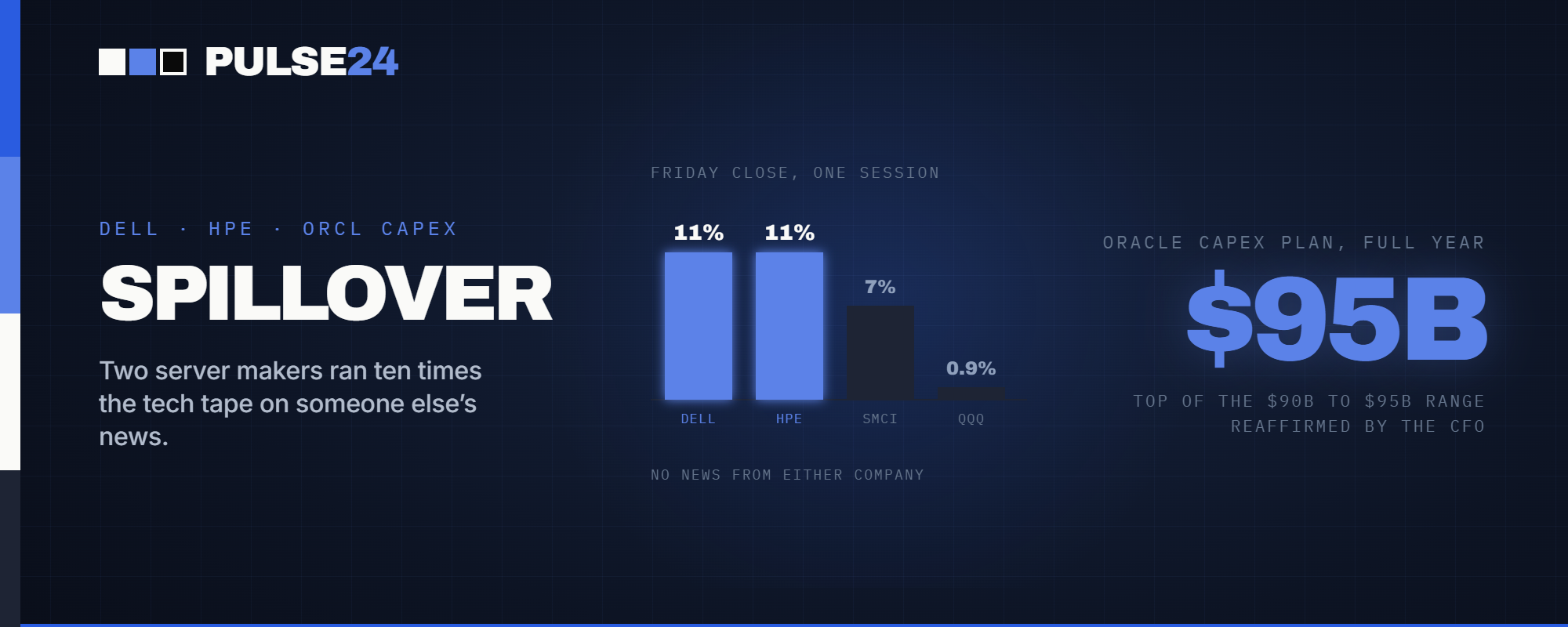
Dell and Hewlett Packard Enterprise both jumped 11% Friday after Oracle's CFO reaffirmed a $90 billion to $95 billion capital spending plan for the year. Neither hardware maker released any news of its own; the market did the inferring.
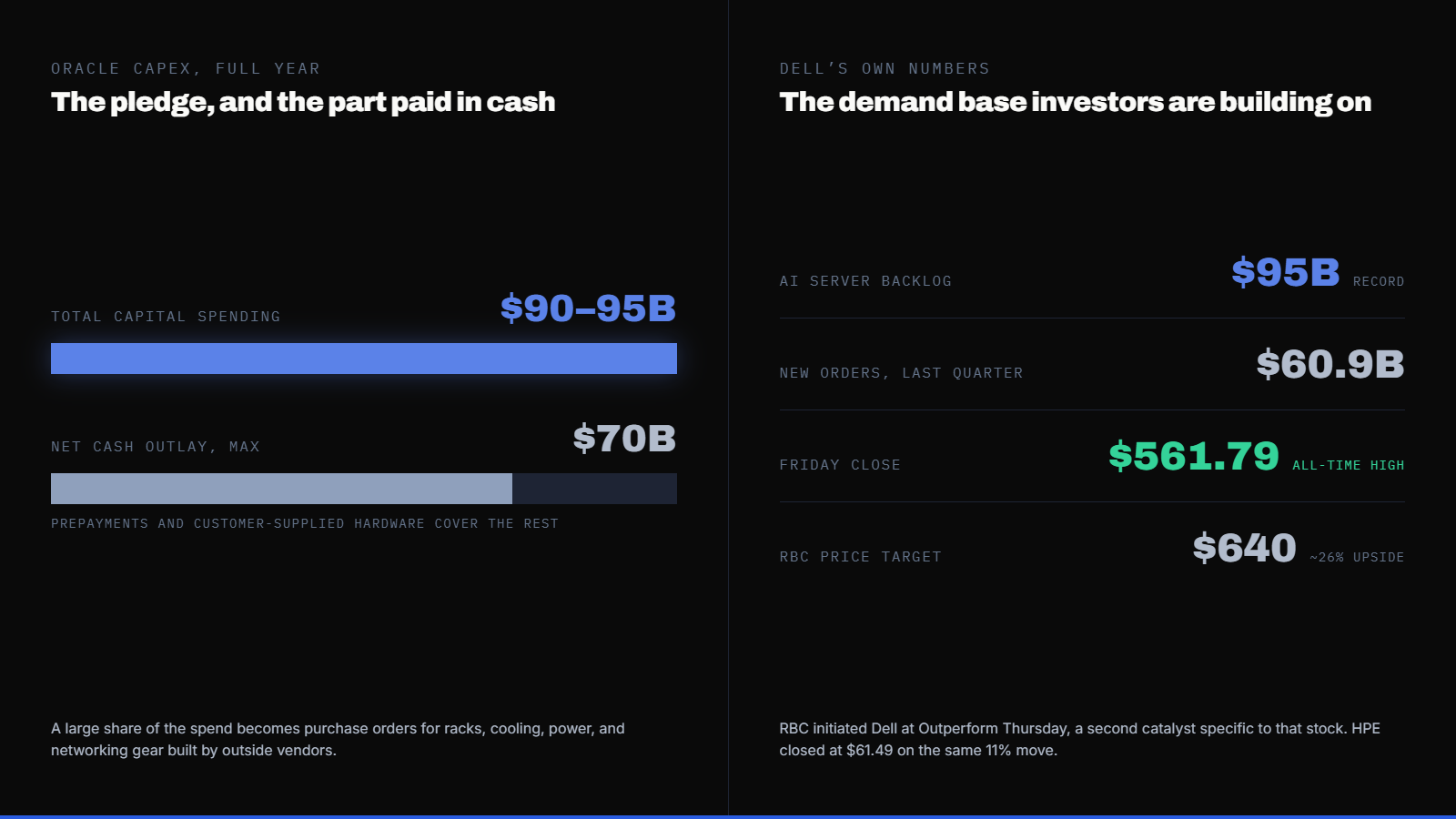
Dell shares closed at $561.79 Friday, an all-time high and an 11% gain in a single session. Hewlett Packard Enterprise rose the identical 11%, finishing at $61.49. Neither company issued a press release, filed an update, or said anything new about its own business that day.
The move stands out against the rest of the market. The Nasdaq-tracking Invesco QQQ Trust gained 0.9%, and the broader technology ETF IYW added about 1%. Two hardware vendors that make servers, storage, and networking gear for corporate data centers outran the entire tech sector by roughly a factor of ten, on a day when neither had earnings, a product launch, or any company-specific news to point to.
What Changed
The source of the move was Oracle. Speaking to investors this week, Oracle Chief Financial Officer Hilary Maxson reaffirmed the company's spending plan, telling analysts Oracle still anticipates $90 billion to $95 billion in capital expenditures for the full year, with no more than $70 billion of that landing as net cash outlay. Oracle has attributed the gap between the two figures to prepayment arrangements and customer-supplied hardware deals, meaning it won't need to fund the entire buildout with its own cash.
That spending doesn't stay inside Oracle's own data centers. A large share of it becomes purchase orders for the physical equipment that fills them: racks, cooling systems, power gear, and networking hardware, much of it built by outside vendors rather than Oracle itself. Dell and HPE are two of the largest suppliers of exactly that equipment. Investors did the math on their own: a slice of Oracle's spending, they reasoned, is a slice of Dell's and HPE's future revenue, even though neither company confirmed a single new order.
A Second Push for Dell
Dell had its own catalyst layered on top. RBC Capital initiated coverage on the stock Thursday with an Outperform rating and a $640 price target, roughly 26% above where shares had been trading, citing Dell's AI server backlog and what it called multi-year revenue visibility stretching into fiscal 2028. That backlog is not a new number: Dell disclosed it reached $95 billion in early September, after fiscal second-quarter revenue jumped 58% to $47 billion and AI server orders alone hit $60.9 billion for the quarter, a report that also showed Dell's Infrastructure Solutions Group margin expanding 620 basis points even as memory chip costs rose. RBC's initiation didn't introduce new information about Dell's business. It packaged existing numbers into a rating that gave portfolio managers a fresh reason to buy.
Why It Matters
Super Micro Computer's reaction is the clearest evidence of what actually moved these stocks. The company rose only 7% Friday, well behind Dell and HPE's 11%, even though it sells into the exact same AI server buildout. The difference is timing of disclosure, not demand. Super Micro's senior vice president of corporate development, Mike Staiger, had already told investors at a Goldman Sachs conference Thursday evening that the company's order book stood at $60 billion, describing the AI infrastructure expansion as a potentially multi-year cycle rather than a one-quarter surge. By Friday morning, that number was priced in. Oracle's confirmation added less incremental information for Super Micro than it did for HPE and Dell, whose Friday gains came without any comparable disclosure of their own.
That pattern says something about how this trade actually works. Investors aren't waiting for Dell or HPE to report their own bookings before repricing the stocks. They're inferring demand from a supplier three steps removed, in Oracle's own spending guidance, and applying it to the companies that build the physical infrastructure underneath. It's a bet on the shape of the AI buildout more than a bet on either company's own numbers.
What to Watch Next
The read-through trade works until it doesn't. Nothing in Friday's move confirms that Oracle's capital spending actually becomes Dell or HPE purchase orders at the scale investors are now pricing in. Oracle could route more of that spending to different partnerships, split it differently across vendors than expected, or slow the pace if its own AI revenue growth cools. The next real test comes when Dell and HPE report earnings and either show that backlog converting into recognized revenue, or don't.
There's also a broader question sitting underneath this specific trade. A liquidity gauge that preceded both the 2008 and 2022 selloffs turned negative back in June, and AI stocks as a group have traded largely sideways since, even as individual names like Dell and HPE post double-digit single-day pops on spending headlines. Days like Friday show real, specific enthusiasm about server hardware demand. They don't yet answer the larger question of whether the financing behind the entire AI infrastructure buildout, prepayments, vendor financing, and now $95 billion capex plans from cloud providers, holds up if AI revenue growth doesn't keep pace with the spending.
The Pulse24 Take
Friday's rally is a read-through trade, and read-through trades can move fast in both directions. Oracle didn't announce new orders for Dell or HPE. It reaffirmed spending guidance it had already given, and the market decided that guidance was worth tens of billions in combined market value for two companies that said nothing new. That's not irrational. Dell's own backlog numbers from earlier this month back up real demand, and RBC's initiation reflects genuine analysis of that backlog rather than pure momentum chasing. But the distance between a spending plan and a delivered, recognized order is where these trades usually get tested. The companies that actually convert Oracle's capex into their own reported revenue over the next two quarters will earn Friday's move. The ones that don't will give it back just as fast as it arrived.
How we read the data
Curious how we get from raw data to a take like this? Our Trader's Toolkit walks through the tools we lean on.
Explore the Toolkit