Pulse24 Original
AMD's 2030 AI Market Estimate Climbed From $2 Trillion to $3 Trillion in One Slide. Independent Analysts Still Say $1.7 Trillion.
September 12, 2026
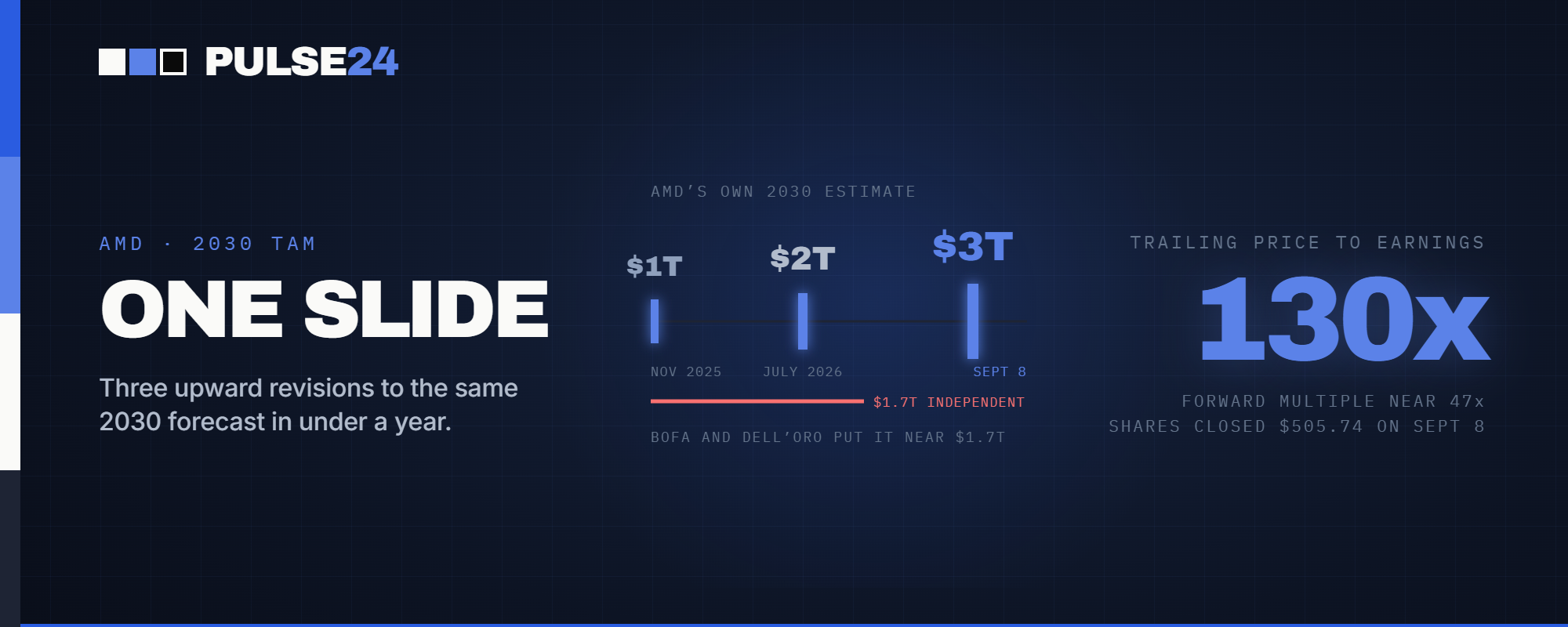
AMD's CFO raised the company's 2030 AI market forecast to $3 trillion on September 8, a trillion dollars higher than the figure it gave investors just six weeks earlier. Bank of America and Dell'Oro Group put the real number closer to $1.7 trillion, and AMD's stock still trades at a trailing P/E above 130.
AMD's chief financial officer told investors on September 8 that the company's own addressable market had grown by roughly a trillion dollars since midsummer. Jean Hu, speaking at Citi's Global TMT Conference, said AMD now sees its 2030 artificial intelligence opportunity reaching as much as $3 trillion, up from the approximately $2 trillion figure the company presented at its Advancing AI event in late July.
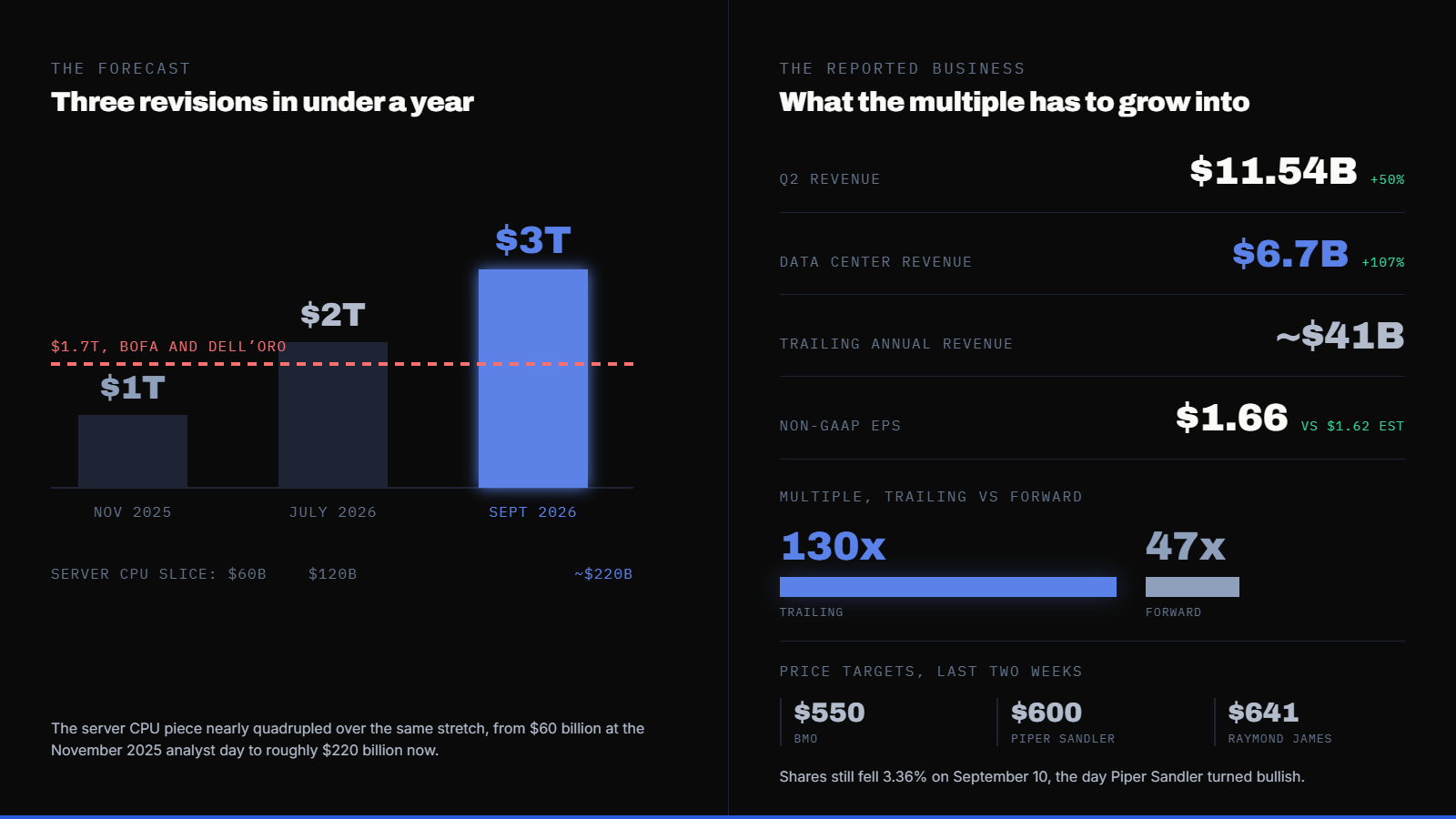
The market's reaction was immediate. AMD shares closed at $505.74 that day, a gain of 5.9%, and added another 3% the next session to $521.10. Investors weren't only responding to an abstract slide. Hu's comment arrived alongside an even steeper revision to a narrower number: AMD's estimate for the 2030 server CPU market, which the company now puts near $220 billion, up from $60 billion at its Financial Analyst Day in November 2025.
What Changed
AMD's addressable-market claims have moved before, but the pace of revision is accelerating. Chief executive Lisa Su told investors at AMD's Financial Analyst Day in November 2025 that the AI data center market alone would reach $1 trillion by 2030. That figure rose to roughly $2 trillion at July's Advancing AI event, and now, about six weeks later, Hu has pushed the ceiling to $3 trillion. Three upward revisions to the same long-term forecast inside about ten months is not typical behavior, even from a management team in a fast-moving industry. The server CPU piece of that market has moved just as fast, from $60 billion at that same November 2025 event, to $120 billion by May 2026, to roughly $220 billion now.
The claim sits on top of real, if less dramatic, results. AMD reported second-quarter revenue of $11.536 billion on August 4, up 50% from a year earlier, with data center revenue of $6.7 billion, a 107% increase that made up 58% of total sales. Non-GAAP earnings per share came in at $1.66, ahead of the $1.62 analysts expected. Even that report produced a volatile stock reaction: shares initially jumped to $518.58, roughly 7% higher, before reversing to below $485 the following session as investors picked apart the guidance.
Wall Street has been racing to keep pace with AMD's own numbers. Raymond James upgraded the stock to Strong Buy on August 25, lifting its price target from $565 to $641 and modeling 44% annual growth in the server CPU market through 2030, reaching roughly $201 billion in revenue. BMO Capital initiated coverage the same day at Outperform with a $550 target, framing AMD's Helios AI server rack, whose initial shipments are scheduled to begin this quarter, as a genuine alternative to Nvidia's hardware for buyers including OpenAI, Meta, and Anthropic. Piper Sandler joined in on September 10 with an Overweight rating and a $600 target, projecting 50% annual revenue growth and earnings per share of $53 by 2030. Even that bullish note didn't stop the stock from falling 3.36% the same session, a reminder that this rally hasn't been moving in one direction.
Why It Matters
A widening TAM estimate matters because AMD's valuation already assumes a great deal of future growth. The stock trades at a trailing price-to-earnings ratio above 130, but a forward multiple closer to 47. That gap only makes sense if earnings expand sharply over the next several years, which is exactly what a $3 trillion market would require. The larger the number management puts in front of investors, the easier today's price becomes to justify on paper. It also raises the less comfortable question of what happens if the number doesn't hold up.
Independent estimates of the same market are considerably more conservative. Bank of America and the research firm Dell'Oro Group have each projected AI data center capital spending will reach $1.7 trillion by 2030, roughly $1.3 trillion below the top end of AMD's own forecast. Companies selling into a market have an obvious incentive to describe it as large as possible, and AMD isn't alone among chipmakers in doing this. What stands out here is the speed of the upward revision, three times in under a year, from a company whose actual data center revenue, while growing fast, remains a small fraction of the multi-trillion-dollar total it's now describing.
None of this is happening in a vacuum. Hyperscalers have been backing similar projections with real capital. Oracle's pledge of $95 billion in AI infrastructure spending sent Dell and HPE shares up 11% in a single session in early September, even though neither company had announced anything of its own that day. That's the kind of demand signal AMD needs flowing consistently if a $3 trillion 2030 market is going to look reasonable in hindsight rather than aspirational today. Results haven't rewarded every AI chip supplier equally, either: Broadcom's AI chip revenue grew 221% last quarter to $16.7 billion, yet a guidance miss of just $230 million wiped out 5% of its stock value within hours, a sign investors are still willing to punish fast-growing AI suppliers the moment results fall short.
What to Watch Next
AMD's third-quarter results are expected in late October or early November, though the company hasn't confirmed an exact date. Investors will be watching whether data center revenue keeps compounding near triple-digit growth rates, and whether management offers more concrete detail on the path from roughly $41 billion in trailing annual revenue to a market it now describes as worth up to $3 trillion by 2030. A guidance number that merely meets expectations, after two straight quarters of volatile post-earnings reactions, could land very differently at a trailing P/E above 130 than it would at a more ordinary multiple.
Also worth tracking is how quickly Helios shipments actually ramp once they begin, and whether Microsoft, OpenAI, Meta, or Anthropic disclose any figures on how much of their own AI infrastructure spending is going to AMD rather than Nvidia. Talk of anchor customers is one thing. Dollar figures attached to specific orders are the evidence that would make a $220 billion server CPU market look achievable rather than aspirational.
The Pulse24 Take
AMD's underlying business is genuinely growing fast, and that part isn't in dispute. Data center revenue doubling year over year is a real, reported number, not a forecast. The trillion-dollar TAM slides belong to a different category of claim, and investors would do well to keep the two separate in their heads. A market estimate for 2030 isn't a promise. It's closer to a marketing tool dressed up in enough math to resemble analysis, and every chipmaker currently selling into the AI buildout has strong incentives to make that number as large as plausibly possible.
The more useful signal right now might be Wall Street's own division on this stock. Multiple analysts initiated or upgraded coverage with price targets between $550 and $641 in the space of about two weeks, yet the stock still fell on the same day one of the most bullish notes was published. A trailing P/E above 130 leaves very little margin for anything less than sustained, extraordinary growth, and the gap between AMD's own $3 trillion figure and Bank of America's $1.7 trillion estimate is exactly the kind of spread worth watching as 2030 gets closer and the actual numbers start arriving.
How we read the data
Curious how we get from raw data to a take like this? Our Trader's Toolkit walks through the tools we lean on.
Explore the Toolkit